
Can Deep Learning Replace Human Jobs In The Future?
Gusti Ayu Tita P
24 September 2026
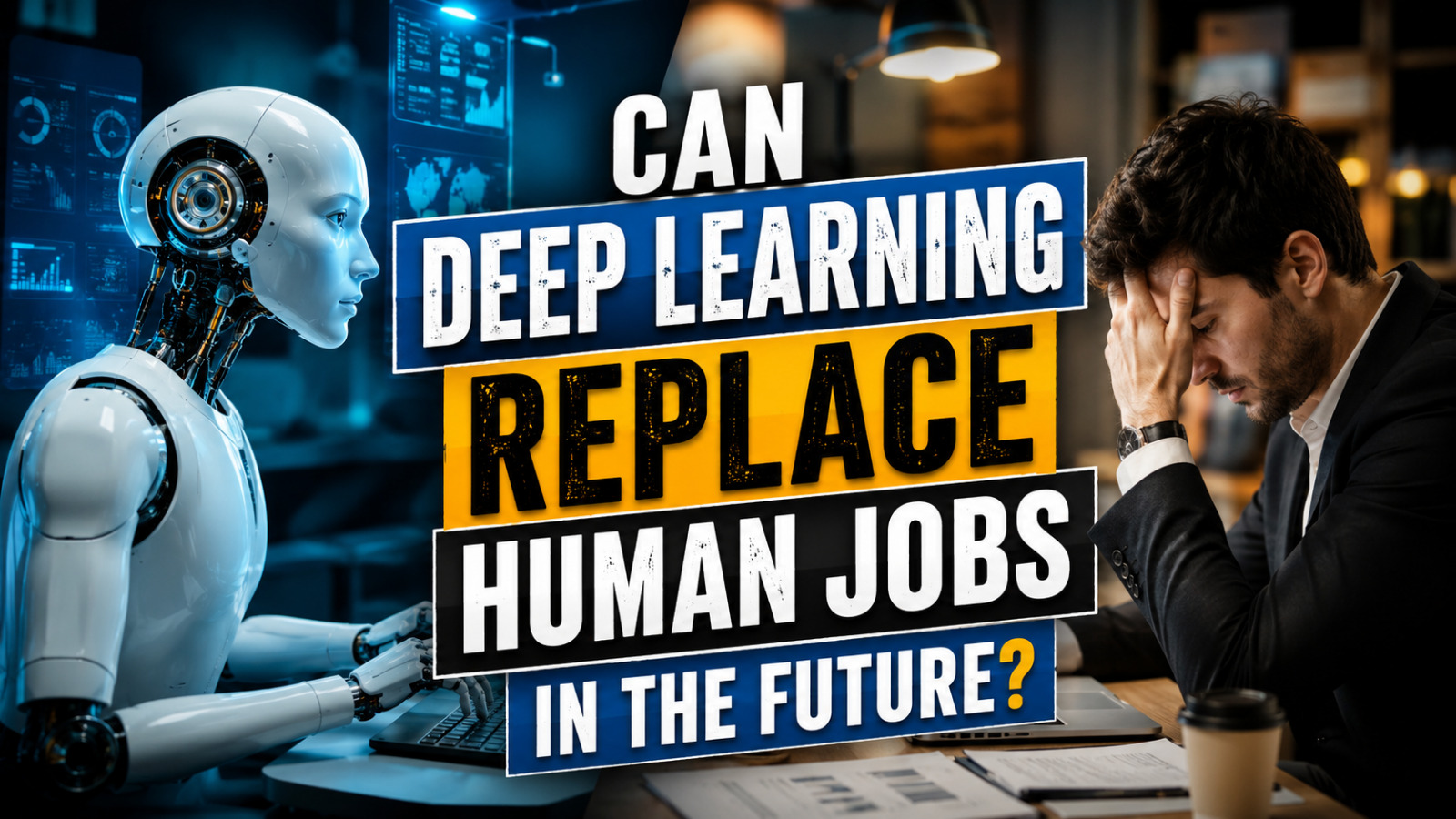
Deep learning has become one of the most influential technologies in the modern world. As part of Artificial Intelligence, it enables computers to recognize patterns, process large amounts of data, and perform tasks that once required human intelligence. From healthcare and finance to education and manufacturing, deep learning is transforming industries at an incredible speed.
Many people wonder whether this technology will eventually replace human workers completely. While Deep Learning can automate repetitive and data-driven tasks, there are still many aspects of human work that machines cannot fully replicate. Understanding both the opportunities and the limitations of this technology is essential for preparing for the future workforce.
WHAT IS DEEP LEARNING?
Deep Learning is an advanced branch of Machine Learning that uses artificial neural networks to analyze complex data and make intelligent decisions. These neural networks are inspired by the structure of the human brain, allowing computers to learn from experience instead of following only fixed programming rules. As more data becomes available, deep learning models generally become more accurate and efficient.
Today, deep learning powers many technologies that people use every day. Examples include voice assistants, facial recognition, language translation, medical image analysis, and autonomous vehicles. These applications demonstrate how deep learning can improve speed, accuracy, and productivity across different industries.
HOW DEEP LEARNING IS CHANGING THE WORKPLACE
Businesses are increasingly adopting Artificial Intelligence and Deep Learning to automate repetitive processes. Manufacturing companies use intelligent robots to assemble products, while banks use AI systems to detect fraud more quickly than traditional methods. Customer service departments also rely on chatbots to answer common questions around the clock.
Despite these improvements, deep learning mainly replaces repetitive and predictable tasks rather than entire professions. Employees are often able to focus on more valuable responsibilities such as problem-solving, creativity, and customer relationships. As a result, technology frequently changes job roles instead of eliminating them completely.
JOBS THAT ARE MOST LIKELY TO BE AUTOMATED
Some occupations involve routine activities that can be performed efficiently by AI-powered systems. Data entry, simple bookkeeping, basic quality inspection, and repetitive administrative work are examples of tasks that are becoming increasingly automated. These jobs usually depend on consistent patterns and structured information.
However, automation does not always mean unemployment. Many organizations retrain employees so they can manage AI systems, analyze results, or perform higher-value responsibilities. Future Careers will likely require workers to combine technical knowledge with human-centered skills that machines cannot easily reproduce.
WHY HUMANS ARE STILL ESSENTIAL?
Although Deep Learning has become remarkably advanced, it cannot fully replace human qualities such as creativity, emotional intelligence, ethical judgment, and critical thinking. Professionals including teachers, psychologists, healthcare providers, artists, and business leaders regularly make decisions that depend on empathy and personal experience. These human characteristics remain difficult for AI to imitate accurately.
In addition, many workplaces require collaboration, negotiation, leadership, and adaptability. Unexpected situations often demand flexible thinking that goes beyond patterns found in training data. Therefore, humans continue to play a vital role in making strategic decisions and building meaningful relationships.
SKILLS NEEDED TO SUCCEED IN THE AI ERA
As Artificial Intelligence continues to evolve, workers should focus on developing skills that complement technology instead of competing with it. Learning about Machine Learning, data analysis, digital literacy, and AI fundamentals can increase career opportunities. At the same time, strengthening communication, teamwork, creativity, and leadership remains equally important.
Lifelong learning has become one of the most valuable career strategies. Individuals who continuously improve their knowledge and adapt to technological change will be better prepared for future challenges. Rather than fearing AI, people can use it as a powerful tool to improve productivity and innovation.
THE FUTURE OF HUMAN JOBS
The future workplace will likely be shaped by collaboration between humans and intelligent machines. Deep Learning will continue to automate routine tasks while creating demand for new careers in AI development, cybersecurity, data science, digital transformation, and technology management. History shows that technological revolutions often create new employment opportunities alongside automation.
Instead of replacing every worker, AI is expected to transform how people perform their jobs. Organizations will increasingly seek professionals who can understand technology while applying uniquely human abilities. This balance between innovation and human expertise will define the workforce of the future.
CONCLUSION
Deep Learning is revolutionizing industries and changing the nature of work, but it is unlikely to replace all Human Jobs. While repetitive and predictable tasks are becoming increasingly automated, creativity, emotional intelligence, critical thinking, and ethical decision-making remain essential human strengths. The most successful professionals will be those who embrace Artificial Intelligence, continuously develop new skills, and work alongside technology to create greater value in the future.
Tentang Penulis
Gusti Ayu Tita P
Penulis — Universitas STEKOM
Penulis aktif yang berfokus pada isu-isu akademik, teknologi pendidikan, dan pengembangan sumber daya manusia di lingkungan kampus.



