Common Mistakes to Avoid in Implementing Decentralization
Gusti Ayu Tita P
4 Oktober 2026
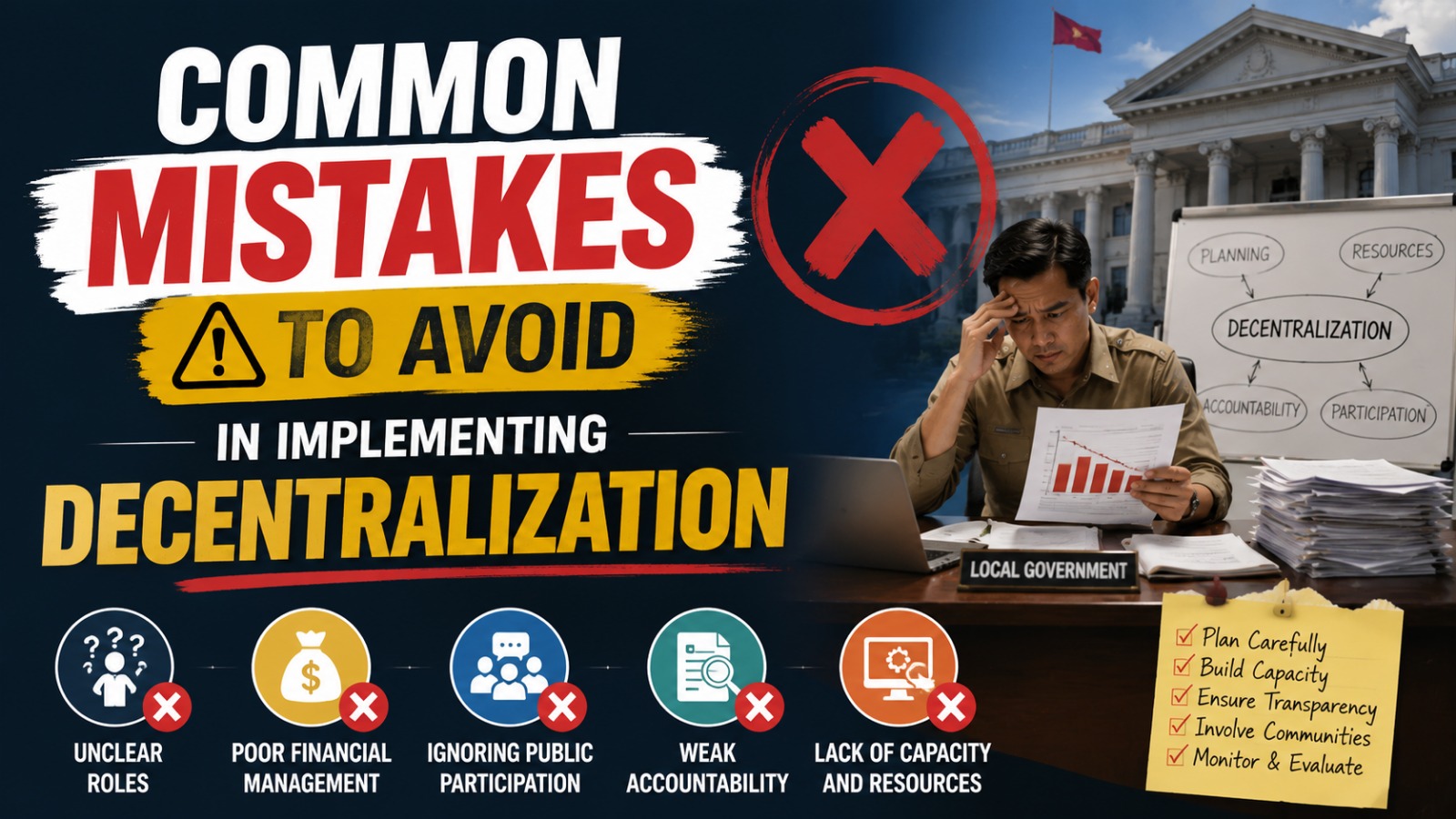
Decentralization is a governance system that transfers certain authorities, responsibilities, and resources from the central government to regional governments. The main goal of decentralization is to allow local authorities to make decisions that better match the needs of their communities. When implemented effectively, decentralization can improve public services, encourage regional development, and increase community participation.
However, the success of decentralization depends on proper planning and management. Many governments face challenges because they make mistakes during the implementation process. Poor preparation, weak institutions, and limited accountability can reduce the positive impact of decentralization. Understanding common mistakes is important to ensure that decentralization policies create meaningful benefits for society.
LACK OF CLEAR AUTHORITY DISTRIBUTION
One common mistake in implementing decentralization is the absence of a clear division of authority between central and local governments. When responsibilities are not clearly defined, different levels of government may experience overlapping duties and conflicts. This situation can slow down decision-making and reduce the effectiveness of public programs.
A successful decentralization system requires clear regulations that explain the roles and responsibilities of each government level. Local governments need sufficient authority to manage regional issues, while the central government should maintain important national standards. Without proper coordination, decentralization may create confusion instead of improving governance.
Clear authority distribution also helps governments use resources more efficiently. Each institution can focus on its specific responsibilities and avoid unnecessary duplication of programs. Therefore, establishing a strong legal framework is an essential step before implementing decentralization.
INSUFFICIENT LOCAL GOVERNMENT CAPACITY
Another major mistake is transferring authority without strengthening local government capacity. Decentralization requires skilled officials who understand administration, financial management, planning, and public service delivery. Without adequate human resources, local governments may struggle to manage their new responsibilities effectively.
Many regions face difficulties because they lack trained employees, strong institutions, and effective management systems. These limitations can lead to poor decision-making, inefficient programs, and low-quality public services. Therefore, governments need to invest in capacity building through training, education, and institutional improvement.
Strengthening local capacity should happen continuously, not only at the beginning of decentralization. Regional governments must adapt to new challenges and improve their management skills over time. Strong local institutions are necessary to ensure that decentralization achieves its intended goals.
POOR FINANCIAL MANAGEMENT
Financial management is one of the most important aspects of successful decentralization. A common mistake is giving local governments financial authority without providing proper systems for budgeting, monitoring, and reporting. Poor financial management can result in inefficient spending and reduced public trust.
Local governments need transparent and responsible methods for managing public funds. Budgets should be allocated based on community priorities and development needs. Without proper planning, financial resources may not produce significant improvements in public services or regional development.
Another challenge is the unequal financial capacity between regions. Some areas have stronger economic resources, while others depend heavily on support from the central government. Effective fiscal management and fair resource distribution are necessary to reduce inequality and support balanced development.
IGNORING PUBLIC PARTICIPATION
A successful decentralization process requires active involvement from citizens. Ignoring public participation is a common mistake that can make government programs less effective. Local communities have valuable knowledge about their problems and should be included in decision-making processes.
When citizens are not involved, policies may fail to address actual community needs. Public consultations, feedback systems, and community discussions can help governments create better solutions. Participation also increases transparency and strengthens the relationship between citizens and local authorities.
Encouraging public involvement does not only improve policies but also increases accountability. When communities understand government programs, they can help monitor implementation and provide constructive feedback. This creates a more inclusive and responsive governance system.
WEAK TRANSPARENCY AND ACCOUNTABILITY
Transparency and accountability are essential elements of effective decentralization. A common mistake is allowing local governments to operate with limited public oversight. Without transparency, the risk of corruption, misuse of resources, and poor governance becomes higher.
Local governments should provide clear information about budgets, policies, and development programs. Citizens need access to information to understand how public resources are being used. Strong accountability mechanisms, such as audits and performance evaluations, can improve government responsibility.
Building accountability requires commitment from both leaders and institutions. Officials must be willing to accept evaluation and improve their performance. With strong transparency systems, decentralization can increase public confidence and create better governance outcomes.
NEGLECTING DIGITAL TRANSFORMATION
In the modern era, ignoring digital technology can limit the effectiveness of decentralization. Many governments fail to use technology to improve administrative services, communication, and public access to information. Digital systems can help local governments provide faster, easier, and more transparent services.
However, technology implementation requires proper preparation. Governments need reliable infrastructure, skilled employees, and strong data protection systems. Simply introducing digital tools without proper planning may create new problems instead of improving services.
Successful digital transformation should focus on improving citizen experiences. Online services, digital information platforms, and electronic administration systems can support more efficient governance. Technology should become a tool to strengthen decentralization, not just a temporary trend.
LACK OF MONITORING AND EVALUATION
Another mistake in decentralization implementation is failing to conduct regular monitoring and evaluation. Without evaluation, governments cannot determine whether policies are achieving their goals. Continuous assessment helps identify weaknesses and improve future programs.
Effective monitoring requires accurate data, clear indicators, and consistent reporting systems. Governments should evaluate public services, financial management, and development outcomes regularly. These evaluations provide valuable information for making better decisions.
Monitoring should not only focus on identifying failures but also recognizing successful innovations. Sharing successful practices between regions can help improve decentralization performance. A strong evaluation system allows governments to adapt and create more effective policies.
IGNORING COORDINATION BETWEEN GOVERNMENT LEVELS
Decentralization does not mean that local governments work completely independently. A common mistake is reducing communication and cooperation between central and regional authorities. Lack of coordination can create inconsistent policies and inefficient resource management.
The central government still has an important role in providing guidance, national standards, and support for regions. Meanwhile, local governments should maintain flexibility to develop solutions based on local conditions. A balanced relationship between autonomy and coordination is necessary for successful decentralization.
Strong cooperation allows different levels of government to share information, solve problems, and achieve common goals. Through effective coordination, decentralization can become a tool for improving governance and regional development.
CONCLUSION
Implementing decentralization requires careful planning, strong institutions, and continuous improvement. Common mistakes such as unclear authority distribution, weak local capacity, poor financial management, and limited public participation can reduce its effectiveness. Governments must recognize these challenges and develop strategies to overcome them.
Successful decentralization depends on transparent governance, responsible leadership, digital innovation, and effective coordination. By avoiding common mistakes and strengthening local institutions, governments can maximize the benefits of decentralization. Ultimately, effective implementation can create better public services, stronger regional development, and improved community welfare.
Tentang Penulis
Gusti Ayu Tita P
Penulis — Universitas STEKOM
Penulis aktif yang berfokus pada isu-isu akademik, teknologi pendidikan, dan pengembangan sumber daya manusia di lingkungan kampus.