Comparing Decentralization and Centralization in Modern Governance
Gusti Ayu Tita P
4 Oktober 2026
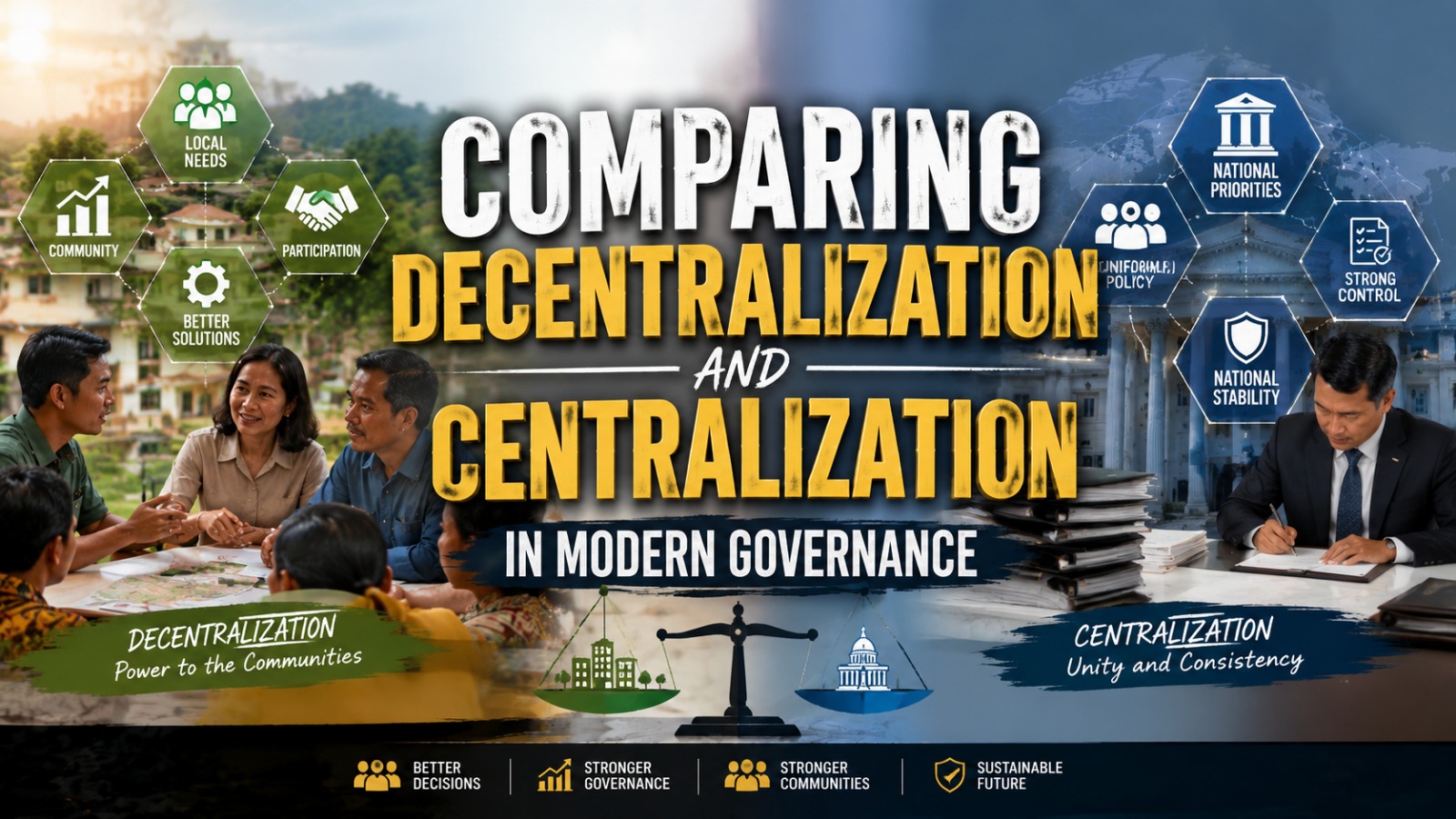
Modern governance systems continue to develop as governments seek the most effective way to manage public affairs. Two important approaches often discussed are decentralization and centralization. Centralization places decision-making authority mainly in the hands of the national government, while decentralization distributes certain powers to regional or local governments. Understanding the differences between these two systems is essential because each approach has its own advantages, challenges, and impacts on public administration.
UNDERSTANDING CENTRALIZATION IN GOVERNANCE
Centralization is a governance system where major decisions, policies, and administrative control are concentrated within the central government. In this system, local authorities usually have limited power and must follow decisions made by national institutions. This approach allows the government to maintain uniform policies and consistent standards across different regions. Centralized systems are often used when governments need strong coordination and control over national priorities.
One advantage of centralization is that it can create more consistent decision-making. National governments can ensure that laws, regulations, and development programs are implemented in a similar way throughout the country. It can also simplify coordination because authority is managed by fewer institutions. However, excessive central control may reduce local flexibility and make it difficult to respond quickly to specific regional needs.
UNDERSTANDING DECENTRALIZATION IN GOVERNANCE
Decentralization is a governance approach that transfers certain responsibilities, authority, and resources from the central government to local governments. This system allows regional authorities to make decisions based on local conditions, community needs, and available resources. Decentralized governance aims to create more responsive and efficient public administration by bringing decision-making closer to citizens.
The main advantage of decentralization is that local governments can develop policies that are more suitable for their communities. They can respond faster to local challenges related to education, healthcare, infrastructure, and economic development. However, successful decentralization requires strong institutions, capable human resources, financial support, and effective accountability systems. Without these elements, decentralization may create differences in service quality between regions.
KEY DIFFERENCES BETWEEN CENTRALIZATION AND DECENTRALIZATION
The main difference between centralization and decentralization lies in the distribution of authority. In a centralized system, decision-making power remains mostly with the national government. Meanwhile, in a decentralized system, local governments receive greater authority to manage regional matters. This difference affects how policies are created, implemented, and evaluated.
Centralization focuses on uniformity and control, while decentralization emphasizes local flexibility and participation. Centralized governments may create policies more quickly at the national level, but they may have less understanding of specific local conditions. On the other hand, decentralized governments can better understand community needs but may face challenges in maintaining consistency between regions.
DECISION-MAKING PROCESS AND GOVERNMENT EFFICIENCY
The decision-making process is one of the most important factors when comparing these two governance systems. Centralization can make national decisions easier to coordinate because authority is controlled by one main institution. This can be beneficial during national emergencies or situations that require immediate unified action. However, decisions may take longer when local issues require approval from central authorities.
In contrast, decentralization allows local governments to make decisions more independently. This can improve government efficiency because problems can be addressed without waiting for approval from higher levels of government. Local officials can use their knowledge of regional conditions to create more appropriate solutions. Nevertheless, decentralization requires strong coordination to prevent conflicting policies between different levels of government.
PUBLIC PARTICIPATION AND COMMUNITY INVOLVEMENT
Public participation is another important aspect of modern governance. Centralized systems may limit direct community involvement because many decisions are made by national institutions. Citizens may have fewer opportunities to influence policies that directly affect their daily lives. However, central governments can still encourage participation through national consultation programs and democratic processes.
Decentralization generally provides greater opportunities for public participation because local governments are closer to citizens. Communities can communicate their needs more easily and participate in regional planning processes. This can strengthen relationships between governments and society. However, participation will only be effective if local governments provide transparency, open communication, and inclusive decision-making mechanisms.
SERVICE DELIVERY AND REGIONAL DEVELOPMENT
The ability to provide quality public services is a major consideration in choosing between centralization and decentralization. Centralized systems can ensure that national service standards are applied consistently across regions. This approach can reduce differences in public services between areas. However, national-level decisions may not always reflect the unique challenges faced by local communities.
Decentralized systems allow regions to design services based on their own priorities and conditions. Local governments can create innovative solutions for healthcare, education, transportation, and economic development. This flexibility can support regional development and improve community satisfaction. However, differences in financial capacity and administrative ability may create unequal results between regions.
CHALLENGES OF CENTRALIZATION AND DECENTRALIZATION
Both governance systems have their own challenges. Centralization may lead to excessive bureaucracy, slower local responses, and limited innovation because decisions are concentrated at the national level. Local governments may struggle to address problems quickly if they depend heavily on central approval. This can reduce government responsiveness.
Meanwhile, decentralization may create challenges related to coordination, accountability, and resource distribution. Some regions may have stronger institutions than others, resulting in unequal development outcomes. Therefore, decentralized systems require effective supervision, clear regulations, and cooperation between central and local authorities. A balance between authority distribution and government control is necessary for successful governance.
THE ROLE OF MODERN GOVERNANCE IN FINDING BALANCE
Modern governance increasingly recognizes that neither complete centralization nor complete decentralization is always the best solution. Many countries apply a combination of both approaches to achieve effective administration. The central government can maintain national standards while allowing local governments enough flexibility to manage regional issues.
The use of digital governance also helps create better cooperation between central and local authorities. Technology can improve communication, data sharing, transparency, and public service delivery. By combining strong coordination with local independence, governments can create systems that are more adaptive, efficient, and responsive to society.
CONCLUSION
Comparing decentralization and centralization shows that both systems have important roles in modern governance. Centralization provides strong control, consistency, and national coordination, while decentralization offers flexibility, faster decision-making, and greater community involvement. The choice between these approaches depends on a country's political structure, social conditions, and administrative capacity.
Effective governance requires a balanced approach that combines national direction with local empowerment. By improving accountability, transparency, and institutional capacity, governments can maximize the benefits of both systems. In the modern era, successful governance is not only about where authority is placed but also about how effectively that authority serves the public interest.
Tentang Penulis
Gusti Ayu Tita P
Penulis — Universitas STEKOM
Penulis aktif yang berfokus pada isu-isu akademik, teknologi pendidikan, dan pengembangan sumber daya manusia di lingkungan kampus.