How Can a New SAR Team Work Effectively During Natural Disasters?
Gusti Ayu Tita P
29 September 2026
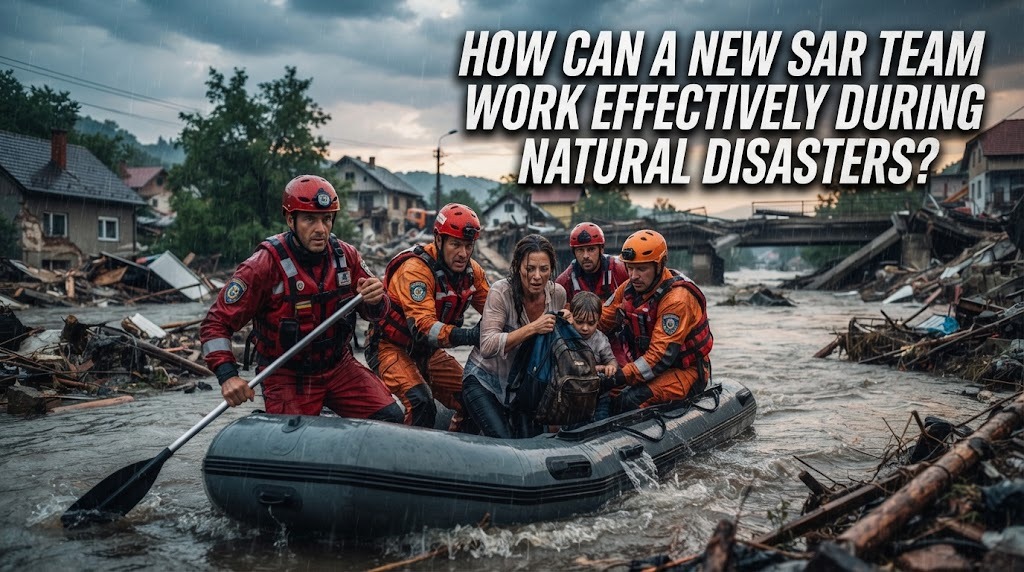
A new SAR team must be well prepared to work effectively during natural disasters such as floods, landslides, earthquakes, and other emergencies. Disaster conditions can change rapidly, while access routes, communication systems, and local infrastructure may be disrupted. For this reason, a new team needs clear procedures, trained personnel, suitable equipment, and strong coordination before entering the field. BASARNAS identifies readiness, initial response, search, rescue, evacuation, communication, and coordination as important parts of search and rescue operations in Indonesia.
Effective disaster response is not only about reaching the affected area quickly. The team must understand the situation, assess hazards, organize available resources, and communicate with other responders. INSARAG also structures USAR response around preparedness, mobilization, operations, demobilization, and post-mission activities, with coordination throughout the process. A new SAR team can become more effective by applying these principles consistently during training and actual operations.
PREPARE BEFORE DISASTER OPERATIONS
Preparation is the foundation of effective SAR disaster response. A new team should regularly train its members, check rescue equipment, practice communication procedures, and establish clear responsibilities before a disaster occurs. BASARNAS offices are responsible for SAR readiness, operational exercises, personnel training, equipment management, and communication systems. This means preparation should be treated as an ongoing activity rather than something done only after receiving an emergency report.
Training should also reflect the types of disasters that are common in the team's working area. Members can practice scenarios involving damaged roads, flooded locations, difficult terrain, missing people, or multiple victims. Realistic exercises allow the team to identify weaknesses in skills, communication, equipment, and coordination. Regular preparation gives new rescuers a clearer understanding of what they may face during an actual operation.
ASSESS THE DISASTER AREA CAREFULLY
Before beginning a rescue, a new search and rescue team needs accurate information about the incident. BASARNAS procedures include receiving and recording reports, verifying information, and gathering additional details before rescue personnel move toward the location. The team should collect information about the affected area, possible victims, access routes, weather, terrain, and known hazards. Situation assessment helps determine what personnel and resources are appropriate for the mission.
Conditions can change quickly after a natural disaster, so assessment should continue during the operation. Roads may become inaccessible, water levels may rise, or damaged structures may become less stable. Recent BASARNAS evaluations of disaster SAR operations in Aceh and Sumatra highlighted challenges including blocked access, extreme terrain, prolonged bad weather, limited air assets, and communication blind spots. A new team should therefore remain alert and adjust its operational plan when new risks appear.
ESTABLISH CLEAR TEAMWORK AND COMMUNICATION
Teamwork and communication are essential when a SAR team works during a natural disaster. Members need to understand their roles, follow the operational structure, and report important findings clearly. BASARNAS describes coordination, deployment, control of SAR resources, and communication management as part of the search and rescue system. Clear communication helps team members maintain the same understanding of the mission.
Communication becomes even more important when several agencies work in the same disaster area. A new team may need to coordinate with other SAR units, medical personnel, local authorities, firefighters, police, or disaster management organizations. One coordinated operational structure can help reduce duplicated tasks and confusion. INSARAG likewise places coordination among teams at the center of its USAR methodology.
USE EQUIPMENT AND TECHNOLOGY APPROPRIATELY
A new SAR team needs equipment that matches the disaster environment and the team's capabilities. Basic resources can include protective equipment, communication devices, navigation tools, medical supplies, lighting equipment, and rescue gear. More specialized equipment may be necessary for water rescue, technical rescue, or urban search and rescue. Indonesia's 2025 SAR guidance states that appropriate equipment is an important factor in successful operations and highlights technologies such as drones, advanced navigation systems, and data-based search methods.
Technology can help rescuers understand large or difficult areas more efficiently. Drones, GPS systems, digital maps, and other tools can support information gathering and location tracking when conditions allow. However, equipment can fail because of damaged infrastructure, weak signals, or depleted batteries. Technology should support trained rescuers, while basic navigation, observation, and communication skills remain important alternatives.
PRIORITIZE RESCUER AND VICTIM SAFETY
A new SAR team must protect rescuers while helping people affected by a disaster. Natural disasters can create secondary hazards such as unstable structures, debris, strong currents, landslides, falling objects, or changing weather. Indonesia's 2025 SAR guidance states that the safety of rescuers is a top priority and that SAR operations should apply proper risk management. This principle is especially important for new team members who may still be building field experience.
Rescuers should use appropriate protective equipment, monitor hazards, and follow established safety procedures throughout the mission. They should not perform tasks beyond their training or available resources. Victim safety and rescuer safety are closely connected, because an injured rescuer can reduce the team's ability to continue the operation. Careful risk assessment therefore needs to remain part of every stage of disaster response.
MANAGE SEARCH, RESCUE, AND EVACUATION SYSTEMATICALLY
During a disaster, a new SAR team should work according to a clear operational sequence. Search activities should be organized so that assigned areas are identified, information is recorded, and important findings are communicated to the appropriate coordinator. BASARNAS describes its operational functions as including searching for victims, providing assistance, carrying out rescue, and evacuating victims. This structured approach helps teams avoid unnecessary duplication and maintain better control of the operation.
After victims are located, the team may need to provide appropriate assistance and move them toward safer locations. The method used should depend on the victim's condition, terrain, available equipment, and level of risk. Safe evacuation planning is important because the route away from danger may contain additional hazards. Coordination with medical or other emergency teams can also support the next stage of care when required.
REVIEW THE OPERATION AND IMPROVE
A new SAR team should evaluate its work after exercises and disaster operations. Team leaders and members can review communication, equipment readiness, search methods, coordination, safety, and resource use. Lessons from real operations can then be used to improve procedures and future training. INSARAG includes a post-mission phase in its USAR methodology, showing that operational learning continues after field activities end.
Continuous improvement is particularly useful for a new team because experience develops over time. Recent BASARNAS disaster evaluations identified improvements such as pre-positioning logistics, integrating drones with ground teams and K9 units, strengthening emergency communications, and improving integrated command and control. These lessons show how operational reviews can lead to practical changes in future disaster response.
CONCLUSION
A new SAR team can work effectively during natural disasters by combining preparation, careful assessment, strong teamwork, suitable equipment, risk management, systematic rescue procedures, and continuous evaluation. Natural disasters can create difficult terrain, damaged infrastructure, changing weather, and communication problems, so teams must remain organized and adaptable. BASARNAS and INSARAG guidance both emphasize preparedness, coordination, communication, safety, and structured operations as important elements of effective search and rescue work.
The development of a new team should therefore continue before, during, and after every mission. Regular training and realistic exercises can strengthen skills, while equipment checks and operational reviews can improve readiness. By working within established procedures and coordinating closely with other responders, a new SAR team can provide organized support to communities affected by natural disasters.
Tentang Penulis
Gusti Ayu Tita P
Penulis — Universitas STEKOM
Penulis aktif yang berfokus pada isu-isu akademik, teknologi pendidikan, dan pengembangan sumber daya manusia di lingkungan kampus.