How Can the Strawberry Generation Overcome Failure in Education and Career?
Gusti Ayu Tita P
26 September 2026
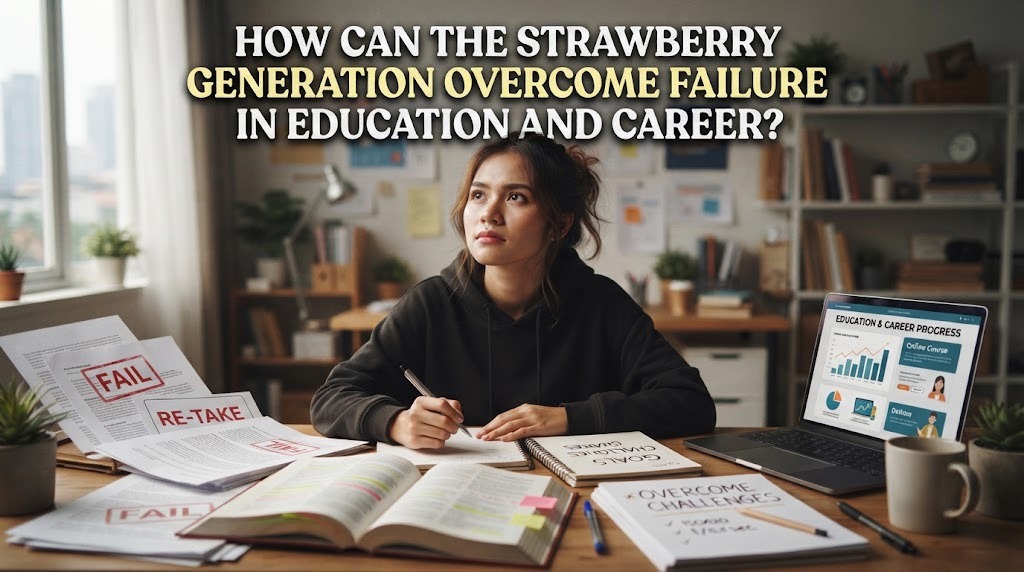
The Strawberry Generation may face various forms of failure during education and career development, such as poor academic results, rejected applications, unsuccessful interviews, missed opportunities, or career plans that do not work as expected. These experiences can feel disappointing, especially when young people face strong expectations from family, society, and themselves. However, failure does not necessarily mean that someone lacks ability or cannot achieve future success.
Learning to respond constructively to failure is an important part of personal and professional development. Failure can provide information about weaknesses, strategies, preparation, and areas that need improvement. By developing resilience, evaluating mistakes, setting realistic goals, and continuing to learn, the Strawberry Generation can turn difficult experiences into opportunities for growth.
ACCEPT FAILURE AS PART OF THE LEARNING PROCESS
The first step in overcoming failure is accepting that setbacks can happen during education and career development. A student may receive a low grade despite studying hard, while a graduate may apply for several jobs without receiving an offer. Failure is an experience, not a permanent definition of a person's ability or future.
Instead of immediately viewing failure as proof of inadequacy, young people can treat it as feedback. Asking what happened, which factors could be controlled, and what could be improved can create a more constructive response. This mindset can help reduce the tendency to give up after one disappointing result.
IDENTIFY THE REAL CAUSE OF THE FAILURE
Not every failure has the same cause. Academic difficulties may result from ineffective study methods, poor time management, unclear understanding of the material, or personal circumstances. Career setbacks may involve limited experience, unsuitable applications, interview preparation, competition, or a mismatch between skills and job requirements.
Identifying the actual cause makes it easier to create an appropriate solution. For example, a student who struggles because of ineffective learning techniques may need to change their study strategy rather than simply spend more hours studying. Similarly, a job seeker who repeatedly fails interviews may benefit from practicing communication and interview skills.
BUILD RESILIENCE AFTER SETBACKS
Resilience is important because education and career development rarely follow a completely smooth path. Young people may experience rejection, criticism, changing plans, or unexpected obstacles. Resilience helps individuals recover from disappointment while continuing to pursue meaningful goals.
Building resilience does not mean ignoring emotions or pretending that failure does not hurt. It means allowing time to process disappointment and then gradually returning to constructive action. Support from family, friends, teachers, mentors, or professional networks can also help young people regain perspective after difficult experiences.
SET REALISTIC GOALS AND CREATE SMALL STEPS
Large goals can sometimes feel overwhelming after a major setback. A student who fails an important examination or a graduate who struggles to find employment may begin to question their entire future. Breaking a large objective into smaller and measurable steps can make progress feel more manageable.
For example, instead of focusing only on getting a job, a graduate can set smaller goals such as improving a resume, completing a relevant course, building a portfolio, practicing interviews, and applying consistently. Small achievements can rebuild confidence while creating practical progress toward a larger goal.
DEVELOP NEW SKILLS AND IMPROVE WEAKNESSES
Failure can reveal skills that still need development. In education, students may need to improve research, writing, communication, critical thinking, or time management. In the workplace, young professionals may need stronger digital skills, teamwork, problem-solving abilities, or industry-specific knowledge.
Continuous learning can transform failure into motivation for skill development. Young people can use online courses, workshops, books, mentoring, practical projects, internships, and organizational activities to strengthen their abilities. The goal is not to become perfect immediately but to demonstrate consistent improvement over time.
AVOID EXCESSIVE COMPARISON WITH OTHERS
Social comparison can make educational and career failure feel more painful. Young people may see classmates graduating earlier, friends receiving job offers, or peers achieving career milestones through social media. Comparing personal setbacks with someone else's visible achievements can create unrealistic expectations about progress.
Everyone has different circumstances, opportunities, skills, responsibilities, and timelines. Instead of measuring success only against other people, the Strawberry Generation can focus on personal progress. Comparing current abilities with previous performance can provide a more useful way to evaluate development.
USE FAILURE TO BUILD A BETTER FUTURE PLAN
Failure can sometimes indicate that a strategy needs to change. A student may discover that a particular learning approach does not suit them, while a graduate may realize that a specific career path does not match their interests or strengths. Changing direction after evaluating experience is not necessarily giving up; it can be part of making a more informed decision.
Young people can review what they have learned from unsuccessful experiences and use that information to adjust their plans. They may explore alternative study methods, different career opportunities, additional qualifications, or new professional interests. With reflection and realistic planning, failure can become useful information for future decisions.
CONCLUSION
The Strawberry Generation can overcome failure in education and career by accepting setbacks, identifying their causes, developing resilience, setting realistic goals, improving skills, avoiding excessive comparison, and using past experiences to create better plans. Failure can be difficult, but it does not have to determine a person's future.
The most important response is not simply to avoid failure but to learn how to respond when it happens. Young people who are willing to reflect, adapt, learn, and continue moving forward can use setbacks as valuable experiences for personal and professional growth. With consistent effort and appropriate support, educational and career failures can become part of a longer process of development and achievement.
Tentang Penulis
Gusti Ayu Tita P
Penulis — Universitas STEKOM
Penulis aktif yang berfokus pada isu-isu akademik, teknologi pendidikan, dan pengembangan sumber daya manusia di lingkungan kampus.