How Do Ministry Civil Servants Support Bureaucratic Reform And Government Efficiency?
Gusti Ayu Tita P
23 September 2026
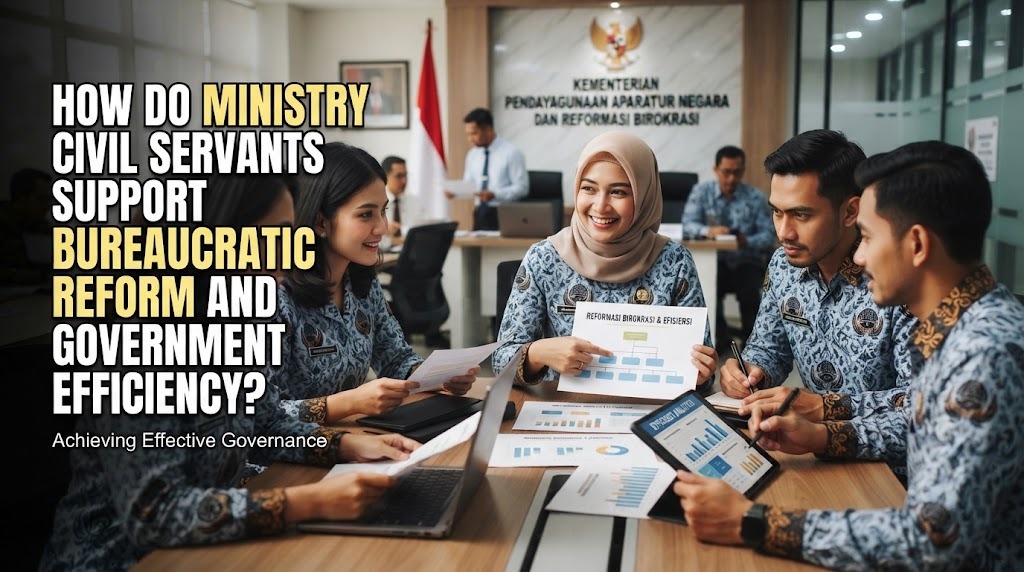
Bureaucratic reform is an important process for improving the quality of government administration and public services. Ministry Civil Servants have an important role because they carry out administrative duties, implement government programs, and provide services according to their responsibilities. Their daily work can directly influence how efficiently government institutions operate. For this reason, civil servants need to understand changes in procedures and continuously improve their professional capabilities.
Government efficiency is not only about completing tasks quickly. It also involves using resources effectively, reducing unnecessary procedures, improving coordination, and maintaining service quality. Civil servants can contribute by following established procedures, using technology appropriately, and identifying processes that can be improved. Their involvement can support the broader objectives of bureaucratic reform.
IMPROVING WORK PROCEDURES
Civil servants can support bureaucratic reform by improving administrative procedures within their areas of responsibility. Procedures should be clear so employees understand their roles and citizens can understand the services they need to access. Unnecessary steps can create delays and increase administrative workloads. Reviewing work processes can help identify areas that may be simplified while still following applicable regulations.
Improving procedures also requires coordination between employees and organizational units. A change in one process may affect another part of the workflow, so it needs to be considered carefully. Standardized procedures can help create consistency and reduce confusion when tasks are transferred between employees. Civil servants can contribute by following established procedures while reporting practical problems that need attention.
USING DIGITAL TECHNOLOGY EFFECTIVELY
Technology can support government efficiency by helping institutions manage documents, information, communication, and public services. Civil servants can use approved digital systems to reduce repetitive manual work and make information easier to manage. Electronic documents and digital workflows can also support faster communication between authorized users. However, technology needs to be used according to security requirements and organizational procedures.
Digital transformation also requires employees to develop relevant skills. Civil servants may need training to operate government applications, manage information, and understand basic cybersecurity practices. Digital competency can help employees adapt when government systems change. Technology can improve efficiency when it is supported by capable employees and appropriate organizational processes.
STRENGTHENING ACCOUNTABILITY
Accountability is an important part of bureaucratic reform. Civil servants need to understand their responsibilities and complete tasks according to applicable rules. Proper documentation can help organizations track decisions, activities, and the use of resources. Clear responsibilities also make it easier to evaluate whether programs and services are being implemented as planned.
Accountability does not only mean reporting completed tasks. It also involves being willing to explain decisions and correct problems when they are identified. Transparent work processes can support public trust when information can be disclosed appropriately. Civil servants can contribute by maintaining accurate records and following established standards in their work.
IMPROVING COORDINATION AND TEAMWORK
Government programs often involve multiple departments or organizational units. Effective teamwork and coordination are therefore important for avoiding duplicated work and communication gaps. Civil servants can support coordination by sharing relevant information through appropriate channels and clearly communicating responsibilities. Regular coordination can also help identify problems before they affect the final result.
Good coordination requires professional communication and respect for the responsibilities of other units. Employees should understand which tasks belong to their own area and when collaboration is necessary. Cross-unit cooperation can help government institutions use resources more efficiently. Strong teamwork can also support the implementation of programs that require contributions from several units.
IMPROVING PUBLIC SERVICE QUALITY
One of the main goals of bureaucratic reform is to support better public service quality. Civil servants can contribute by providing information clearly, processing requests according to established procedures, and responding professionally to public needs. Public feedback can also provide useful information about problems experienced during service delivery. Institutions can use this information to identify areas that require improvement.
Service quality should consider both efficiency and accessibility. A faster service is not necessarily better if citizens cannot understand the requirements or access the service. Citizen-focused services should therefore be designed according to applicable standards and the needs of the people being served. Civil servants have an important role in ensuring that improvements in procedures and technology remain connected to actual public needs.
CONCLUSION
Ministry Civil Servants can support bureaucratic reform and government efficiency through better work procedures, effective technology use, accountability, strong coordination, and improved public services. These contributions require professional competence, adaptability, and an understanding of applicable regulations. Bureaucratic reform is not only an institutional process but also involves the daily actions of employees who implement government programs and services. Continuous improvement can help government institutions work more efficiently while maintaining service quality.
Tentang Penulis
Gusti Ayu Tita P
Penulis — Universitas STEKOM
Penulis aktif yang berfokus pada isu-isu akademik, teknologi pendidikan, dan pengembangan sumber daya manusia di lingkungan kampus.