How Does a New SAR Team Coordinate With Other Rescue Agencies?
Gusti Ayu Tita P
29 September 2026
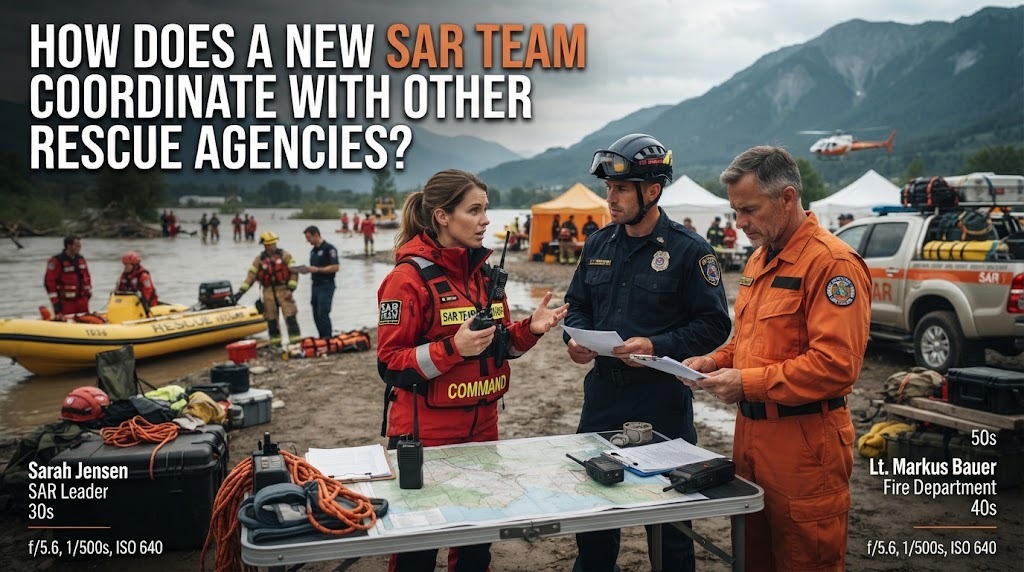
A new SAR team must learn how to coordinate with other rescue agencies because emergency operations often involve several organizations at the same time. A major incident may require cooperation between SAR teams, medical services, police, firefighters, local authorities, disaster management agencies, and community responders. BASARNAS explains that the success of search, rescue, and evacuation activities is strongly influenced by coordination between relevant agencies and SAR potential elements. (basarnas.go.id)
For a new team, coordination means more than simply communicating with another organization. Members need to understand the command structure, assigned responsibilities, communication channels, operational priorities, and information-sharing procedures. INSARAG also emphasizes that coordination is a continuous part of USAR operations and involves local emergency authorities, national and international rescue teams, and other relevant stakeholders. (insarag.org) Good coordination allows different teams to work toward the same objective without unnecessary overlap or confusion.
UNDERSTANDING EACH AGENCY'S ROLE
The first step for a new SAR team is understanding what other rescue agencies are responsible for. Different organizations may have different expertise, equipment, authority, and operational functions. For example, medical teams may focus on patient care, firefighters may handle fire or hazardous conditions, and police may support security and access control. Understanding these roles helps the new team know when to provide support and when to request another agency.
INSARAG guidance identifies the Local Emergency Management Authority or LEMA as the authority responsible for disaster operations and for setting operational objectives and rescue priorities in international USAR coordination. (insarag.org) A new SAR team should therefore understand where it fits within the wider response structure. Clear role recognition can help prevent duplicated responsibilities during complex emergencies.
ESTABLISHING CLEAR COMMUNICATION
Communication is one of the most important parts of coordination. A new SAR team needs clear methods for reporting team locations, search results, victim information, hazards, resource needs, and operational changes. INSARAG's coordination model is built around communication between coordination actors, locations, and platforms, allowing different responders to exchange information during operations. (insarag.org)
The team should use agreed communication channels and terminology whenever possible. Members should also practice radio procedures and information reporting before participating in major operations. Accurate and timely communication helps other agencies understand what the SAR team has already done and what support may still be required. When normal communication systems are disrupted, teams should use appropriate backup methods.
JOINING A SHARED OPERATIONAL PLAN
A new search and rescue team should avoid creating a separate operational plan that conflicts with other responders. The team should first understand the main incident objectives and then align its activities with the wider response plan. INSARAG guidance states that LEMA establishes operational objectives and rescue priorities, while coordination structures help ensure that USAR teams remain aligned with those priorities. (insarag.org)
A shared plan should clarify which teams are assigned to particular areas and what each team is expected to accomplish. Coordinated task assignment can reduce the possibility of several agencies searching the same location while another area receives insufficient attention. When new information changes the situation, the team should communicate the update and adjust its activities through the established structure.
SHARING INFORMATION AND RESOURCES
A new SAR team can improve coordination by sharing useful operational information with other agencies. This can include victim locations, search results, hazards, access conditions, available equipment, and resource requirements. INSARAG's coordination guidance emphasizes information exchange among local authorities, national USAR teams, international teams, and other stakeholders. (insarag.org)
Resource sharing may also become important during large emergencies. One team may have specialized equipment, while another has additional personnel or medical capability. BASARNAS conducts coordination related to the development and use of SAR personnel and equipment as part of efforts to improve operational capability. (nias.basarnas.go.id) Efficient resource coordination can help agencies make better use of what is already available.
TRAINING TOGETHER BEFORE EMERGENCIES
Coordination becomes easier when agencies have practiced together before a real emergency happens. BASARNAS conducts cooperation, education, training, and joint activities with other organizations to strengthen SAR capabilities and operational coordination. (nias.basarnas.go.id) A new team can take part in joint drills, simulations, and field exercises to become familiar with other agencies' procedures.
Joint exercises can reveal differences in communication methods, role assignments, equipment, and command structures. Teams can then discuss these differences and improve their procedures before facing a real incident. INSARAG also uses training and exercises as part of preparedness and promotes interoperability among response teams. (insarag.org) Regular cooperation helps create more predictable coordination during emergencies.
MAINTAINING SAFETY AND COMMAND DISCIPLINE
A new SAR team must coordinate without ignoring safety requirements. Members should report hazards, follow site instructions, and understand who has authority over operational priorities. INSARAG guidance states that team management is responsible for ensuring coordination with other response entities, while safety and security planning continues throughout the mission. (insarag.org)
Command discipline is also important when several agencies are present. A new team should not independently change major operational priorities without communicating through the established structure. Safety, coordination, and clear leadership should work together throughout the mission. When a task exceeds the team's capabilities, members should request the appropriate specialized support instead of taking unnecessary risks.
EVALUATING COORDINATION AFTER THE MISSION
Coordination should continue after an emergency operation has ended. A new SAR team should review how effectively it communicated and worked with other agencies. The review can examine information sharing, task distribution, resource use, safety, communication problems, and coordination delays. INSARAG's operational methodology includes a post-mission phase, while its preparedness framework encourages teams to use lessons learned to strengthen future readiness. (insarag.org)
The results should be turned into practical improvements. Teams can update standard operating procedures, modify training scenarios, improve communication systems, and clarify responsibilities with partner agencies. Continuous evaluation helps a new SAR team build stronger inter-agency relationships over time. This is especially valuable because real emergencies may reveal coordination problems that are difficult to identify during normal activities.
CONCLUSION
A new SAR team coordinates with other rescue agencies by understanding roles, establishing clear communication, following a shared operational plan, exchanging information, coordinating resources, training together, and maintaining command and safety discipline. BASARNAS and INSARAG both emphasize coordination, communication, cooperation, preparedness, and structured operations as important elements of effective rescue response. (nias.basarnas.go.id)
Coordination should also continue after the mission through evaluation and lessons learned. Joint exercises, clear procedures, reliable communication, and regular cooperation can help a new team become more prepared to work with other responders. With a shared understanding of responsibilities and operational priorities, a new search and rescue team can contribute to emergency missions in a more organized and coordinated way.
Tentang Penulis
Gusti Ayu Tita P
Penulis — Universitas STEKOM
Penulis aktif yang berfokus pada isu-isu akademik, teknologi pendidikan, dan pengembangan sumber daya manusia di lingkungan kampus.