
How To Improve Deep Learning Skills Effectively?
Gusti Ayu Tita P
24 September 2026
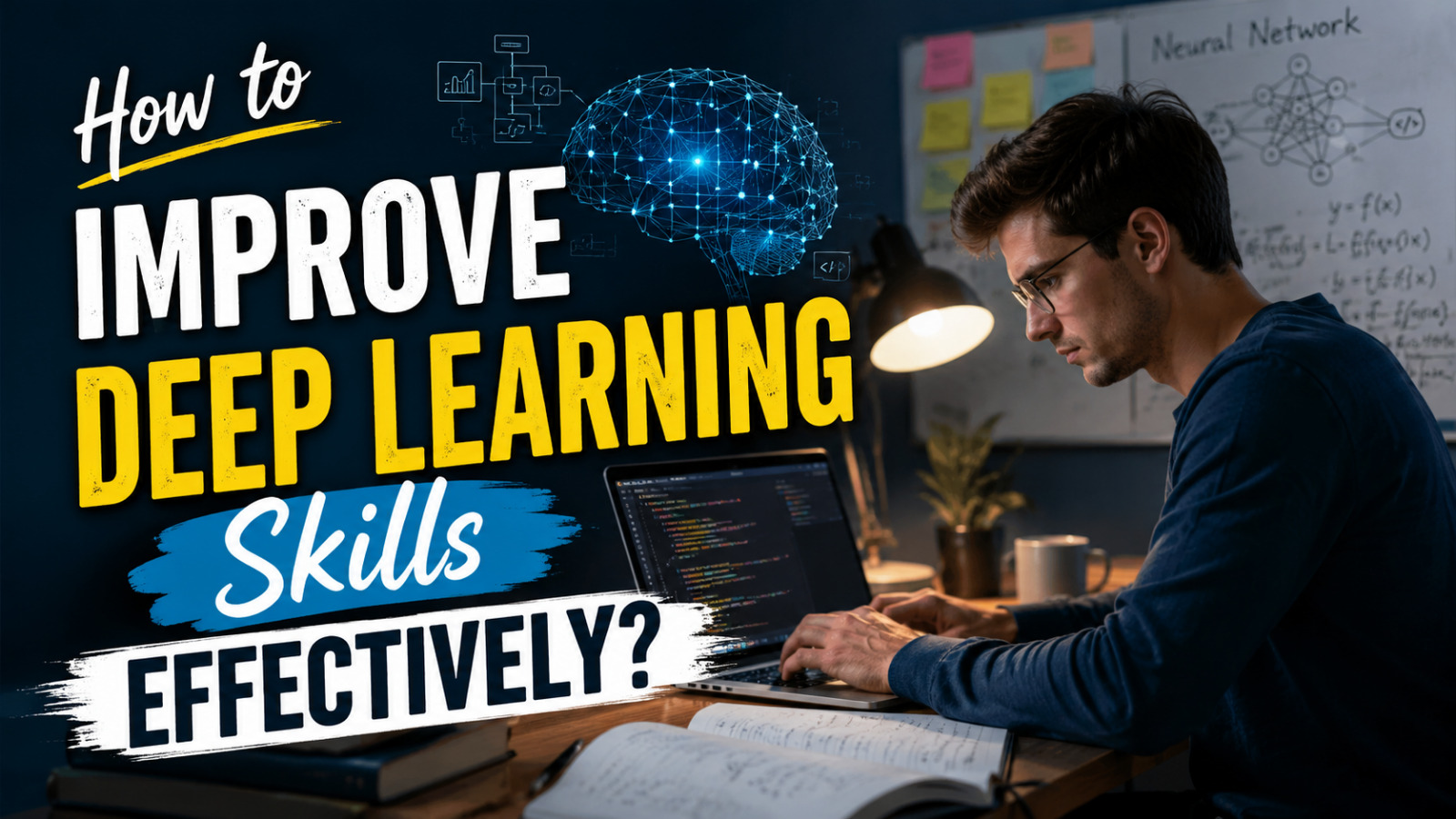
Deep Learning has become one of the most valuable technologies in modern artificial intelligence. It is widely used in image recognition, speech processing, autonomous vehicles, healthcare, finance, and many other industries. Learning deep learning effectively requires more than simply watching tutorials or reading books. A structured learning approach, consistent practice, and continuous improvement are essential for mastering this field.
Whether you are a student, researcher, or aspiring AI engineer, building strong Deep Learning Skills will significantly improve your career opportunities. Understanding the fundamentals before moving into advanced topics helps reduce confusion and increases long-term retention. With the right strategy, anyone can gradually become proficient in developing intelligent AI models.
BUILD A STRONG FOUNDATION
A solid understanding of the fundamentals is the first step toward improving Deep Learning Skills. Before studying complex neural network architectures, you should understand Machine Learning, basic statistics, probability, and linear algebra. These concepts explain how algorithms learn from data and make predictions. Without this knowledge, advanced deep learning topics may become difficult to understand. Learning the basics also makes troubleshooting and model optimization much easier.
Programming is another essential foundation. Python Programming is the most popular language for deep learning because of its simplicity and extensive ecosystem. Learning Python libraries such as NumPy, Pandas, and Matplotlib prepares you for handling datasets and visualizing results. Strong programming skills allow you to focus more on solving AI problems rather than struggling with syntax.
MASTER NEURAL NETWORK CONCEPTS
Understanding how Neural Networks work is one of the most important milestones in deep learning. Learn the structure of neurons, hidden layers, activation functions, forward propagation, and backpropagation. These concepts explain how a model learns from training data and continuously improves its predictions. A clear understanding of these mechanisms makes it easier to develop accurate AI models.
You should also study different network architectures designed for specific tasks. Convolutional Neural Networks are commonly used for image classification, while Recurrent Neural Networks and Transformers perform well in language processing and sequential data. Comparing various architectures helps you select the most suitable model for different applications. This knowledge also prepares you for advanced AI research and development.
PRACTICE WITH REAL AI PROJECTS
Theory alone is not enough to become skilled in deep learning. Working on practical AI Projects helps reinforce concepts and develop problem-solving abilities. Start with simple image classification, handwritten digit recognition, or sentiment analysis before progressing to more advanced applications. Small projects gradually build confidence and technical experience.
As your knowledge grows, work with larger datasets and more challenging problems. Experiment with model tuning, feature engineering, and hyperparameter optimization. Each completed project improves your portfolio while strengthening your understanding of real-world AI development. Practical experience is often more valuable than memorizing theoretical concepts.
LEARN POPULAR DEEP LEARNING FRAMEWORKS
Modern deep learning relies heavily on powerful software frameworks. Learning TensorFlow and PyTorch allows you to build, train, and deploy sophisticated neural networks efficiently. These frameworks provide ready-to-use tools for creating high-performance AI applications. Becoming familiar with both platforms increases your flexibility in different professional environments.
Study official documentation and build multiple practice projects using each framework. Understanding model creation, dataset preparation, training pipelines, and evaluation techniques will significantly improve your technical capabilities. Consistent practice with these tools develops confidence in handling increasingly complex AI tasks.
IMPROVE THROUGH CONTINUOUS LEARNING
Artificial intelligence evolves rapidly, making continuous learning extremely important. New research papers, optimization methods, and model architectures are introduced every year. Reading technical articles, following AI conferences, and exploring recent publications help you stay informed about industry developments. Continuous learning prevents your knowledge from becoming outdated.
Participating in online communities also accelerates improvement. Joining discussions, asking questions, and reviewing other developers' projects expose you to different approaches and solutions. Learning from experienced practitioners often provides practical insights that cannot be found in textbooks alone. Regular practice combined with curiosity leads to long-term success.
DEVELOP PROBLEM-SOLVING AND ANALYTICAL THINKING
Deep learning is not only about writing code but also about solving complex problems. Strong analytical thinking helps identify data quality issues, choose appropriate algorithms, and evaluate model performance effectively. Developing this mindset enables you to make better decisions throughout the AI development process. Careful analysis often leads to more reliable and accurate models.
Always evaluate your models using appropriate performance metrics rather than relying solely on accuracy. Learn how to interpret confusion matrices, precision, recall, and loss curves. These evaluation techniques help identify weaknesses and guide model improvements. Continuous analysis results in better-performing AI systems over time.
CONCLUSION
Improving Deep Learning Skills requires dedication, consistency, and practical experience. Building a strong foundation in Machine Learning, mathematics, and Python Programming creates the knowledge needed for advanced learning. Mastering Neural Networks, completing practical AI Projects, learning industry-standard frameworks, and continuously updating your knowledge will accelerate your growth. With regular practice and a structured learning approach, you can develop the expertise needed to succeed in the rapidly expanding field of Artificial Intelligence.
Tentang Penulis
Gusti Ayu Tita P
Penulis — Universitas STEKOM
Penulis aktif yang berfokus pada isu-isu akademik, teknologi pendidikan, dan pengembangan sumber daya manusia di lingkungan kampus.



