How to Prove Land Ownership During a Dispute?
Gusti Ayu Tita P
2 September 2026
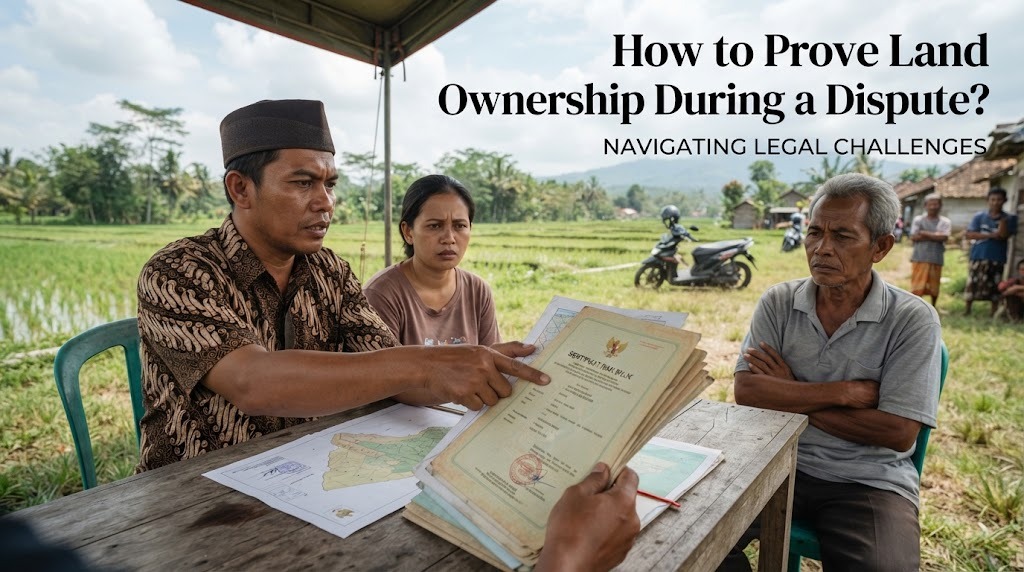
Proving land ownership during a dispute requires more than simply claiming that a property belongs to you. The strongest approach is to present consistent evidence showing how the land was acquired, registered, controlled, and transferred over time. In Indonesia, a land certificate is an important piece of evidence, but other documents and facts may also be relevant depending on the circumstances. A careful review of the property's legal and administrative history can help establish a stronger position.
CHECK THE LAND CERTIFICATE
The first document that should be examined is the land certificate, if one exists. Check the registered owner's name, certificate number, land area, location, boundaries, and measurement information. These details should correspond with the physical property being disputed. A certificate is an important form of evidence of registered land rights, although its evidentiary value can still be examined when there is a dispute concerning the underlying rights or registration process.
It is also important to determine whether the certificate is still valid and whether there are records or claims affecting the land. If two certificates appear to cover the same property, the matter requires a more detailed examination of the history and basis of each right. Do not assume that simply holding a document automatically settles every aspect of a complicated land dispute. The documents should be assessed together with other available evidence.
COLLECT PROOF OF HOW THE LAND WAS ACQUIRED
Documents showing how the land was obtained can strengthen an ownership claim. Depending on the situation, these may include a sale and purchase deed, grant document, inheritance documents, or other legally relevant records. Payment records and correspondence relating to the transaction may also help establish the history of the property. The objective is to create a clear chain showing how the right to the land passed from one party to another.
Old documents should also be preserved rather than discarded simply because a newer certificate exists. They may help explain the origin of the registered right or clarify an earlier transaction. Every document should be checked for consistency regarding names, dates, land boundaries, area, and location. If significant inconsistencies exist, professional legal assistance may be appropriate before relying on the documents in a dispute.
PROVE PHYSICAL POSSESSION OF THE LAND
Evidence of physical possession can support an ownership claim in certain circumstances. Examples include maintaining the property, constructing buildings, cultivating the land, installing fences, or using the property continuously. Photographs, receipts for improvements, and other records can help demonstrate the nature and duration of possession. However, physical possession alone does not automatically establish legal ownership because someone may possess land as a tenant, licensee, caretaker, or other lawful occupant.
Tax payment records may also be relevant as supporting evidence, but they should not automatically be treated as conclusive proof of ownership. The evidence needs to be evaluated together with the certificate, acquisition documents, land records, and other facts. A strong case generally comes from several pieces of evidence that support the same ownership history.
FIND WITNESSES WHO KNOW THE LAND HISTORY
Witnesses can help explain facts that may not be fully reflected in written documents. For example, a witness may have direct knowledge of a land sale, inheritance, boundary, long-term possession, or transfer between previous owners. The most useful witnesses are people who personally know the relevant events rather than individuals who only heard about them from someone else. Their statements should be consistent with the documentary evidence whenever possible.
Witness testimony is particularly useful when there are gaps in old land records. However, relying exclusively on witnesses can be risky when stronger documentary evidence is available. Their statements should therefore be considered as part of the overall evidence rather than as an automatic replacement for official ownership documents.
CHECK LAND RECORDS WITH THE LAND OFFICE
If ownership is disputed, checking the relevant records with the local Land Office can provide important information. The records may help clarify registered rights, measurements, ownership history, and other administrative information associated with the property. This is particularly important when there are allegations of overlapping claims, incorrect boundaries, or multiple certificates.
Bring copies of all relevant documents when requesting clarification or administrative services. If the dispute involves an alleged administrative error, the appropriate legal and administrative mechanism should be identified before taking action. A land dispute may involve both civil rights and land administration issues, so the appropriate procedure depends on the specific circumstances.
COMPARE THE DOCUMENTS WITH THE PHYSICAL LAND
A document should be compared with the actual property on the ground. Check whether the location, boundaries, buildings, access points, and land area correspond to what is written in the documents. This can be especially important when neighboring properties have similar addresses or unclear boundaries. In court proceedings involving disputed land, a local examination may also be conducted to help establish the physical condition and location of the disputed object.
If the boundaries are unclear, avoid moving fences or changing the physical condition of the property yourself. Instead, preserve the existing condition and seek appropriate professional or administrative assistance. Physical evidence can become important when determining whether the documents actually relate to the land being disputed.
ORGANIZE THE EVIDENCE CHRONOLOGICALLY
Once all available evidence has been collected, arrange it according to the history of the land. Start with the original acquisition and continue through every sale, inheritance, grant, or other transfer that led to the current ownership claim. This makes it easier to identify whether there are gaps or inconsistencies in the ownership chain. It also helps a lawyer, mediator, or court understand the dispute more quickly.
Create copies of important documents and keep the originals in a secure place. Make a simple timeline containing important dates, names of parties, transactions, and changes in ownership. If different documents contain conflicting information, identify the differences rather than attempting to hide them. Transparent and consistent evidence is generally more useful than a large collection of unrelated documents.
SEEK LEGAL ASSISTANCE WHEN THE DISPUTE ESCALATES
If the dispute cannot be resolved through discussion or mediation, legal assistance can help determine the appropriate next step. A lawyer can review the evidence, identify the legal basis of the ownership claim, prepare formal correspondence, and provide representation where necessary. This can be especially valuable when the property has multiple owners, involves inheritance, or is subject to overlapping certificates.
Before filing a lawsuit, make sure the disputed property and all relevant parties are identified accurately. The legal claim should also correspond to the actual problem, whether it concerns ownership, possession, a contractual issue, or an alleged unlawful act. Filing the wrong type of claim or failing to involve an essential party can create procedural difficulties.
CONCLUSION
Proving land ownership during a dispute requires a combination of reliable documents, consistent ownership history, and supporting factual evidence. A land certificate is important, but it should be examined together with acquisition documents, physical possession evidence, witness statements, and official land records. The evidence should be organized chronologically and checked against the actual condition of the property. If negotiations and mediation do not resolve the matter, obtaining legal advice before starting formal proceedings can help protect your rights. The key is to rely on verifiable evidence and follow the appropriate legal procedure rather than taking unilateral action.
Tentang Penulis
Gusti Ayu Tita P
Penulis — Universitas STEKOM
Penulis aktif yang berfokus pada isu-isu akademik, teknologi pendidikan, dan pengembangan sumber daya manusia di lingkungan kampus.