Is the Strawberry Generation Really Less Resilient When Facing Problems
Gusti Ayu Tita P
26 September 2026
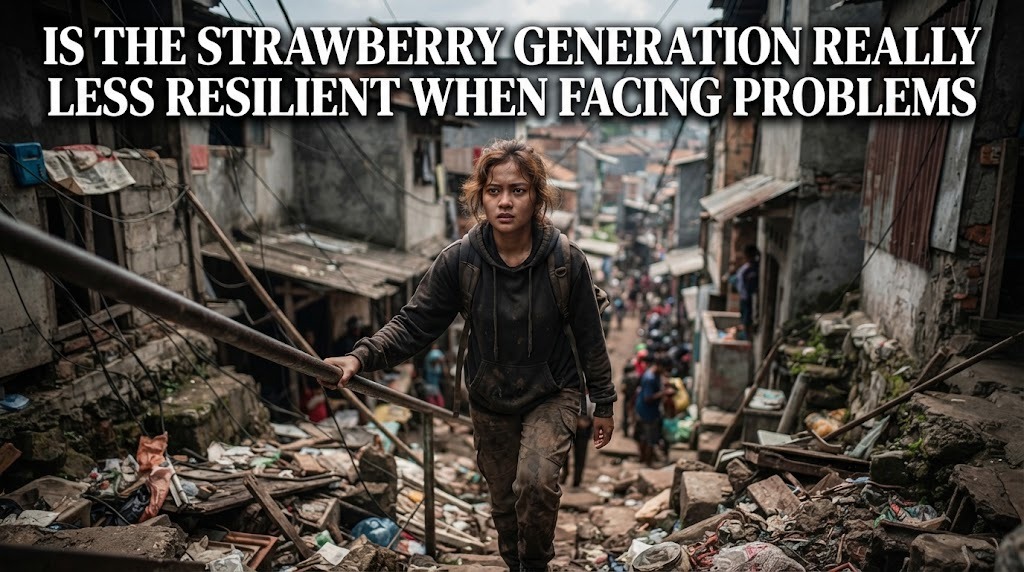
The term Strawberry Generation is often used to describe younger people who are perceived as more sensitive to pressure, criticism, failure, and difficult situations. This label can create the impression that young people today are less resilient than previous generations. However, resilience is influenced by many factors, and it cannot be accurately judged only by how someone reacts to particular challenges.
Modern young people also face problems that are different from those experienced by earlier generations. Economic uncertainty, social media pressure, rapid technological change, academic competition, and changing workplace expectations can create new forms of stress. Therefore, understanding the Strawberry Generation requires looking at both the challenges they face and the ways they develop resilience.
THE STRAWBERRY GENERATION FACES DIFFERENT TYPES OF PRESSURE
Young people today may experience pressure from education, career competition, financial concerns, family expectations, and social relationships. Digital technology has also created an environment where information and social comparisons are constantly available. These conditions can make modern pressure feel continuous rather than limited to one particular situation.
Previous generations also faced serious difficulties, but the nature of those difficulties was not always the same. Comparing generations directly can therefore be misleading if their social and economic environments are different. A person's ability to cope with problems should be considered within the circumstances they actually experience.
SENSITIVITY DOES NOT ALWAYS MEAN LOW RESILIENCE
Being emotionally sensitive does not automatically mean that someone is unable to handle difficult situations. A sensitive person may recognize stress, disappointment, or criticism more strongly while still being capable of finding solutions. Emotional awareness can become a strength when it is combined with healthy coping strategies.
Some younger people are also more comfortable discussing emotional wellbeing and personal boundaries. This can make their struggles more visible than those of people who were less likely to talk openly about similar experiences. As a result, greater openness about difficulties should not automatically be interpreted as lower resilience.
SOCIAL MEDIA CAN CHANGE HOW RESILIENCE IS PERCEIVED
Social media allows people to publicly discuss failures, stress, career difficulties, and personal problems. This can make the challenges experienced by young people more visible. At the same time, social media can create pressure through constant comparison with carefully presented images of success.
The combination can affect how young people evaluate themselves. Comparing personal progress with the online achievements of others may reduce confidence and increase feelings of failure. However, this is a social and technological challenge rather than proof that an entire generation lacks resilience.
RESILIENCE CAN DEVELOP THROUGH EXPERIENCE
Resilience is not necessarily something that people permanently possess from birth. It can develop through experience, problem-solving, supportive relationships, learning from mistakes, and gradually handling difficult situations. Repeated experiences of overcoming manageable problems can strengthen confidence and adaptability.
Young people who initially struggle with challenges may become more capable as they gain experience. Failure can also provide useful lessons about preparation, decision-making, and personal limits. This means that being discouraged by a problem at one stage of life does not determine someone's ability to handle future challenges.
FAMILY AND EDUCATION CAN INFLUENCE RESILIENCE
The environment in which someone grows up can affect how they respond to difficulties. Family support, educational experiences, opportunities to make decisions, and exposure to reasonable challenges can all influence independence and confidence. Young people generally need both emotional support and opportunities to solve problems themselves.
Overprotective environments may sometimes limit opportunities to practice independent decision-making, while excessively harsh environments can create unnecessary pressure. A balanced approach can help young people develop responsibility while knowing that support is available when necessary. These factors can be more informative than simply labeling someone as part of the Strawberry Generation.
YOUNG PEOPLE CAN DEVELOP STRONGER COPING SKILLS
Resilience can be strengthened through practical habits and skills. Setting realistic goals, managing time, communicating openly, learning from failure, and limiting unhealthy social comparison can help young people handle pressure more effectively. Self confidence often grows when people experience themselves solving problems rather than avoiding every difficulty.
It is also important to understand that asking for help can be part of healthy coping. Friends, family members, teachers, mentors, and qualified professionals can provide different forms of support. Seeking support does not necessarily indicate weakness, because knowing when and how to ask for help is also an important life skill.
THE LABEL SHOULD NOT DEFINE AN ENTIRE GENERATION
The term Strawberry Generation can be useful for discussing certain social perceptions, but it should not be treated as a complete description of every young person. Individuals within the same generation can have very different personalities, family backgrounds, opportunities, experiences, and coping abilities. Generational labels can oversimplify complex individual differences.
Rather than asking whether an entire generation is less resilient, it may be more useful to examine what conditions help young people develop resilience. Supportive environments, realistic expectations, meaningful challenges, and opportunities for growth can help people become more adaptable. Resilience should therefore be understood as a quality that can continue developing throughout life.
CONCLUSION
The Strawberry Generation is not necessarily less resilient simply because some young people may appear more sensitive to pressure or more willing to discuss their difficulties. Resilience depends on individual experiences, social conditions, support systems, coping skills, and opportunities to overcome challenges.
Modern young people face pressures that may differ from those experienced by previous generations, including digital comparison, rapid technological change, career uncertainty, and changing social expectations. Instead of judging resilience through generational labels, it is more useful to understand the factors that help young people build confidence, adaptability, emotional strength, and problem-solving skills over time.
Tentang Penulis
Gusti Ayu Tita P
Penulis — Universitas STEKOM
Penulis aktif yang berfokus pada isu-isu akademik, teknologi pendidikan, dan pengembangan sumber daya manusia di lingkungan kampus.