What Causes the Emergence of the Term Strawberry Generation Among Young People?
Gusti Ayu Tita P
26 September 2026
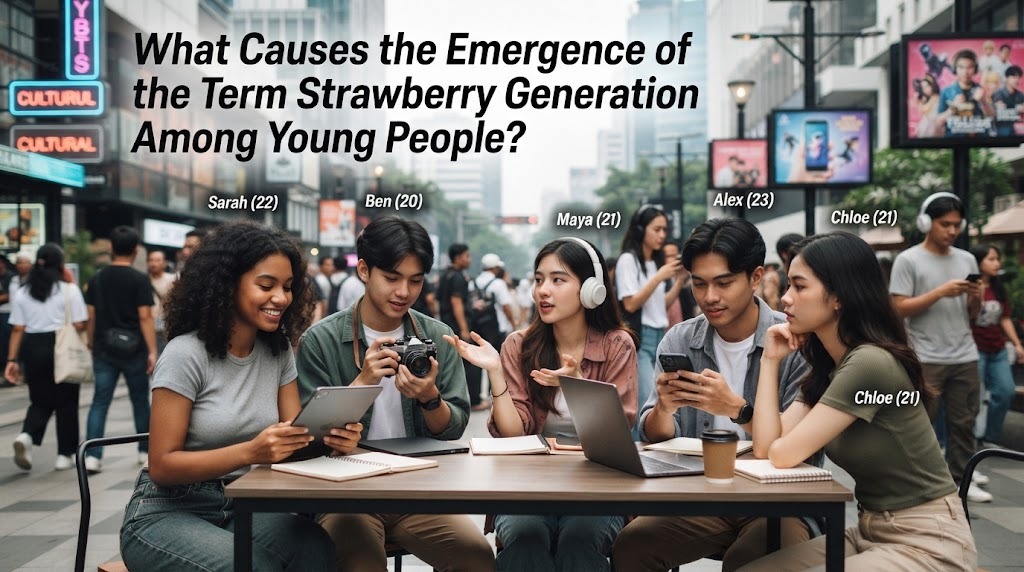
The term Strawberry Generation has become widely used to describe a perception of young people who may be more sensitive to pressure, criticism, failure, and difficult situations. The expression is often connected with the idea that some young people appear more easily discouraged when facing challenges. However, the term is a social label rather than a precise description of every young person.
The emergence of this term is influenced by several social changes, including different parenting styles, changing educational environments, digital technology, social media, economic pressure, and evolving attitudes toward emotional wellbeing. Understanding these factors can provide a more balanced explanation of why the term has become part of discussions about younger generations.
CHANGING PARENTING STYLES AND FAMILY ENVIRONMENTS
One factor often discussed in relation to the Strawberry Generation is the changing way some parents raise and protect their children. Some young people may grow up with greater parental assistance in education, personal decisions, and everyday problems. Strong parental protection can provide security, but excessive protection may sometimes reduce opportunities to practice independent problem-solving.
At the same time, family environments differ greatly between individuals. Not every young person receives the same level of protection or support. Therefore, parenting should be understood as one possible influence rather than a universal explanation for the emergence of the Strawberry Generation label.
INCREASING ACADEMIC AND SOCIAL EXPECTATIONS
Young people today can face considerable expectations related to academic achievement, career preparation, financial success, and personal development. Students may feel pressure to obtain high grades, develop useful skills, participate in activities, and prepare for competitive employment. When several expectations appear at the same time, young people may experience significant emotional pressure.
These expectations can also influence how failure is perceived. A young person who believes that every mistake could affect their future may become more worried about taking risks or making decisions. The Strawberry Generation label can emerge when this sensitivity to achievement pressure is interpreted as a sign of reduced resilience.
THE GROWTH OF SOCIAL MEDIA AND DIGITAL CULTURE
Social media has changed how young people communicate, share experiences, and evaluate themselves. Platforms allow users to see other people's achievements, lifestyles, relationships, and career progress almost constantly. Continuous exposure to carefully presented success can encourage comparison and create unrealistic expectations about personal achievement.
Digital culture can also make personal struggles more visible. Young people may openly discuss stress, anxiety, disappointment, or workplace difficulties online. This greater visibility can contribute to the perception that younger generations are more emotionally sensitive, even though previous generations may also have experienced similar challenges without discussing them publicly.
CHANGING ATTITUDES TOWARD EMOTIONAL WELLBEING
Another important factor is the growing willingness to talk about emotions and personal wellbeing. Many young people are more comfortable discussing stress, boundaries, emotional exhaustion, and the need for support. Greater openness can make emotional difficulties easier to see and discuss.
However, talking about emotional problems does not automatically mean that someone is weak or unable to cope. In some situations, recognizing emotions and asking for appropriate support can be a healthy coping strategy. The Strawberry Generation label may therefore reflect a difference in how emotional experiences are expressed rather than a simple decline in resilience.
RAPID TECHNOLOGICAL AND SOCIAL CHANGES
Young people are growing up during a period of rapid technological development. New digital tools, changing communication habits, artificial intelligence, evolving career requirements, and fast-moving information can create new opportunities while also creating uncertainty. The need to constantly adapt can contribute to stress and pressure among young people.
These changes also influence education and employment. Skills that are valuable today may change as technology develops, requiring young people to continue learning throughout their careers. The pressure to remain adaptable can become another reason why some people perceive younger generations as more vulnerable to modern challenges.
ECONOMIC AND CAREER UNCERTAINTY
Economic conditions can also influence how young people experience adulthood. Rising living costs, competitive employment markets, changing career paths, and uncertainty about financial independence can make the transition from education to work more complicated. Career uncertainty can create pressure that affects confidence and long-term planning.
Young people may therefore face challenges that are not completely under their control. Difficulties finding suitable employment or achieving financial stability should not automatically be interpreted as personal weakness. The broader economic environment can influence how easily young people can establish independent and stable lives.
GENERATIONAL DIFFERENCES CAN SHAPE THE LABEL
The Strawberry Generation term also emerges from comparisons between younger and older generations. Older people may have different experiences with work, education, communication, family responsibilities, and hardship. Differences in social conditions can make younger people appear to have different attitudes toward pressure and personal wellbeing.
However, generational comparisons can oversimplify individual differences. Young people within the same generation can have very different family backgrounds, economic conditions, personalities, opportunities, and life experiences. Therefore, the term should be understood as a social perception rather than a fixed definition of an entire generation.
CONCLUSION
The emergence of the Strawberry Generation term can be connected to several changes, including parenting styles, academic expectations, social media, greater emotional openness, technological development, economic uncertainty, and generational differences. These factors can influence how young people's behavior and responses to pressure are perceived.
The label does not necessarily mean that every young person is fragile or unable to handle challenges. Young people's resilience can be shaped by their experiences, support systems, opportunities, and coping skills. Understanding the social conditions behind the term can provide a more balanced perspective than judging an entire generation through a single label.
Tentang Penulis
Gusti Ayu Tita P
Penulis — Universitas STEKOM
Penulis aktif yang berfokus pada isu-isu akademik, teknologi pendidikan, dan pengembangan sumber daya manusia di lingkungan kampus.