What Is the Difference Between a Campus Email and a Personal Email?
Gusti Ayu Tita P
28 September 2026
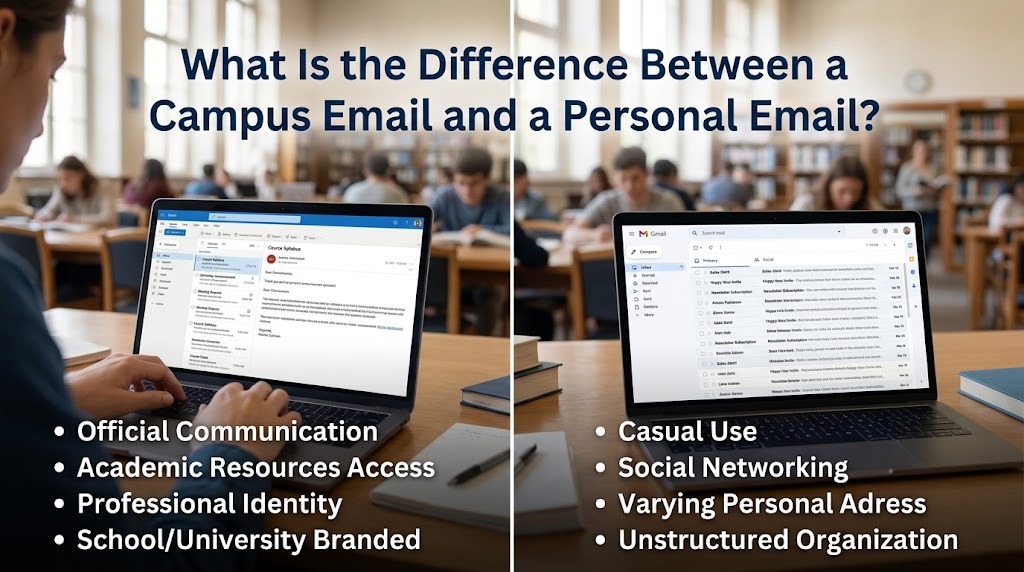
Email has become an important communication tool in everyday life, including in higher education. Students commonly use both campus email and personal email for different purposes. Although both can send and receive messages, they have different functions, ownership, and levels of connection to academic activities. Understanding these differences can help students choose the appropriate email account for each situation. Proper email use can also make academic communication more organized and professional.
WHAT IS A CAMPUS EMAIL?
A campus email is an official email account provided by a university or other educational institution to its students. The account usually uses an institutional domain that identifies the student's connection with the university. It may be used to communicate with lecturers, academic staff, departments, and other members of the institution. Universities can also use campus email to distribute important academic announcements and information. The exact services and features depend on the institution's email system.
Campus email is generally intended for academic and institutional purposes. Students may use it to receive information about schedules, assignments, registration, events, or other university activities. Some institutions may also connect campus email with learning platforms, cloud storage, calendars, or other digital services. Because it is managed by the institution, students should follow the university's rules for using the account. Students should also protect their login information and avoid sharing their account with other people.
WHAT IS A PERSONAL EMAIL?
A personal email is an email account that an individual creates and manages for personal use. Examples include accounts provided by common email service providers, although the specific provider is not important to its basic function. Students can use personal email for communication with friends, family, online services, and other personal matters. Unlike campus email, a personal email account normally remains under the individual's control regardless of their student status. This makes it useful for maintaining long-term personal communication.
Personal email can also be used for academic activities when a university or lecturer allows it. For example, a student may use a personal account to register for an external educational website or communicate with an organization outside the university. However, students should check whether an institution specifically requires communication through a campus email. Using the correct account can prevent confusion between personal and academic messages. Keeping academic and personal communication separate can also make information easier to organize.
DIFFERENCES IN PURPOSE AND OWNERSHIP
The main difference between the two accounts is their purpose and management. Campus email is connected to an educational institution and is primarily intended to support academic or institutional communication. Personal email is managed by the individual and is generally used for personal communication and online services. A campus email may be subject to university policies and may depend on the student's relationship with the institution. Personal email is normally maintained by the individual according to the provider's terms.
Another difference is the identity represented by the email address. A campus email can help recipients recognize that the sender is associated with a particular university. This can be useful when communicating with lecturers, departments, or official campus services. A personal email does not necessarily identify the sender as a student of a specific institution. Therefore, students should consider the context before deciding which account to use.
DIFFERENCES IN ACADEMIC USE
Campus email is particularly useful when students need to communicate about academic matters. It can be used to contact lecturers, receive university announcements, send documents when permitted, and participate in institutional activities. Some universities may provide additional services through the campus account, depending on their digital infrastructure. These services can make the account more useful for daily academic tasks. Students should always follow the communication procedures established by their institution.
Personal email can still have an important role in education. Students may use it for external courses, personal portfolios, applications, newsletters, or communication with organizations outside the university. It can also serve as a long-term contact address when a campus account is no longer available after graduation. However, students should avoid assuming that personal email can replace an official campus account for every academic purpose. The appropriate choice depends on the requirements of the university or the recipient.
HOW STUDENTS CAN USE BOTH EMAIL ACCOUNTS EFFECTIVELY
Students can benefit from maintaining separate campus and personal email accounts. The campus account can be prioritized for university announcements, lecturers, academic departments, and official student activities. The personal account can be used for personal communication and services that are not directly connected to the university. This separation can help students keep their academic messages organized. It can also reduce the risk of missing important university information among personal emails.
Students should regularly check both accounts and use appropriate security practices. Strong and unique passwords, careful handling of attachments, and awareness of suspicious messages can help protect email accounts. Students should also check the recipient, subject, attachment, and content before sending an important message. When communicating with lecturers or university staff, they should use clear and respectful language. By using each account according to its purpose, students can manage their digital communication more effectively.
CONCLUSION
Campus email and personal email have similar basic functions, but they serve different roles. A campus email is connected to an educational institution and is mainly used for official academic and institutional communication. A personal email is controlled by the individual and is generally intended for personal communication and long-term use. Students can use both accounts effectively by understanding their purposes and following the requirements of their university. Choosing the appropriate email account can make communication more organized, secure, and suitable for each situation.
Tentang Penulis
Gusti Ayu Tita P
Penulis — Universitas STEKOM
Penulis aktif yang berfokus pada isu-isu akademik, teknologi pendidikan, dan pengembangan sumber daya manusia di lingkungan kampus.