What Makes a New SAR Team Ready for Difficult Rescue Missions?
Gusti Ayu Tita P
29 September 2026
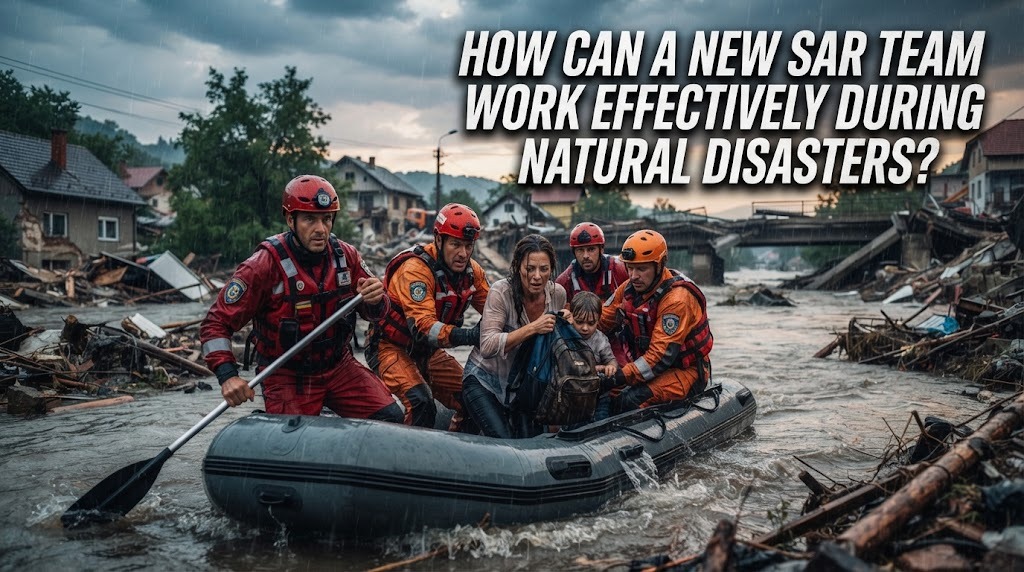
A new SAR team is ready for difficult rescue missions when its members have the skills, equipment, procedures, and coordination needed to operate safely in challenging environments. Difficult missions may involve natural disasters, missing persons, damaged buildings, remote terrain, dangerous water, or limited access. Preparation must therefore cover much more than basic physical fitness. Indonesia's Indonesia SAR Manual 2025 highlights training, communication, supporting infrastructure, and the management and improvement of SAR services as important elements of effective operations.
Readiness also means that every member understands their role and knows how to work within the team's operational structure. INSARAG emphasizes preparedness, coordination, interoperability, and readiness for complex emergency operations, while recent regional training has continued to focus on coordinated response capabilities. A new team becomes more prepared when these abilities are tested through regular exercises rather than learned only in theory. This creates a stronger foundation for dealing with unexpected situations during a real rescue mission.
STRONG RESCUE TRAINING
The foundation of a ready SAR team is practical and structured rescue training. Members should develop skills such as searching, navigation, first aid, casualty handling, communication, and appropriate technical rescue techniques according to their operational role. Training should also reflect the environments in which the team is expected to work. Repeated practical exercises help rescuers become more familiar with procedures and equipment before they encounter a real emergency.
Training should not stop after members learn basic techniques. Difficult rescue missions can change rapidly, so rescuers need opportunities to practice responding to new hazards, limited information, and changing conditions. INSARAG identifies training and exercises as important parts of preparedness and continues to develop training programs for USAR teams. Regular practice can help a new team build consistency and understand the limits of its capabilities.
READY AND WELL-MAINTAINED EQUIPMENT
A team cannot be considered fully prepared if its essential equipment is missing, damaged, or difficult to access. Rescue equipment should match the team's mission and may include protective equipment, communication devices, navigation tools, medical supplies, ropes, search tools, and specialized equipment. FEMA guidance states that PPE and communications equipment should be based on the position, incident, mission, and environmental conditions.
Technical equipment also needs to be inspected and used only by properly trained personnel. FEMA resource guidance includes search cameras, listening devices, GPS and mapping equipment, shoring systems, rope rescue equipment, and other specialized resources for appropriate USAR missions. Equipment checks, maintenance, inventory control, and practical equipment drills should therefore be part of routine team preparation.
CLEAR COMMUNICATION AND TEAM COORDINATION
Difficult missions often involve several rescuers working in different locations, so clear communication is essential. Members need to know how to report their positions, relay hazards, share victim information, and receive instructions from team leaders. Communication systems should be tested during exercises so problems can be identified before deployment. Indonesia's SAR Manual 2025 specifically identifies communication as one of the important supporting elements of SAR operations.
A new SAR team must also be able to coordinate with other emergency organizations when a situation becomes too large or complex for one team. This may include other SAR units, medical personnel, firefighters, police, authorities, or specialized technical teams. Recent INSARAG training in the Asia-Pacific region emphasized coordination and interoperability to improve complex emergency response. Strong coordination allows different resources to work toward the same operational objectives.
PHYSICAL AND TECHNICAL READINESS
Difficult rescue missions can require rescuers to walk long distances, climb, carry equipment, work in confined areas, or remain active for extended periods. A new team therefore needs appropriate physical readiness based on the demands of its expected missions. Physical preparation should be combined with technical skills rather than treated as a replacement for them. Members should also understand their own limitations and avoid performing tasks beyond their training.
Technical readiness is especially important for specialized operations. A team may need skills for rope rescue, structural incidents, water rescue, or other environments depending on its assigned role. FEMA USAR resources identify specialized technical capabilities and equipment for different rescue situations. Training must match the team's actual mission profile so that members are prepared for the tasks they may realistically be expected to perform.
RISK ASSESSMENT AND SAFETY AWARENESS
A ready search and rescue team must be able to identify hazards before and during an operation. Difficult environments may contain unstable structures, floodwater, falling objects, severe weather, debris, or other threats. FEMA guidance emphasizes site assessment, structural stability assessment, and safety considerations during search and rescue operations. This means rescuers must understand that helping a victim safely also requires protecting the rescue team.
Safety awareness should continue throughout the mission because conditions can change after the team enters the area. Members should report new hazards, follow established procedures, and communicate when additional resources are needed. Risk assessment should influence decisions about routes, equipment, personnel, and rescue methods. A team that understands when to modify or stop an activity can reduce unnecessary operational risks.
REALISTIC SIMULATIONS AND FIELD EXERCISES
Classroom learning alone cannot fully prepare a new SAR team for the uncertainty of difficult rescue missions. Simulation exercises can reproduce realistic challenges involving communication, navigation, equipment use, victim access, and changing environmental conditions. FEMA training materials describe search strategies that require prioritization, multiple search methods, rapid victim location, and simultaneous attention to structural stability. These exercises can show whether members can apply their knowledge under operational pressure.
Field exercises are also useful for testing logistics and teamwork in realistic environments. After an exercise, the team should review its performance and identify problems involving equipment, communication, procedures, or coordination. INSARAG's preparedness framework includes training, exercises, and lessons learned as continuing elements of readiness. Regular evaluation helps a new team turn training experience into practical improvements.
LEADERSHIP AND OPERATIONAL READINESS
A difficult mission requires clear leadership so that members understand priorities and responsibilities. FEMA's US&R framework assigns task force leaders responsibilities that include leadership, direct supervision, wellness, safety, and oversight of medical, logistics, and planning activities. A new team therefore needs leaders who can organize people and resources while maintaining attention to safety.
Operational readiness also means the team can mobilize with the required personnel and equipment when an incident occurs. This includes checking equipment, maintaining communication systems, preparing transportation and logistics, and keeping procedures current. Readiness is a continuous process, not a condition achieved after one training session. Regular drills and reviews can help ensure that the team remains prepared when a difficult mission happens unexpectedly.
CONCLUSION
A new SAR team becomes ready for difficult rescue missions through a combination of strong training, reliable equipment, clear communication, teamwork, physical and technical readiness, risk assessment, leadership, and realistic exercises. These elements support one another and help the team operate more systematically in challenging environments. Official SAR guidance from Indonesia, INSARAG, and FEMA all place importance on preparation, safety, communication, training, and organized operations.
Readiness should also be maintained through continuous evaluation and improvement. A new team can use training results and operational experience to update procedures, improve equipment management, and strengthen coordination. By building these capabilities consistently, a search and rescue team can be better prepared to handle demanding missions while protecting both rescuers and the people they are trying to help.
Tentang Penulis
Gusti Ayu Tita P
Penulis — Universitas STEKOM
Penulis aktif yang berfokus pada isu-isu akademik, teknologi pendidikan, dan pengembangan sumber daya manusia di lingkungan kampus.