What Training Programs Help a New SAR Team Become More Prepared?
Gusti Ayu Tita P
29 September 2026
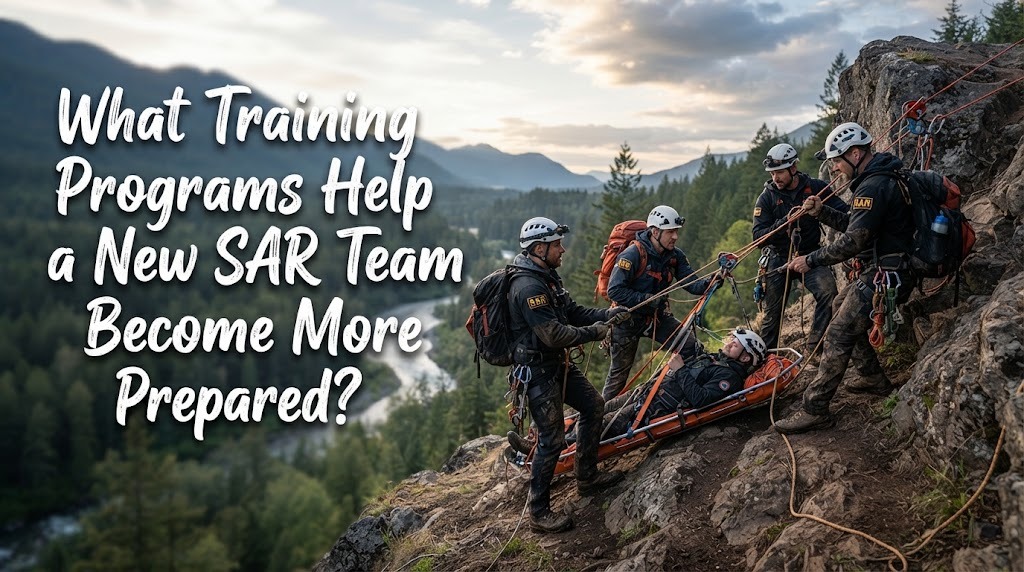
A new SAR team needs structured training programs to build the knowledge and practical abilities required for emergency rescue operations. Search and rescue work can involve difficult terrain, missing persons, floods, accidents, natural disasters, and other situations that require different skills. Indonesia's Indonesia SAR Manual 2025 was created as an operational guide for search and rescue personnel and incorporates developments in technology, global SAR methodology, and INSARAG guidance.
Training should not focus on only one skill because SAR operations involve many connected responsibilities. A prepared team needs technical skills, safety awareness, communication, planning, teamwork, and practical field experience. INSARAG's preparedness framework specifically includes training, exercises, lessons learned, SOP updates, and several capability areas such as information management, medical response, search and rescue, and logistics. These programs help a new team gradually develop a more complete operational capability.
BASIC SAR AND EMERGENCY RESPONSE TRAINING
The first program for a new SAR team should introduce the basic principles of search and rescue operations. Members need to understand how emergency information is received, how an operation is planned, how teams are deployed, and how searching and rescue activities are conducted. Recent BASARNAS preparedness exercises have simulated the full sequence from receiving incident information and planning to search, rescue, and final evaluation. This type of training gives new members a clearer picture of how an operation works from beginning to end.
Basic training can also introduce important concepts such as team roles, operational procedures, safety, and coordination. Members should understand what they are responsible for and how their work connects with other parts of the team. This foundation is important before members move into more specialized programs. A strong basic course can therefore serve as the starting point for further SAR development.
FIRST AID AND CASUALTY HANDLING TRAINING
A new team also benefits from first aid training because rescuers may reach victims before advanced medical support is available. Training can teach members how to provide appropriate initial assistance within their qualifications and how to handle victims during evacuation. BASARNAS training activities include casualty movement and basic SAR knowledge as part of field-oriented instruction. These abilities are especially useful when victims are located in remote or difficult-to-access areas.
Casualty handling should be practiced carefully because the way a victim is moved can affect safety. Members should learn how to assess basic conditions, use suitable equipment, and coordinate with medical personnel when further treatment is required. Medical training must match the rescuer's level of competence and authorization. Regular practice can make these procedures more familiar before an actual emergency occurs.
NAVIGATION AND SEARCH TECHNIQUE TRAINING
Navigation is an important part of search and rescue training, particularly for teams working in forests, mountains, coastlines, and remote areas. BASARNAS field instruction includes land navigation and search techniques for mountain and forest environments. Members can learn how to use maps, coordinates, compass systems, GPS devices, and other appropriate navigation tools.
Search training should also teach members how to work systematically in an assigned area. They need to understand how to follow routes, record findings, communicate locations, and avoid unnecessary duplication of search effort. Search accuracy and location awareness become especially important when terrain is large or visibility is limited. Combining navigation practice with realistic search exercises can make these skills more useful in the field.
COMMUNICATION AND SAR PLANNING TRAINING
A new team needs training in emergency communication and SAR planning because rescue operations require accurate information and organized decisions. BASARNAS held SAR Planning training in 2025 that covered operational planning, cross-agency coordination, modern information systems, and evaluation of SAR operations. This demonstrates that planning is not limited to determining where rescuers should go but also includes coordination and information management.
Communication training should teach members how to report important information clearly and use the team's approved communication systems. They should practice sharing locations, hazards, victim information, and changes in operational conditions. Good communication supports good planning, because operational decisions depend on reliable information. Regular exercises can also reveal communication gaps that need to be corrected before a real mission.
SPECIALIZED TECHNICAL RESCUE TRAINING
Some SAR teams need specialized programs based on their mission profile. These may include water rescue, rope rescue, urban search and rescue, mountain rescue, or other technical disciplines. In June 2026, Kantor SAR Palembang conducted a three-day underwater SAR exercise to improve technical competence and readiness for water-related emergencies. Such specialized programs allow members to develop skills that cannot be fully covered by basic SAR training.
Technical training should always be matched with appropriate equipment and supervised practice. Members need to understand both how a technique works and the risks associated with performing it in an actual emergency. Specialized skills should only be used within the person's training and operational authorization. This approach helps prevent inexperienced rescuers from attempting procedures beyond their capabilities.
SIMULATION AND FIELD EXERCISE PROGRAMS
Training becomes more meaningful when members can apply their knowledge through simulation exercises. BASARNAS Palu's September 2026 preparedness exercise divided participants into teams and required them to practice the stages of an SAR operation from receiving information through planning, field search and rescue, and evaluation. Exercises like this can test whether procedures work when several tasks must be handled at the same time.
INSARAG also encourages USAR teams to conduct training and exercises during the preparedness period between disaster responses. Field exercises can introduce realistic conditions such as difficult terrain, communication problems, changing weather, or limited resources. Realistic practice helps members discover weaknesses before those weaknesses appear during an actual operation.
TEAMWORK AND COORDINATION TRAINING
A new SAR team must learn how to work with other responders, not only with its own members. Training programs can involve joint exercises with other SAR units, medical teams, authorities, community responders, or other organizations. In June 2026, a BASARNAS Denpasar preparedness exercise involved six SAR potential elements as part of cross-agency collaboration and coordination. This type of training can help different organizations understand how to communicate and work within a coordinated response.
Teamwork training should cover role clarity, information sharing, leadership, communication, and mutual support. Members need to understand how individual tasks contribute to the wider mission. Joint exercises can also reveal differences in procedures and help organizations improve coordination before an emergency occurs. Strong cooperation becomes especially important when an incident requires multiple teams and resources.
EVALUATION AND CONTINUOUS IMPROVEMENT TRAINING
A new team should not stop learning after completing a training course. Evaluation and lessons learned should be built into the training program so the team can identify what needs improvement. INSARAG's preparedness framework specifically calls for teams to review previous experiences, update SOPs when needed, and plan future responses. This creates a continuous cycle of practice, evaluation, and improvement.
BASARNAS also conducts evaluations of training readiness and operational programs, including efforts to improve training assessment and personnel preparedness. After each exercise, the team can review communication, equipment, planning, teamwork, safety, and technical performance. Continuous evaluation helps ensure that training remains relevant as operational needs, technology, and risks change.
CONCLUSION
Several training programs can help a new SAR team become more prepared, including basic SAR training, first aid, navigation, communication, SAR planning, specialized technical rescue, simulations, teamwork, and evaluation. The exact combination should reflect the team's operational responsibilities and the environments in which it will work. Current BASARNAS activities show that training increasingly combines theory, practical exercises, coordination, technical skills, and evaluation.
Preparation should be treated as an ongoing process rather than a one-time course. Regular exercises, lessons learned, equipment practice, and updated procedures can help a new team strengthen its capabilities over time. With structured and relevant training, a search and rescue team can develop the skills and coordination needed to respond to emergencies in a safer and more organized way.
Tentang Penulis
Gusti Ayu Tita P
Penulis — Universitas STEKOM
Penulis aktif yang berfokus pada isu-isu akademik, teknologi pendidikan, dan pengembangan sumber daya manusia di lingkungan kampus.