What Volleyball Rules Are Determined By FIVB?
Gusti Ayu Tita P
29 September 2026
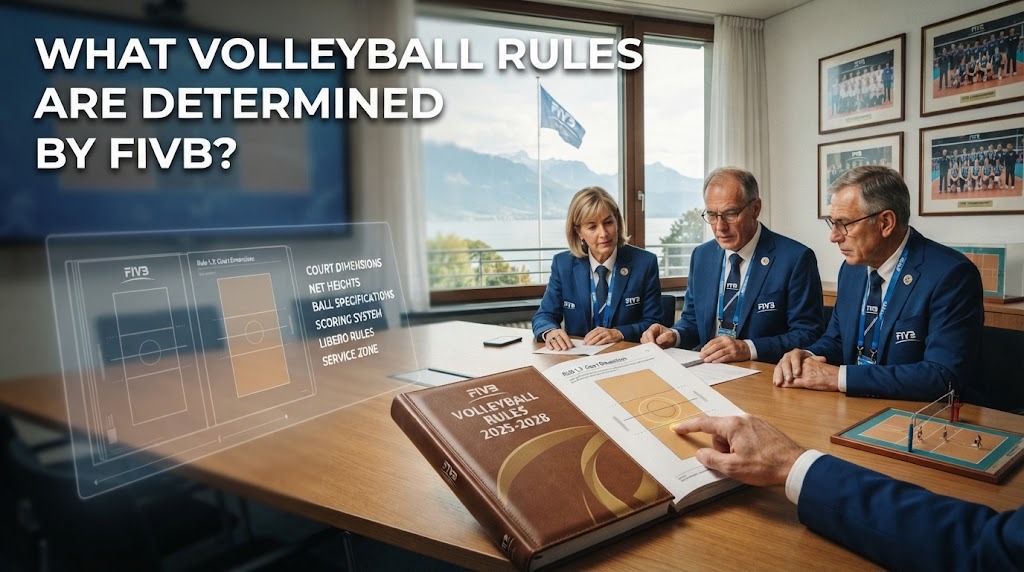
The Fédération Internationale de Volleyball (FIVB) is the global governing body responsible for regulating volleyball. One of its main responsibilities is establishing the Official Volleyball Rules used in international competitions. These rules help make matches fair, organized, and consistent between countries. The current official indoor volleyball rules cover the 2025–2028 period.
FIVB rules cover many parts of the game, including the playing area, equipment, teams, scoring, playing actions, substitutions, the libero, officials, and match procedures. FIVB also has separate official rules for beach volleyball. This means the rules can differ depending on the form of volleyball being played.
PLAYING AREA AND COURT DIMENSIONS
FIVB determines the official requirements for the volleyball court and playing area. The indoor volleyball court is a rectangle divided into two equal sides by a net. The rules also define areas such as the front zone, back zone, service zone, substitution zone, and free zone. These measurements and markings help ensure that international matches are played under consistent conditions.
FIVB also provides specific requirements for the space around the court and the position of important areas such as team benches and scorer tables. Standardized court dimensions are important because teams from different countries must compete on an equivalent playing surface. These requirements are particularly important for FIVB, World, and Official Competitions.
NET AND EQUIPMENT REQUIREMENTS
FIVB establishes rules for volleyball equipment, including the net, posts, ball, player uniforms, and other equipment used during official competitions. The official rules specify technical requirements that equipment must meet. For example, player uniforms must follow requirements related to design, numbers, and identification.
FIVB also uses homologation regulations to manage technical requirements and testing procedures for equipment such as indoor and beach volleyballs and sport floors. This helps ensure that equipment used in major competitions meets established standards. Consistent equipment can support fair playing conditions and reduce differences caused by unsuitable materials.
TEAM COMPOSITION AND PLAYER POSITIONS
FIVB determines rules concerning team composition and player participation. Players who are recorded on the official score sheet are the players permitted to participate in the match. The rules also establish requirements concerning team areas, player equipment, and the responsibilities of team members.
In indoor volleyball, teams normally have six players on the court at one time. Players must follow the correct rotational order when the ball is put into play. Once the serve has been made, players can move according to the rules and their tactical roles, but backcourt players have restrictions on attacking and blocking near the net.
SCORING AND MATCH FORMAT
FIVB determines the basic scoring system and match format for international volleyball. Indoor volleyball uses the Rally Point System, meaning a team scores a point whenever it wins a rally. A standard match is played as a best-of-five format, with the first four sets normally played to 25 points and the deciding fifth set played to 15 points. A team must win a set by at least two points.
These rules create a clear structure for international matches. The scoring system also means that every rally can directly affect the result. Because teams must maintain a two-point advantage to win a set, matches can continue beyond the normal target score when the teams remain close.
SERVICE AND ROTATION RULES
FIVB also regulates the service and rotation system. A service begins each rally and must send the ball over the net into the opponent's court. Players must follow the correct rotation order before the serve is made. If a team is out of rotation, it can be penalized according to the applicable rules.
After a receiving team wins a rally and gains the right to serve, its players rotate one position clockwise. This rotation system requires players to understand both their positions and tactical responsibilities. It also prevents teams from simply keeping their strongest attackers at the net for every rotation.
BALL CONTACT AND PLAYING ACTIONS
FIVB establishes rules for how players may contact and play the ball. A team normally has a maximum of three hits to return the ball over the net, in addition to the block contact under the indoor rules. Players can use different techniques such as passing, setting, attacking, and blocking. The ball must be hit rather than caught or thrown.
The rules also define faults involving actions such as illegal contacts, net interference, and incorrect playing actions. These regulations help referees determine whether a rally should continue or whether a team has committed a fault. Clear playing rules are essential for keeping matches fair and understandable.
LIBERO AND SUBSTITUTION RULES
FIVB created the libero position as a specialist role for backcourt defence. The libero wears a uniform that is different from the other players. The libero has specific restrictions and cannot perform certain actions such as blocking or completing an attack hit above the top of the net.
FIVB also determines rules concerning substitutions and player replacements. The number and procedures can depend on the applicable competition regulations and any officially approved rule tests. For example, FIVB approved an eight-substitution test for selected 2026 international competitions, showing that some rules can be tested before possible future changes are considered.
REFEREES AND MATCH OFFICIALS
FIVB establishes rules and procedures that guide referees and match officials. Officials are responsible for applying the rules during matches and making decisions about faults, scoring, player positions, and other situations. Consistent officiating is important because international teams need to compete under the same interpretation of the rules.
FIVB also has a Rules of the Game and Refereeing Commission that works on rules and refereeing matters. The commission focuses on maintaining fairness and integrity within volleyball. This helps ensure that the official rules are applied consistently across international competitions.
RULES FOR INTERNATIONAL COMPETITIONS
FIVB does more than determine the basic actions of volleyball. It also establishes regulations for international competitions, including competition procedures, eligibility, officials, and other organizational requirements. Its legal framework includes sports regulations and event regulations that apply to FIVB activities.
FIVB can also review how the sport is played and test possible changes. In 2026, for example, FIVB approved tests involving playing actions, video challenges, coach-referee interaction, substitutions, team rosters, and other procedures in selected competitions. Any permanent changes to the Official Volleyball Rules are subject to review after the testing process.
WHY FIVB RULES ARE IMPORTANT
FIVB rules are important because they create a common standard for international volleyball. Without common rules, teams from different countries could face different requirements during international competitions. Standard rules help players, coaches, referees, and organizers understand what is expected during a match.
The rules also support fair competition and consistency. They cover everything from court dimensions and equipment to scoring, player positions, substitutions, and officiating. By regularly reviewing the rules and testing possible improvements, FIVB can keep international volleyball organized while allowing the sport to develop.
CONCLUSION
FIVB determines many of the rules that control how international volleyball is played. These include rules for the playing area, equipment, team composition, scoring, rotation, service, ball contact, libero, substitutions, and refereeing. FIVB also establishes regulations for international competitions and technical standards for equipment and facilities.
The purpose of these rules is to create a fair, consistent, and professional volleyball environment. Although rules can be reviewed and tested over time, official changes are handled through FIVB's established regulatory process. This allows volleyball to develop while maintaining a clear structure for players and teams around the world.
Tentang Penulis
Gusti Ayu Tita P
Penulis — Universitas STEKOM
Penulis aktif yang berfokus pada isu-isu akademik, teknologi pendidikan, dan pengembangan sumber daya manusia di lingkungan kampus.