Why Is the Strawberry Generation Often Associated With Emotional Fragility?
Gusti Ayu Tita P
26 September 2026
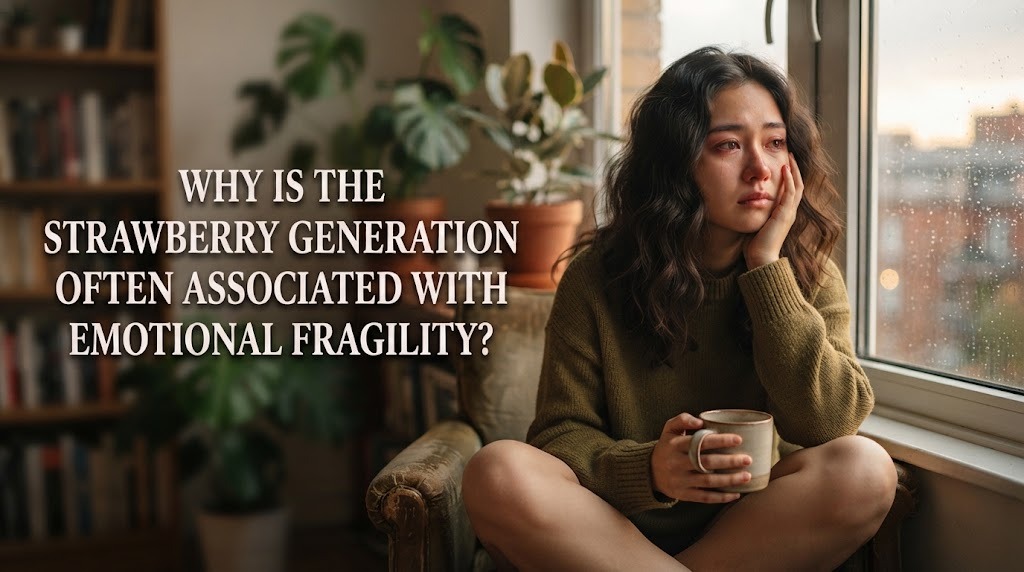
The Strawberry Generation is often associated with emotional fragility because some young people are perceived as more sensitive to criticism, pressure, rejection, and failure. The term is commonly used to describe a generation that may appear less comfortable with difficult situations compared with traditional expectations of toughness. However, this perception does not mean that every young person has the same emotional characteristics.
Modern life also creates unique pressures that can influence emotional responses. Social media comparison, academic competition, career uncertainty, family expectations, and rapid technological change can make young people feel overwhelmed. Understanding these factors provides a more balanced explanation of why the Strawberry Generation is sometimes associated with emotional fragility.
HIGH SOCIAL AND ACADEMIC EXPECTATIONS CAN CREATE PRESSURE
Young people often face expectations to perform well in education, build successful careers, and achieve financial independence. These expectations can become stressful when success is treated as something that must happen quickly. Constant pressure to achieve can make failure feel more emotionally difficult.
Academic competition can also affect confidence. Students may compare their grades, achievements, or university choices with their peers and feel that they are falling behind. When expectations become unrealistic, disappointment can become stronger and contribute to the perception of emotional fragility.
SOCIAL MEDIA CAN INCREASE EMOTIONAL COMPARISON
Social media has made comparison more frequent and visible. Young people can easily see other people's achievements, lifestyles, relationships, and career progress. Comparing everyday life with carefully selected online content can create unrealistic expectations about success and happiness.
This does not mean that social media automatically makes someone emotionally fragile. However, frequent comparison can influence self confidence and create feelings of inadequacy. Learning to recognize that online content does not show someone's complete life can help create a healthier perspective.
GREATER EMOTIONAL OPENNESS CAN BE MISUNDERSTOOD
One reason young people may appear emotionally fragile is that they are often more willing to talk about stress, boundaries, disappointment, and emotional wellbeing. In some environments, openly discussing these experiences may have been less common in the past. Greater willingness to express emotions does not necessarily mean weaker emotional resilience.
Being able to identify and communicate feelings can actually support healthy relationships and problem-solving. Someone who openly says they are struggling may be taking an active step toward managing the problem. Therefore, emotional openness should not automatically be confused with an inability to handle difficulties.
FEAR OF FAILURE CAN AFFECT EMOTIONAL RESILIENCE
Failure can be difficult for anyone, but strong expectations of success may make mistakes feel particularly threatening. Some young people may worry that one failure will negatively affect their education, career, reputation, or future opportunities. This fear can cause disappointment to feel more serious than the actual situation.
Learning to view failure as part of development can help reduce this pressure. Mistakes can provide information about what needs to change and what skills still need improvement. Resilience grows when people learn from setbacks instead of defining themselves entirely by them.
FAMILY ENVIRONMENT CAN SHAPE EMOTIONAL DEVELOPMENT
Family experiences can influence how young people respond to stress and disappointment. Strong parental support can provide emotional security, but young people also need opportunities to make decisions and experience reasonable consequences. A balance between protection and independence can help develop confidence and emotional resilience.
If someone rarely has the opportunity to solve problems independently, unfamiliar challenges may feel more difficult later. On the other hand, excessive pressure can also make emotional stress harder to manage. The way young people are supported can therefore influence how they develop their coping skills.
MODERN UNCERTAINTY CAN AFFECT EMOTIONAL SECURITY
Young people today may have concerns about employment, financial stability, technological change, and future career requirements. Rapid changes can make long-term planning feel uncertain. Uncertainty can create emotional pressure when people feel that they must constantly adapt to remain successful.
At the same time, young people can develop valuable skills by learning to adapt to change. Communication, problem-solving, digital literacy, and continuous learning can improve confidence when facing uncertain situations. Adaptability can therefore become an important part of emotional resilience in modern life.
EMOTIONAL RESILIENCE CAN CONTINUE TO DEVELOP
Emotional resilience is not necessarily a fixed quality. People can strengthen it through experience, supportive relationships, healthy routines, realistic expectations, and opportunities to solve problems independently. Young people who struggle with pressure today can become more resilient as they gain experience and learn effective coping strategies.
It is also important to avoid treating the Strawberry Generation as one uniform group. Individuals have different personalities, backgrounds, opportunities, and life experiences. A generational label cannot fully explain someone's emotional strength or vulnerability, so resilience should be considered at an individual level.
CONCLUSION
The Strawberry Generation is often associated with emotional fragility because of high expectations, social media comparison, fear of failure, changing family dynamics, and uncertainty in modern life. However, these factors do not prove that an entire generation is emotionally weaker than previous generations.
Greater emotional openness may also make young people's struggles more visible. With healthy support, realistic expectations, practical coping skills, self confidence, and meaningful life experiences, young people can continue developing stronger emotional resilience. The Strawberry Generation should therefore be understood through its social environment and individual differences rather than through a single stereotype.
Tentang Penulis
Gusti Ayu Tita P
Penulis — Universitas STEKOM
Penulis aktif yang berfokus pada isu-isu akademik, teknologi pendidikan, dan pengembangan sumber daya manusia di lingkungan kampus.