
Complete Guide to Land Ownership Certificates for Land and Homeowners
Gusti Ayu Tita P
28 Agustus 2026
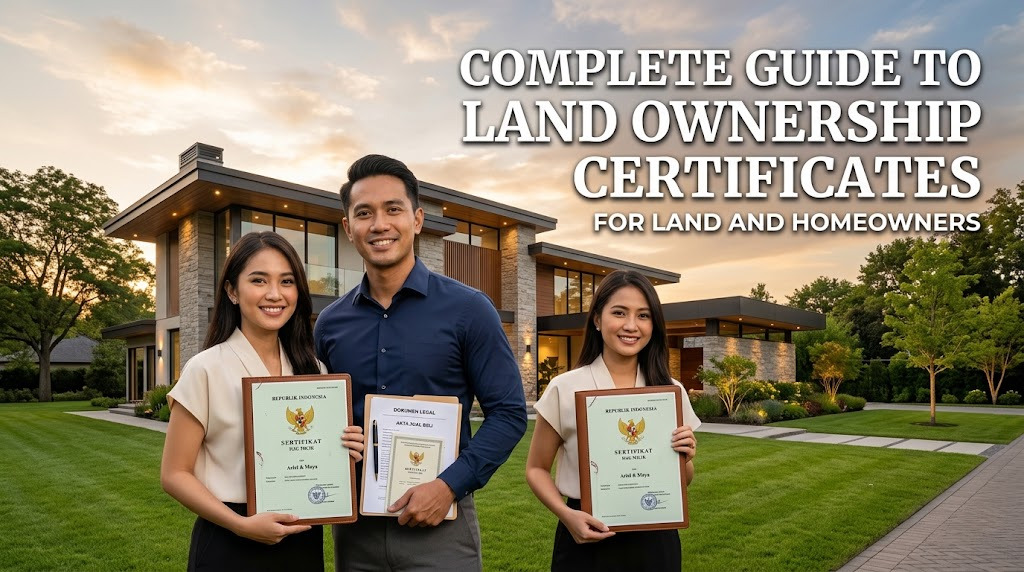
A Land Ownership Certificate is one of the most important documents for land and homeowners in Indonesia. The certificate provides evidence of registered rights over a particular plot of land and contains important information about the rights holder and the property. Understanding how land certificates work can help owners manage their property more carefully and reduce the risk of future legal or administrative problems.
For homeowners, it is also important to understand that land rights and building-related matters are not always the same thing. A house may stand on land with a particular type of land right, while the building itself can have separate administrative requirements. Therefore, property owners should understand both the certificate and the documents associated with the building.
UNDERSTANDING LAND OWNERSHIP CERTIFICATES
A Land Ownership Certificate is evidence of registered rights over land. In Indonesia, Sertifikat Hak Milik (SHM) is commonly associated with Hak Milik, which is a specific type of land right under Indonesian agrarian law. The certificate contains information used to identify the registered rights and the relevant land.
Having an SHM does not mean that the owner can use the land without restrictions. Land use must comply with applicable laws and spatial planning requirements. Owners should therefore understand the scope of their rights as well as their responsibilities.
TYPES OF LAND RIGHTS THAT OWNERS SHOULD KNOW
Indonesia recognizes several types of land rights, and each has different characteristics. Hak Milik and Hak Guna Bangunan (HGB) are among the rights that commonly appear in property transactions. HGB, for example, provides a right to establish and own buildings on land for a specified period under applicable regulations.
Understanding the type of certificate is essential before buying property. An HGB certificate is not the same as an SHM certificate, and the duration and legal characteristics can differ. Buyers should check the certificate carefully rather than assuming that every house comes with Hak Milik.
HOW TO OBTAIN A LAND OWNERSHIP CERTIFICATE
People who do not yet have a registered certificate may need to complete the land registration process through the relevant ATR/BPN Land Office. Depending on the circumstances, the process can involve document verification, land measurement, mapping, legal examination, and administrative registration.
The documents required can vary according to the origin and status of the land. Land obtained through purchase, inheritance, grant, or another legal basis may require different supporting documents. Applicants should confirm the current requirements with the relevant Land Office before submitting an application.
HOW TO VERIFY A LAND CERTIFICATE
Before purchasing land or a house, buyers should conduct land certificate verification. Important information to examine includes the registered owner's name, certificate number, land area, location, and other relevant land data.
Do not rely solely on the certificate's physical appearance. Official verification through ATR/BPN channels is more reliable than simply examining paper, stamps, or printing. When a transaction is complex, assistance from a PPAT can also help ensure that the required legal and administrative procedures are followed.
LAND CERTIFICATE FOR BUYING AND SELLING PROPERTY
A certificate plays an important role when buying or selling land and houses. Before completing the transaction, buyers should confirm that the seller has the appropriate authority to transfer the land rights. The property details should also correspond with the certificate and supporting documents.
For a registered land transfer, the transaction generally involves an appropriate Akta Jual Beli (AJB) prepared through a PPAT when required. Buyers should carefully review the transaction documents before signing. Completing the transfer properly helps ensure that the land registration records can be updated to reflect the new owner.
TRANSFERRING THE CERTIFICATE AFTER PURCHASE
After buying property, the buyer should complete the transfer of registered land rights according to the applicable procedure. The process can involve preparing the necessary documents, completing the transaction deed, fulfilling applicable tax and administrative obligations, and submitting the transfer for registration.
The new owner should carefully check the updated certificate after the process is completed. The owner's name, land area, location, and other relevant information should be reviewed for accuracy. Store the original certificate safely and maintain copies of important transaction documents.
INHERITED LAND AND CERTIFICATE TRANSFER
When land is inherited, the ownership records need to be handled according to the applicable inheritance and land registration procedures. The heirs may need documents establishing the death of the previous owner and identifying the legally recognized heirs.
If there are several heirs, their rights should be properly addressed. One family member should not simply transfer or sell inherited land without considering the rights of other entitled heirs. Proper documentation can help prevent disputes among family members in the future.
USING SHM AS LOAN COLLATERAL
Under certain circumstances, Sertifikat Hak Milik can be used as collateral for financing. However, acceptance depends on the lender's requirements, the legal status of the property, its value, and the borrower's creditworthiness.
When land is used as security, the appropriate legal mechanism may involve Hak Tanggungan. Borrowers should understand the financing agreement and the consequences of default. If repayment obligations are not fulfilled, the collateral may be subject to enforcement according to the applicable agreement and law.
WHAT TO DO IF THE CERTIFICATE IS LOST
A lost Land Ownership Certificate should be handled through the official replacement procedure. The owner should report the loss and prepare the required documents before submitting the replacement application to the relevant land administration authority.
The exact procedure can depend on the circumstances and available land records. Never attempt to create or modify a replacement certificate independently. Once a replacement is issued, store it securely and keep copies of important supporting documents.
RISKS OF BUYING LAND WITHOUT CLEAR DOCUMENTATION
Buying land without a clear certificate or adequate evidence of rights can create legal and financial risks. Potential problems include unclear ownership, boundary disputes, difficulties with future transfers, and problems obtaining financing.
The absence of a certificate does not automatically mean that land has no valid rights, but the buyer must investigate the underlying status carefully. Do not rely solely on verbal promises that the certificate will be completed later. Official verification and professional assistance can be particularly important in complicated transactions.
HOW TO PROTECT YOUR PROPERTY DOCUMENTS
After obtaining a certificate, owners should store the original document in a secure location. Protect it from moisture, fire, unauthorized access, and accidental loss. Other important property documents should be organized and stored safely as well.
Creating secure copies of the certificate can also be useful. Digital or photocopied records do not replace the original certificate, but they can help preserve important information if the original becomes unavailable. Good document management makes future property administration easier.
CONCLUSION
A Land Ownership Certificate is a crucial document for land and homeowners because it records registered land rights and important information about the property. Owners should understand the type of land right, the certificate's information, the registration process, and the procedures for transactions, inheritance, financing, and certificate replacement.
Before purchasing or transferring property, always verify the certificate, registered owner, land area, location, legal status, and supporting documents. Use official ATR/BPN procedures and consider PPAT assistance for transactions that require professional legal documentation. Careful property administration can provide greater legal certainty and help protect valuable land and housing assets.
About the Author
Gusti Ayu Tita P
Author — STEKOM University
An active author focused on academic issues, educational technology, and human resource development in the campus environment.















