
A Complete Guide to Game Development from Concept to Release
Gusti Ayu Tita P
5 Agustus 2026
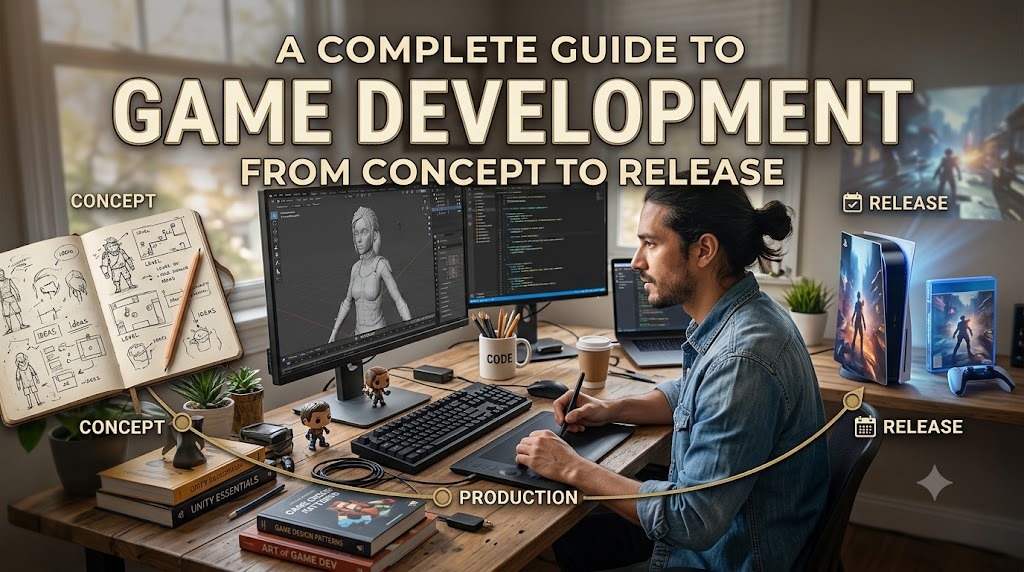
Game development is the process of turning an idea into an interactive game that people can play and enjoy. It involves many stages, from creating the initial concept to designing gameplay, producing visual assets, programming systems, testing the game, and finally releasing it to players. Game development can involve a small independent team or a large studio with professionals from different fields.
Although the process may look complicated, understanding each stage can make it easier to follow. A successful game requires more than attractive graphics because gameplay, storytelling, performance, user experience, and technical stability also influence the quality of the final product. This guide explains the main stages of game development in a simple and practical way.
DEVELOPING THE INITIAL GAME CONCEPT
The first stage of game development is creating a clear concept. Developers need to decide what type of game they want to create, such as an action game, role playing game, strategy game, simulation, puzzle game, or adventure game. The concept should explain the basic gameplay experience, target audience, platform, and main features. A strong concept gives the development team a clear direction before production begins.
Developers should also consider what makes the game interesting or different. This can be a unique gameplay mechanic, memorable characters, an unusual setting, or an engaging story. Creating a simple game design document can help organize these ideas and prevent important details from being forgotten. The concept should remain realistic enough to match the team's available time, skills, technology, and budget.
PLANNING THE GAME PROJECT
Good planning helps developers understand what needs to be completed before the game can be released. The team can divide the project into smaller tasks such as game design, programming, art, animation, audio, testing, and marketing. Developers can also establish milestones to track progress throughout production. A clear development schedule can reduce confusion and make it easier to identify problems early.
Project planning should also include decisions about the game engine and development tools. Different engines provide different features for graphics, physics, audio, scripting, and platform support. The choice should match the project's requirements and the team's technical abilities. Developers should avoid adding too many features at the beginning because uncontrolled expansion of the project can lead to delays and increased development costs.
DESIGNING GAMEPLAY AND MECHANICS
Gameplay describes what players actually do while playing the game. Developers need to design game mechanics, rules, challenges, controls, rewards, and progression systems that create an enjoyable experience. The mechanics should work together rather than feeling like unrelated features. Good gameplay usually gives players clear goals while allowing them to make meaningful decisions.
Developers often create prototypes before building the complete game. A prototype is a simplified version used to test whether a gameplay idea is enjoyable and technically possible. Playtesting at this stage can reveal problems that may not be obvious during planning. If the core gameplay is not fun, developers can make changes before investing significant time in graphics and other content.
CREATING ART AND VISUAL ASSETS
Visual design plays an important role in communicating the identity and atmosphere of a game. Artists may create characters, environments, objects, animations, user interfaces, effects, and other visual assets. The visual style should support the game's genre and overall experience. A consistent art direction can make the game feel more professional and recognizable.
The amount of visual work depends on the project's scope. A small indie game may use a simple art style to reduce production time, while a large project may require specialized teams for character art, environment design, animation, lighting, and visual effects. Developers should make sure that visual quality does not come at the expense of performance and gameplay. Good visuals should support the experience rather than distract players from it.
PROGRAMMING THE GAME
Programming turns game designs into systems that can actually function. Game programmers create features such as player controls, artificial intelligence, physics, combat systems, inventory systems, menus, saving systems, and interactions. They also connect different game components so that they work together correctly. Programming is therefore one of the central technical parts of game development.
Developers must also consider performance, stability, and compatibility. A game should respond properly to player input and avoid unnecessary crashes or serious technical problems. Optimization becomes especially important when a game is released on devices with different hardware capabilities. Clean and organized code can also make future updates and maintenance easier.
ADDING AUDIO AND MUSIC
Audio is often an important part of creating an immersive game experience. Sound designers can create sound effects for actions, environments, characters, menus, and other interactions. Music can help establish emotions and support important moments in the game. Voice acting may also be included when the project requires character dialogue.
Audio should be designed to work together with gameplay and visuals. For example, an appropriate sound effect can make an action feel more powerful, while background music can increase tension during an important scene. Developers should also make sure that audio levels are balanced so that dialogue, effects, and music do not interfere with each other. Proper audio design can make a game feel more complete and engaging.
BUILDING AND INTEGRATING THE GAME
During production, developers combine code, art, animation, audio, level design, and other assets into playable builds. A build is a version of the game that can be tested by the development team. Regular builds allow developers to check whether newly added features work correctly with existing systems. This process also helps identify technical problems before they become more difficult to fix.
Version control and organized project management are particularly important when multiple people work on the same game. Developers need to keep track of changes and avoid accidentally overwriting important work. Frequent testing can also reveal conflicts between different systems. Keeping the project organized throughout development can make collaboration much more efficient.
TESTING AND FIXING BUGS
Quality assurance or QA testing is an essential part of game development. Testers look for bugs, crashes, broken mechanics, visual problems, performance issues, and other unexpected behavior. Testing can involve different devices, hardware configurations, difficulty levels, and player actions. The goal is to make the game as stable and enjoyable as possible before release.
Not every bug has the same level of importance. Critical problems that prevent players from progressing or cause frequent crashes should usually receive high priority. Developers may also use feedback from external testers or selected players to identify usability problems. After fixes are implemented, the affected features should be tested again to make sure the changes did not create new problems.
POLISHING THE GAME
After the major features are working, developers can enter the polishing stage. This stage focuses on improving small details that make the overall experience smoother and more enjoyable. Developers may adjust controls, animations, interface elements, visual effects, sound levels, loading times, and performance. Small improvements can have a significant impact on how players perceive the final game.
Polishing should not be confused with endlessly adding new features. The main goal is to improve what already exists and remove unnecessary problems. Developers should compare the game against the original project goals and determine whether the core experience is complete. A controlled polishing stage helps prevent development from continuing indefinitely.
PREPARING FOR GAME RELEASE
Before release, developers need to prepare the game for its target platforms. This can involve platform requirements, store information, screenshots, trailers, descriptions, ratings, pricing, and technical submissions. The team should make sure that the game meets the requirements of the intended digital storefront or platform. Legal and administrative requirements should also be reviewed before publication.
Marketing preparation is equally important because releasing a game does not automatically guarantee that players will discover it. Developers can build awareness through social media, trailers, developer updates, demos, communities, and other appropriate promotional activities. A clear marketing strategy can help the game reach its intended audience. The timing of the release should also consider the project's readiness and competitive market conditions.
KEY FACTORS FOR SUCCESSFUL GAME DEVELOPMENT
Successful game development requires a combination of creativity, technical knowledge, teamwork, and careful planning. A good idea is important, but it must be supported by practical production decisions. Developers should understand their target audience and create an experience that matches the project's goals. They also need to be prepared to change or simplify ideas when technical or financial limitations require it.
Another important factor is continuous learning. Game technology, player expectations, development tools, and distribution platforms continue to change. Developers who improve their skills and learn from player feedback can adapt more effectively. Most importantly, a manageable scope, strong teamwork, regular testing, and attention to player experience can significantly increase the chances of completing a successful game project.
CONCLUSION
Game development is a long process that begins with an idea and continues through planning, design, production, testing, release, and post-release support. Each stage has a different purpose, but all stages are connected. Problems that are ignored early in development can become more expensive and difficult to solve later. For this reason, developers should combine creativity with structured planning and regular testing.
Whether a game is created by a small indie team or a large studio, the fundamental goal remains the same: to create an enjoyable, functional, and memorable experience for players. Understanding the complete development process can help beginners build realistic expectations and make better decisions. With the right skills, teamwork, patience, and willingness to learn, a simple concept can gradually become a complete game ready to reach its audience.
About the Author
Gusti Ayu Tita P
Author — STEKOM University
An active author focused on academic issues, educational technology, and human resource development in the campus environment.















