Advantages and Disadvantages of AI Animation in the Digital Era
Gusti Ayu Tita P
31 Agustus 2026
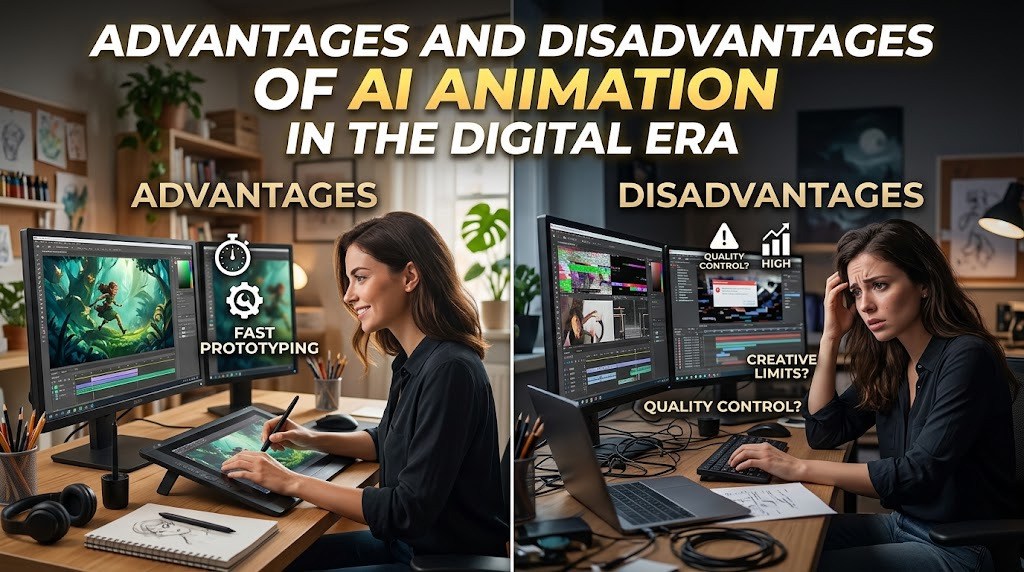
AI animation refers to the use of artificial intelligence to assist in creating or transforming animated visual content. Depending on the technology, AI can help generate characters, animate images, create motion, develop backgrounds, or turn text descriptions into visual scenes. This development has made AI animation technology increasingly accessible to creators, businesses, educators, and independent filmmakers.
Unlike traditional animation, which can require extensive manual work, AI-assisted workflows can automate or simplify some production stages. This does not mean that every animation can be created automatically from start to finish. Human creativity, editing, visual direction, and quality control remain important for producing content that is coherent and professional.
ADVANTAGES OF AI ANIMATION FOR CREATORS
One of the biggest advantages of AI animation is its ability to speed up parts of the creative process. Creators can experiment with characters, environments, visual concepts, and animation styles without manually building every element from the beginning. This can be particularly useful for individuals and small teams with limited production resources.
AI also makes animation more accessible to beginners. Someone without advanced animation skills can use AI animation tools to explore ideas and produce basic visual content. As a result, more people can experiment with animation for education, entertainment, social media, marketing, and storytelling.
REDUCED PRODUCTION TIME AND COST
Traditional animation can require significant time for character design, modeling, rigging, motion creation, rendering, and editing. AI can assist with some of these stages, potentially reducing the amount of manual work involved. This can allow creators to produce prototypes and visual experiments more quickly.
Lower production barriers can also benefit small businesses and independent creators. Instead of immediately investing in a large production team, they can use AI-assisted tools to test ideas first. However, the actual cost depends on the complexity of the project, the tools used, the amount of editing required, and whether professional assets or services are involved.
GREATER CREATIVE EXPERIMENTATION
Another major advantage is the ability to experiment with different visual concepts quickly. A creator can test realistic animation, cartoon styles, fantasy environments, futuristic scenes, or 3D characters without rebuilding an entire project manually each time.
This flexibility can encourage creative exploration. If one concept does not work, the creator can try another approach without necessarily losing a large amount of production time. AI can therefore function as a creative experimentation tool rather than simply a method for producing final videos.
AI ANIMATION FOR EDUCATION AND BUSINESS
AI animation can make educational information easier to visualize. Teachers, educators, and content creators can use animated characters, diagrams, simulations, and visual explanations to support learning. Complex concepts may become easier to understand when information is presented through appropriate visual examples.
Businesses can also use AI animation for marketing and communication. Product demonstrations, advertisements, promotional videos, internal training materials, and social media content can benefit from animated visuals. However, businesses should ensure that generated content matches their brand identity and follows applicable licensing requirements.
DISADVANTAGES OF AI ANIMATION
Despite its benefits, AI animation has several limitations. Generated content may contain visual errors, inconsistent characters, unnatural movements, distorted objects, or unexpected details. These problems can become especially noticeable when creating realistic characters or complex scenes.
Another limitation is that AI does not always understand creative intent in the same way a human animator does. A prompt may produce a technically attractive result that does not actually fit the story or message. Human review is therefore necessary to determine whether the animation communicates the intended idea effectively.
PROBLEMS WITH CHARACTER CONSISTENCY
Character consistency remains one of the common challenges in AI-generated animation. When the same character is generated across multiple scenes, details such as facial features, hairstyle, clothing, body proportions, or accessories may change. This can make a longer story feel visually inconsistent.
Creators can reduce this problem by using reference images, detailed character descriptions, consistent prompts, and supported character-reference features. Even with these methods, additional editing may still be necessary. Professional projects usually require careful checking of every scene before publication.
COPYRIGHT AND LICENSING CONCERNS
The growth of AI animation has also created questions about copyright, ownership, licensing, and the use of training data. The legal treatment of AI-generated content can vary depending on the jurisdiction and circumstances. In addition, different AI platforms may have different rules regarding commercial use and generated assets.
Creators should therefore read the terms of service for the tools they use. They should also avoid assuming that every AI-generated element is automatically free from legal restrictions. When a project involves commercial distribution, professional legal guidance may be appropriate for complex copyright questions.
ETHICAL AND RESPONSIBLE USE OF AI ANIMATION
AI animation can be used responsibly when creators consider how their content may affect other people. Problems can arise when realistic AI-generated visuals are presented as authentic footage without appropriate context. This is particularly important when content depicts real people, sensitive events, or realistic situations.
Creators should prioritize transparency when AI-generated visuals could reasonably confuse viewers. They should also respect privacy and obtain appropriate permission when using identifiable people or personal images. Responsible AI use is becoming an increasingly important part of modern digital content creation.
IMPACT ON PROFESSIONAL ANIMATORS
The development of AI animation has created both opportunities and concerns for professional animators. Some repetitive tasks may become easier to automate, while new roles may emerge around AI-assisted production, creative direction, prompt development, editing, and quality control.
AI does not necessarily eliminate the need for skilled animators. Complex productions still require artistic judgment, storytelling, technical knowledge, character performance, and detailed refinement. Animators who learn how to work effectively with new technologies may be able to expand their existing capabilities rather than simply compete against AI.
AI ANIMATION VERSUS TRADITIONAL ANIMATION
Traditional animation provides artists with detailed control over individual elements and movements. Artists can deliberately shape character performance, visual composition, timing, and artistic style. This level of control can be especially valuable for projects with highly specific creative requirements.
AI-assisted animation, on the other hand, can provide speed and experimentation. It may be useful for concept development, rapid prototyping, background generation, motion assistance, and other tasks. In many professional workflows, the most effective solution may be a combination of AI and traditional animation techniques.
HOW TO USE AI ANIMATION EFFECTIVELY
Creators should begin with a clear objective rather than using AI simply because it is available. Define the audience, message, visual style, characters, and desired outcome before generating animation. This can make the production process more organized and reduce unnecessary generations.
It is also important to treat AI output as a starting point when necessary. Review the generated content, correct errors, refine the timing, and add human-created elements such as voice-over, sound design, editing, subtitles, and visual effects. This approach can produce a more polished result while preserving the creator's individual style.
CONCLUSION
AI animation in the digital era offers significant advantages, including faster experimentation, greater accessibility, reduced manual work, and new creative opportunities. It can support creators in producing content for social media, education, marketing, entertainment, business, and storytelling.
However, AI animation also has disadvantages, including inconsistent results, technical limitations, copyright questions, ethical concerns, and the need for human quality control. The most effective approach is not to view AI as a complete replacement for human creativity, but as a powerful creative and production assistant. By combining AI technology with human judgment, storytelling, editing, and responsible practices, creators can take advantage of its benefits while reducing its limitations.
About the Author
Gusti Ayu Tita P
Author — STEKOM University
An active author focused on academic issues, educational technology, and human resource development in the campus environment.