
AI Animation for TikTok and YouTube Ideas Tips and Creative Opportunities
Gusti Ayu Tita P
31 Agustus 2026
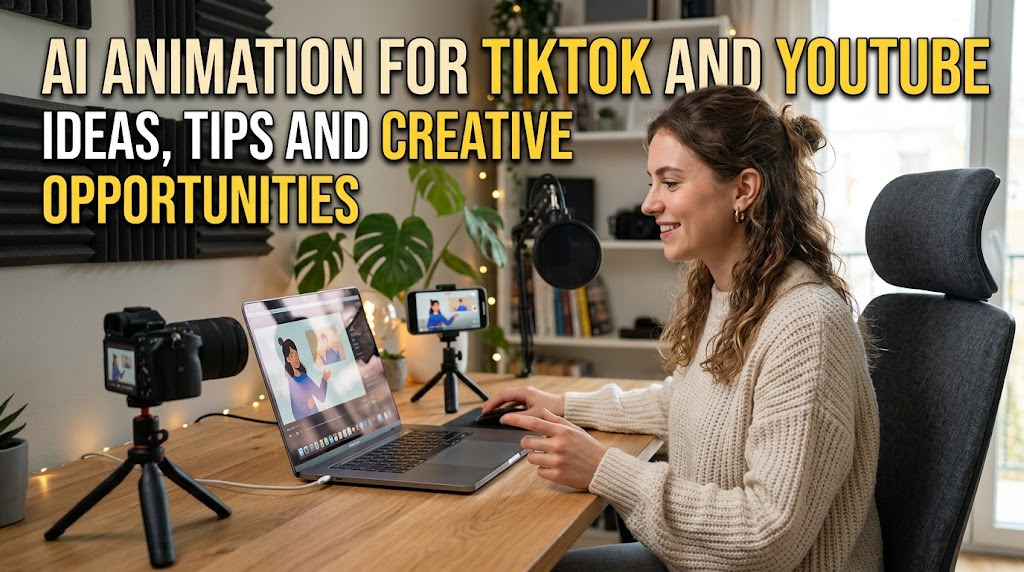
AI animation is becoming increasingly popular on TikTok and YouTube because creators can produce visually interesting content more efficiently. Traditional animation can require significant time for drawing, modeling, rendering, and editing, while AI animation tools can assist with several parts of the creative process. This makes animation more accessible to beginners, independent creators, and small production teams. AI can also help creators experiment with different visual concepts without having to build everything manually.
The popularity of short-form video has also increased the demand for fresh and engaging content. Creators can use AI video generation to produce animated characters, moving backgrounds, visual effects, and short storytelling scenes. However, AI alone does not guarantee successful content because viewers still respond to originality, entertainment, useful information, and strong storytelling. The best approach is to use AI as a creative assistant rather than relying entirely on automated generation.
CREATIVE AI ANIMATION IDEAS FOR TIKTOK CONTENT
TikTok provides many opportunities for AI animation content because short videos can communicate simple ideas quickly. Creators can produce animated stories, funny character situations, fictional scenarios, educational clips, motivational videos, or visual transformations. For example, an ordinary photograph can be transformed into a moving scene with subtle camera motion and environmental effects. These formats can make familiar topics appear more dynamic.
Another interesting idea is creating a recurring animated character. The same character can appear in different situations, such as studying, working, traveling, solving problems, or experiencing humorous moments. A consistent character can help viewers recognize a creator's content and encourage them to follow future episodes. Creators should focus on a strong opening because the first few seconds are important when competing for viewers' attention.
AI ANIMATION IDEAS FOR YOUTUBE VIDEOS
YouTube gives creators more space to develop long-form AI animation projects. Possible formats include animated explainers, fictional stories, educational videos, documentaries with animated elements, product presentations, and short films. AI can assist with developing visual scenes while traditional editing can be used to organize the clips into a complete narrative.
Creators can also build a YouTube animation series around original characters. Each episode can introduce a new problem, location, or challenge while maintaining familiar characters and visual elements. This can help create continuity between videos and give viewers a reason to return. For longer videos, creators should pay close attention to pacing, narration, transitions, sound design, and story structure.
HOW TO CREATE ENGAGING AI ANIMATION VIDEOS
The first step is to develop a clear content concept before generating any animation. Decide what the video is about, who the intended audience is, and what the viewer should learn, feel, or remember. A simple idea with a strong message can be more effective than a complicated video filled with attractive visuals but no clear purpose.
After establishing the concept, divide the story into individual scenes. Describe the character, action, environment, camera movement, lighting, and visual style for each scene. Then generate the clips separately and combine them during editing. This workflow gives creators more control than attempting to generate an entire story in one long sequence.
HOW TO WRITE EFFECTIVE AI ANIMATION PROMPTS
Good AI animation prompts should provide clear instructions without becoming unnecessarily complicated. A useful prompt can begin with the main character and then describe the action, environment, camera movement, lighting, and overall style. For example, instead of writing "a character walking," a creator can specify a young explorer walking slowly through a futuristic city at night while the camera follows from behind.
Creators should also experiment with prompts instead of expecting the first generation to be perfect. Small changes in wording can affect the character's movement, camera behavior, and overall appearance. Saving successful prompts can make future production faster and help maintain a consistent visual style across multiple videos.
TIPS FOR MAKING AI ANIMATION CONTENT MORE CREATIVE
One way to make AI-generated animation more engaging is to combine it with other forms of media. Creators can add voice-over, background music, sound effects, subtitles, illustrations, photographs, and conventional video footage. These elements can make the final content feel more complete and reduce the impression that it consists entirely of automatically generated clips.
Creators should also experiment with different visual concepts. They can explore cinematic animation, cartoon characters, futuristic environments, fantasy worlds, realistic scenes, or minimalist motion graphics. At the same time, a consistent visual identity should be maintained when building a personal brand or YouTube channel.
HOW TO USE AI ANIMATION FOR STORYTELLING
AI storytelling becomes more effective when every visual supports a clear narrative. Even a short TikTok video can have a basic structure consisting of an introduction, a problem, a development, and a conclusion. This gives viewers a reason to continue watching instead of simply presenting disconnected AI-generated scenes.
Characters should also have recognizable motivations and personalities. A curious character may explore unfamiliar places, while a determined character may try to solve a difficult problem. Giving characters a clear purpose can make animated storytelling more engaging and easier for viewers to follow.
CREATIVE OPPORTUNITIES FOR CONTENT CREATORS
AI animation provides new opportunities for creators who previously found traditional animation too expensive or technically demanding. A solo creator can experiment with animated characters, fictional environments, cinematic scenes, and visual effects using AI-assisted workflows. This can lower some production barriers and allow more people to explore animation.
Businesses and freelancers can also use AI animation for marketing content, product demonstrations, educational videos, advertisements, and social media campaigns. However, commercial creators should carefully review the licensing and usage conditions of the AI tools and assets they use. Understanding these rules is important when content will be published or monetized.
HOW TO MAKE AI ANIMATION STAND OUT
The increasing popularity of AI means that simply using an AI tool is no longer enough to make content distinctive. Creators need a unique concept, recognizable style, strong opening, and valuable or entertaining message. Copying popular AI videos without adding an original perspective can make a channel difficult to distinguish from competitors.
A creator can develop originality by creating recurring characters, unique storylines, unusual visual themes, or a recognizable editing style. Personal experiences and creative perspectives can also be incorporated into AI-assisted content. The technology may generate the visuals, but the creative identity should come from the creator.
COMMON MISTAKES TO AVOID
One common mistake is creating AI animation without a clear purpose. Impressive visuals may attract attention temporarily, but viewers are unlikely to remain interested if there is no useful, entertaining, or meaningful message. Every scene should contribute to the overall purpose of the video.
Another problem is publishing raw AI output without reviewing it. AI-generated clips can contain inconsistent characters, unnatural movements, distorted objects, flickering details, or unexpected changes. Creators should carefully review each clip and use video editing to remove problems. Adding narration, sound design, subtitles, and appropriate transitions can also improve the final presentation.
Creators should also avoid misleading viewers when AI-generated content represents realistic people, events, or situations. Transparency and responsible use become increasingly important as AI-generated visuals become more realistic. Checking copyright, licensing, and platform requirements before publishing is also a good practice.
CONCLUSION
AI animation for TikTok and YouTube offers creators new ways to produce engaging visual content with greater flexibility. From short animated stories and recurring characters to educational videos, advertisements, and cinematic projects, AI can support many different content formats. It can be particularly useful for creators who want to experiment without investing in a large production team.
However, successful content still depends on original ideas, storytelling, editing, audience understanding, and creative direction. AI should be used as a tool that supports the creator rather than replacing human creativity. By combining AI animation tools, effective prompts, strong storytelling, quality editing, and responsible content creation, creators can build more distinctive and engaging TikTok and YouTube videos.
About the Author
Gusti Ayu Tita P
Author — STEKOM University
An active author focused on academic issues, educational technology, and human resource development in the campus environment.















