
Behind Academic Discussions Is There an Unspoken Competition of Status and Symbols
Gusti Ayu Tita P
24 Agustus 2026
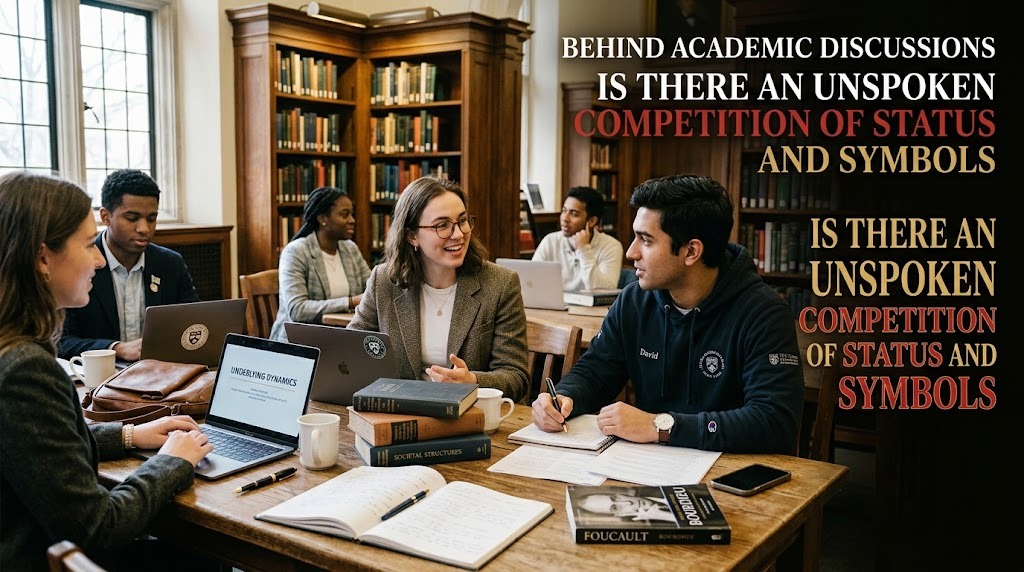
Academic discussions are often presented as spaces for exchanging ideas, asking questions, and developing knowledge. However, social interactions in educational environments can involve more than the academic topic itself. Students may become aware of who speaks confidently, who receives recognition, or who appears to have greater knowledge and influence. This can create an unspoken competition of status and symbols even when nobody openly describes it as a competition. Understanding this dynamic can help students participate in academic discussions more confidently and fairly.
GRADES AND ACHIEVEMENTS AS SOCIAL SYMBOLS
Grades and awards are common indicators of academic performance. Students who frequently receive high grades or win competitions may gain recognition from classmates and teachers. Over time, these achievements can become symbols of competence and success. Academic achievements can influence social perceptions even when they are not intended to do so.
Recognition can motivate students to improve, but it can also encourage unhealthy comparison. Some students may feel that they need to collect achievements simply to maintain their social position. This can shift attention from learning toward external validation. Achievement becomes problematic when recognition matters more than genuine learning.
APPEARANCE AND PERSONAL BELONGINGS CAN ALSO CREATE SYMBOLS
Academic status is not always communicated through grades or knowledge. Clothing, laptops, smartphones, accessories, and other personal belongings can influence first impressions. Certain products or styles may be associated with wealth, professionalism, or social identity. Material objects can become symbols through the meanings people attach to them.
These perceptions are not always accurate. A person's possessions do not reliably indicate their intelligence, financial situation, or academic ability. Students should avoid judging classmates based solely on appearance or belongings. Social status is more complex than what can be seen on the surface.
SOCIAL MEDIA CAN STRENGTHEN STATUS COMPARISONS
Social media provides another space where students can display achievements and lifestyles. Certificates, competition results, events, internships, and academic projects can easily become part of an online identity. Seeing these posts repeatedly may cause students to compare their progress with others. Digital visibility can make academic status feel more prominent than it actually is.
The problem is that social media usually shows selected moments rather than someone's complete experience. A student may appear highly successful online while dealing with challenges that are not visible. Therefore, students should avoid using online content as a complete measure of their own progress. Comparing private struggles with someone else's public achievements can create unrealistic expectations.
WHY STUDENTS MAY PARTICIPATE IN STATUS COMPETITION
There are several reasons why students may become involved in status competition. Recognition from teachers, classmates, family, or online audiences can provide a strong sense of achievement. Some students may also believe that visible success will improve their future opportunities. The desire for recognition can influence academic behavior.
Social comparison is another important factor. Students naturally observe the performance of people around them and use it to evaluate their own progress. Comparison can be useful when it provides inspiration, but it becomes harmful when self-worth depends entirely on outperforming others. Healthy comparison should encourage learning rather than create constant insecurity.
THE POSITIVE SIDE OF ACADEMIC COMPETITION
Not every form of competition is negative. Academic competition can encourage students to study more seriously, develop new skills, and challenge their existing abilities. Seeing classmates achieve something can also motivate others to set higher goals. Healthy competition can create energy for personal improvement.
The key is maintaining a constructive attitude. Students should appreciate other people's achievements without seeing them as threats. They can ask what they can learn from successful classmates rather than simply trying to defeat them. Competition becomes more productive when it encourages growth instead of hostility.
WHEN STATUS COMPETITION BECOMES UNHEALTHY
Unhealthy status competition can make students overly concerned about how others perceive them. They may feel pressure to appear intelligent, successful, wealthy, or constantly productive. This pressure can reduce authentic participation because students become afraid of making mistakes. Fear of losing status can interfere with genuine learning.
Students may also begin to dismiss classmates who have different abilities or backgrounds. This can create social divisions within academic communities. A healthy educational environment should instead encourage respect and equal opportunities to contribute. Academic discussions should be spaces for learning rather than demonstrations of social superiority.
HOW TO BUILD HEALTHIER ACADEMIC DISCUSSIONS
Students can help create healthier discussions by focusing on ideas instead of personal status. Asking thoughtful questions, listening carefully, and responding respectfully can make conversations more productive. There is no need to demonstrate superior knowledge in every discussion. Good academic participation is about contributing value, not dominating the conversation.
Teachers also have an important role in creating balanced discussion environments. They can encourage different students to participate and recognize multiple forms of contribution. A thoughtful question can be just as valuable as a sophisticated answer. Inclusive discussions allow more students to develop confidence and critical thinking.
HOW STUDENTS CAN AVOID UNHEALTHY COMPARISON
Students can begin by identifying their own learning goals. Instead of asking whether they are better than classmates, they can ask whether they are improving compared with their previous performance. This shift can reduce unnecessary pressure and make progress easier to recognize. Personal development provides a healthier standard for measuring success.
Students should also remember that everyone develops at a different pace. One person may excel academically while another may have stronger communication, creativity, leadership, or practical skills. These differences do not necessarily establish a hierarchy of human value. Different strengths can coexist without creating a permanent ranking of people.
CONCLUSION
Behind academic discussions, there can indeed be an unspoken competition of status and symbols. Grades, awards, language, confidence, appearance, possessions, and social media visibility can all influence how students perceive one another. However, these symbols do not always represent a person's true ability or value.
Academic environments become healthier when students focus on learning, mutual respect, personal development, and meaningful contribution. Competition can remain useful when it encourages improvement without turning into social comparison. Ultimately, the strongest academic community is not one where everyone tries to appear superior, but one where students feel confident enough to share ideas, ask questions, learn from mistakes, and grow together.
About the Author
Gusti Ayu Tita P
Author — STEKOM University
An active author focused on academic issues, educational technology, and human resource development in the campus environment.















