
Benefits of LRT for Urban Mobility
Gusti Ayu Tita P
11 Agustus 2026
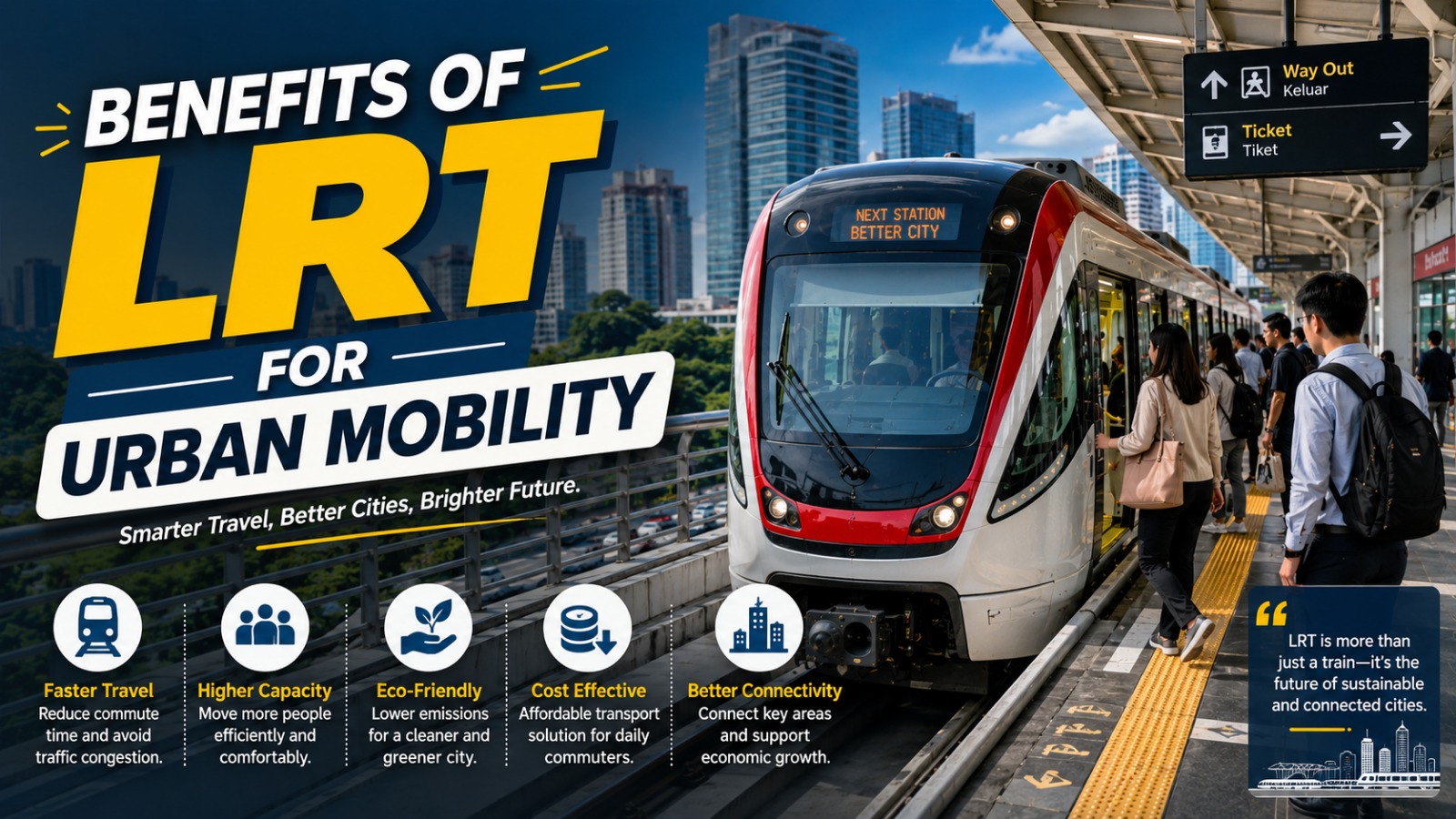
Light Rail Transit or LRT is an important part of modern urban transportation systems. It provides a practical alternative for people who travel regularly for work, education, business, and other activities. Unlike road based public transport, LRT operates mainly on dedicated rail infrastructure, which can make travel times more predictable. Its ability to carry many passengers also makes it useful for busy urban areas. With proper planning and integration, LRT can support faster, more organized, and more sustainable urban mobility.
REDUCES TRAVEL TIME
One of the main benefits of LRT for urban mobility is its ability to provide more predictable travel times. Because LRT trains operate on dedicated tracks, they are less directly affected by road traffic congestion than buses and private vehicles. This can make daily trips easier to plan, especially during busy hours. Passengers can also use scheduled services to organize their departure and arrival times. However, actual travel time can still depend on station stops, service conditions, and passenger volume.
More predictable journeys are particularly useful for workers and students who need to arrive at their destinations on time. When LRT is supported by reliable schedules and good station access, it can become an efficient option for regular urban travel.
CARRIES MANY PASSENGERS
LRT is designed as a mass transportation system that can move a large number of passengers in each train. This makes it suitable for cities where roads and public transportation services experience high demand. Carrying many people in a single train can reduce the number of individual vehicle trips needed on the road. As a result, LRT can contribute to more efficient use of urban transportation infrastructure.
The exact passenger capacity depends on the train design, number of carriages, station facilities, and operating policies. Service frequency can also be adjusted to respond to passenger demand. With effective operations, LRT can provide an important transport option for densely populated urban areas.
REDUCES DEPENDENCE ON PRIVATE VEHICLES
LRT gives residents an alternative to using cars and motorcycles for daily trips. A reliable public transportation option can encourage people to leave their private vehicles at home, particularly when stations are easy to reach. Fewer private vehicle trips can help reduce pressure on busy roads. This benefit becomes stronger when LRT is connected with buses, walking routes, cycling facilities, and other forms of public transportation.
However, LRT alone cannot eliminate traffic congestion. Its effectiveness depends on factors such as service coverage, affordability, frequency, station accessibility, and connections with other transport modes. A well integrated transportation network can make public transport more attractive for everyday travel.
SUPPORTS MORE SUSTAINABLE TRANSPORTATION
LRT systems commonly use electric trains, which produce no direct tailpipe emissions during operation. This can provide an environmental advantage over conventional vehicles that burn gasoline or diesel. When LRT replaces a significant number of private vehicle trips, its potential environmental benefits can become greater. Mass transportation also allows many passengers to share the energy and infrastructure required for one journey.
The overall environmental impact still depends on how electricity is generated and how the system is built and operated. For this reason, LRT should be considered as part of a wider sustainable transportation strategy. Clean energy, efficient operations, and increased public transport use can work together to improve urban environmental performance.
PROVIDES MORE PREDICTABLE ROUTES
LRT trains operate along fixed rail routes with clearly defined stations. This makes the transportation network relatively easy to understand once passengers become familiar with the system. Clear routes can help users plan where to board, where to transfer, and where to leave the train. Station information and route maps can further support passengers who are using the system for the first time.
Fixed routes also provide consistency for daily commuters. Passengers can develop regular travel patterns based on their usual stations and schedules. However, users may still need another transport mode for destinations located far from LRT stations.
IMPROVES URBAN CONNECTIVITY
A well planned LRT network can connect residential areas with business districts, educational institutions, shopping areas, and other important destinations. Stations can serve as important points within a wider urban transportation network. When LRT is integrated with buses and other public transport services, passengers can reach more destinations without relying entirely on private vehicles. This creates a more connected and flexible travel system.
Good connectivity also depends on station location and convenient transfers. Walking access, feeder services, clear passenger information, and coordinated schedules can make transfers easier. Therefore, the value of LRT is not only determined by the railway itself but also by how effectively it connects with the rest of the city.
IMPROVES DAILY TRAVEL COMFORT
LRT can provide a comfortable alternative for people who want to avoid the stress of driving in heavy traffic. Passengers can spend their travel time reading, listening to audio, checking schedules, or simply resting. Modern stations and trains may also provide facilities designed to improve passenger convenience. The experience can be particularly useful for people who travel regularly across busy urban areas.
Comfort can vary depending on passenger density, service quality, station facilities, and operating conditions. During peak hours, trains may become crowded, so proper passenger management remains important. Even so, a reliable and well maintained LRT system can provide a practical option for daily urban mobility.
CONCLUSION
The benefits of LRT for urban mobility include more predictable travel times, high passenger capacity, better connectivity, and reduced dependence on private vehicles. LRT can also support more sustainable transportation by using electric trains and encouraging shared mobility. Its impact becomes stronger when stations are accessible and the system is properly connected with buses, walking routes, cycling facilities, and other transport modes. Although LRT is not a complete solution to every urban transportation problem, it can play an important role in building a more efficient and organized mobility system. With reliable services and effective planning, LRT can become a valuable part of modern urban transportation.
About the Author
Gusti Ayu Tita P
Author — STEKOM University
An active author focused on academic issues, educational technology, and human resource development in the campus environment.















