Bhinneka Tunggal Ika as the Key to Preserving Indonesian Diversity
Gusti Ayu Tita P
4 Agustus 2026
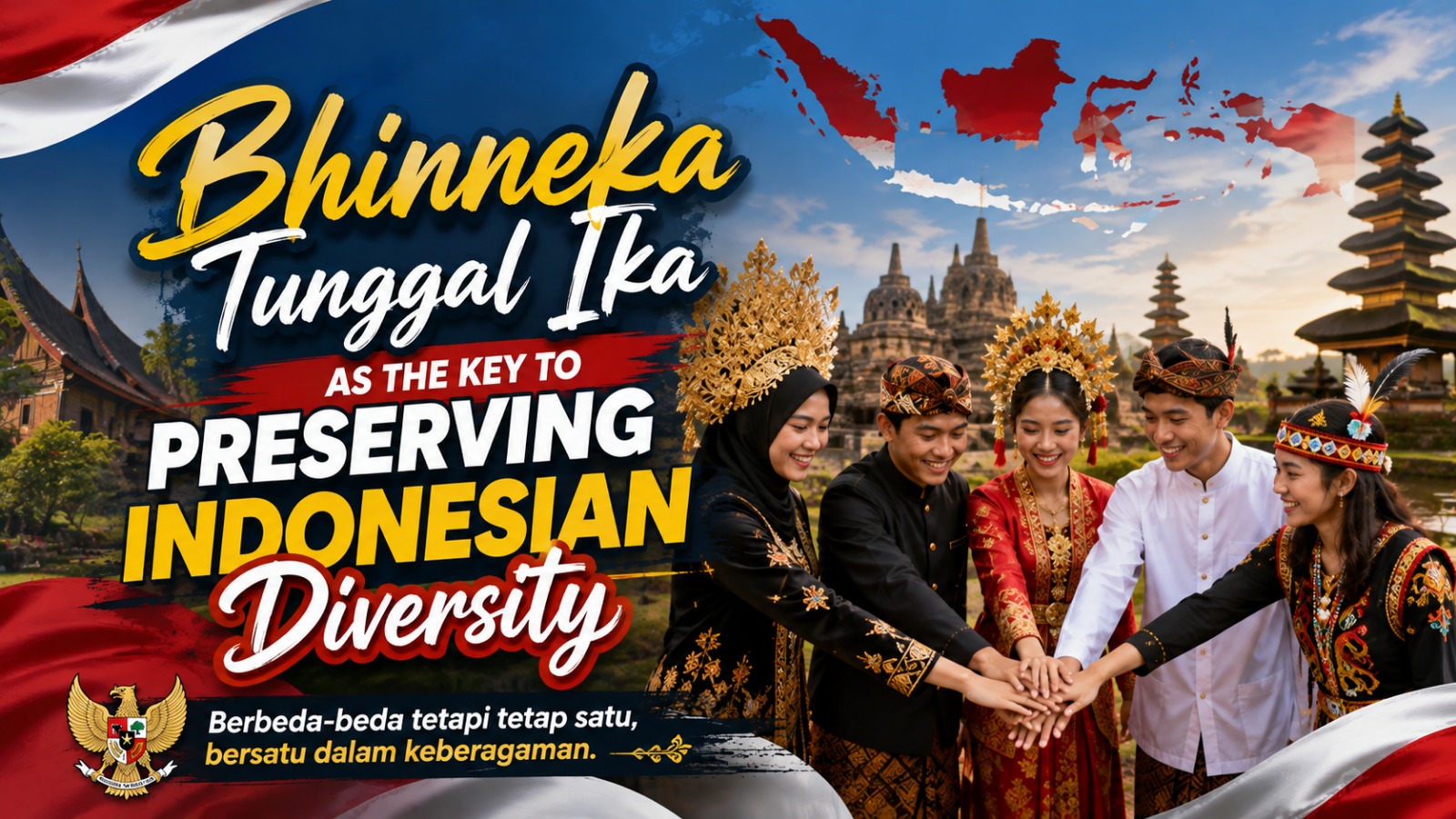
Indonesia is a country with extraordinary diversity. Its people come from many ethnic groups, religions, regional cultures, languages, and traditions. This diversity is an important national asset, but it also requires mutual respect and a strong commitment to unity. One principle that plays an important role in maintaining this balance is Bhinneka Tunggal Ika. The national motto reminds Indonesians that differences can exist without preventing people from living together as one nation.
Bhinneka Tunggal Ika is commonly understood as Unity in Diversity. It encourages people to appreciate differences while maintaining a shared sense of belonging as Indonesians. The principle does not ask citizens to abandon their cultural or religious identities. Instead, it promotes tolerance, cooperation, mutual respect, and peaceful coexistence. For this reason, Bhinneka Tunggal Ika remains an important foundation for preserving Indonesia's diversity.
THE MEANING AND ORIGIN OF BHINNEKA TUNGGAL IKA
The phrase Bhinneka Tunggal Ika comes from Old Javanese and is associated with the Kakawin Sutasoma, a literary work attributed to Mpu Tantular during the Majapahit era. Historically, the phrase expressed an idea of harmony between different religious traditions. Its message showed that differences in belief did not necessarily have to result in conflict. Over time, this idea became closely connected with the broader concept of unity within Indonesian diversity. The historical background gives Bhinneka Tunggal Ika a strong connection to Indonesia's cultural heritage.
After independence, Bhinneka Tunggal Ika became the national motto of Indonesia and was placed on the scroll held by Garuda Pancasila. Its inclusion in the national emblem reflects the importance of unity in Indonesian national life. The motto emphasizes that Indonesia's strength comes partly from its ability to bring diverse communities together. People can maintain their unique identities while sharing a common national identity. Therefore, Bhinneka Tunggal Ika provides an important foundation for preserving diversity without creating division.
INDONESIAN DIVERSITY AS A NATIONAL STRENGTH
Indonesia's diversity can be seen in its ethnic groups, regional languages, traditional arts, customs, foods, clothing, and religious communities. Each group contributes unique traditions and knowledge to the country's cultural heritage. When these differences are respected, they can enrich Indonesian society and create opportunities for cultural exchange. Diversity also allows people to learn about different ways of life and perspectives. This makes cultural diversity an important part of Indonesia's national strength.
However, diversity can only become a strength when it is managed through mutual respect. Misunderstandings, prejudice, and discrimination can create tension between communities. Bhinneka Tunggal Ika encourages people to see differences as something that should be understood rather than feared. By developing tolerance and open communication, communities can prevent differences from becoming sources of conflict. In this way, diversity can continue to strengthen rather than weaken Indonesian society.
THE ROLE OF TOLERANCE IN PRESERVING DIVERSITY
Tolerance is one of the most important values for applying Bhinneka Tunggal Ika in daily life. It means respecting the rights, beliefs, traditions, and identities of people who may be different from ourselves. Tolerance does not require people to agree on everything. Instead, it allows individuals and communities to maintain their identities while respecting others. This approach is essential in a diverse country such as Indonesia.
Tolerance can be practiced through simple actions. People can respect religious practices, appreciate cultural traditions, listen to different opinions, and avoid judging others based on their background. Communities can also work together on social activities despite differences in identity. These actions build trust and strengthen relationships between citizens. When practiced consistently, tolerance can help preserve diversity while supporting national unity.
THE IMPORTANCE OF CULTURAL PRESERVATION
Preserving culture is an important part of maintaining Indonesia's diversity. Traditional languages, dances, music, crafts, ceremonies, stories, and local knowledge represent the identities of different communities. If these traditions are not passed on to younger generations, some aspects of cultural heritage may gradually disappear. Bhinneka Tunggal Ika encourages Indonesians to recognize that every cultural tradition has value. Protecting cultural heritage therefore contributes to protecting national diversity.
Young people have a particularly important role in cultural preservation. They can learn local traditions from families and communities while adapting cultural knowledge to modern forms of communication. Digital platforms can also be used to introduce traditional arts, regional languages, local food, and cultural events to wider audiences. However, cultural content should be presented accurately and respectfully. By combining tradition with responsible innovation, young people can help ensure that Indonesian culture remains relevant for future generations.
BHINNEKA TUNGGAL IKA IN EDUCATION
Education is an important way to introduce the values of Bhinneka Tunggal Ika to younger generations. Schools and universities can teach students about Indonesia's history, cultural diversity, and national values. Learning about different communities can reduce stereotypes and help students develop greater respect for others. Educational activities can also bring students from different backgrounds together through collaboration. These experiences can build tolerance from an early stage.
Teachers can strengthen these values through group projects, classroom discussions, cultural programs, and community activities. Students can learn to communicate respectfully when they have different opinions. Working with classmates from diverse backgrounds also develops cooperation and empathy. These skills are useful for both social life and future careers. Education can therefore become a powerful foundation for preserving Indonesian diversity.
BHINNEKA TUNGGAL IKA IN THE DIGITAL ERA
Digital technology creates new opportunities to preserve and promote Indonesia's cultural diversity. Social media allows local communities to introduce traditions to audiences across Indonesia and even internationally. Young people can create videos, articles, photographs, and other educational content about regional culture. Digital platforms can also connect people from different backgrounds and encourage cultural exchange. When used responsibly, technology can strengthen appreciation for Indonesian diversity.
However, digital spaces can also create challenges for social harmony. Misinformation, hate speech, discrimination, and provocative content can spread rapidly online. Such content can create prejudice and deepen divisions between communities. Applying Bhinneka Tunggal Ika in the digital era therefore requires strong digital literacy. People should verify information, avoid discriminatory content, and communicate respectfully when discussing cultural or social differences.
THE ROLE OF YOUNG PEOPLE IN PROTECTING DIVERSITY
Young people are important actors in preserving Indonesian diversity because they will shape the country's future. They can demonstrate Bhinneka Tunggal Ika by respecting classmates, friends, coworkers, and community members from different backgrounds. Participation in cultural activities, student organizations, volunteer programs, and community projects can strengthen their understanding of diversity. These experiences teach young people how to cooperate despite differences. They also help develop social skills that are useful in a diverse society.
Young people can also use digital technology to promote positive messages about diversity. They can introduce regional cultures, support local creative communities, and share educational content about Indonesian heritage. At the same time, they need to avoid spreading misinformation or content that attacks particular groups. Responsible online behavior can help create a more respectful digital environment. Through these efforts, the younger generation can help ensure that Bhinneka Tunggal Ika remains relevant.
BUILDING UNITY WITHOUT ELIMINATING DIFFERENCES
Preserving diversity does not mean forcing everyone to have the same beliefs, traditions, or cultural practices. True unity allows different communities to maintain their identities while working toward shared national goals. Bhinneka Tunggal Ika supports this balance by connecting diversity with cooperation. People can remain proud of their local heritage while identifying themselves as part of one Indonesian nation. This creates a form of unity that respects differences instead of eliminating them.
Cooperation is especially important when society faces common challenges. Communities can work together on education, environmental protection, social welfare, disaster response, and other shared interests. Such cooperation demonstrates that differences do not prevent people from contributing to the same goals. When citizens focus on common interests, social relationships become stronger. This is one of the most practical ways to preserve diversity while maintaining national unity.
CHALLENGES TO PRESERVING INDONESIAN DIVERSITY
Indonesia's diversity faces several challenges, including intolerance, discrimination, cultural erosion, misinformation, and social polarization. Globalization and rapid technological change can also influence how younger generations interact with traditional culture. These developments are not necessarily negative, but they require careful management. Communities need to adapt while ensuring that important cultural values and traditions are not forgotten. Bhinneka Tunggal Ika provides a useful principle for responding to these changes.
Addressing these challenges requires cooperation between individuals, families, schools, communities, government institutions, and other organizations. Everyone has a role in creating an environment where differences are respected. Cultural education and digital literacy can help people respond more effectively to modern challenges. Open dialogue can also reduce misunderstandings between communities. With consistent efforts, Indonesia can preserve its diversity while continuing to adapt to a changing world.
CONCLUSION
Bhinneka Tunggal Ika is a key principle for preserving Indonesian diversity because it connects differences with unity, tolerance, and cooperation. Indonesia's cultural richness should not be viewed as a source of division but as an important national asset. By respecting different ethnic groups, religions, languages, traditions, and cultural identities, Indonesians can protect the diversity that makes their country unique. The principle also provides guidance for responding to challenges in education, society, and the digital environment.
Preserving Indonesian diversity is a shared responsibility. Young people, families, educational institutions, communities, and society as a whole can contribute through tolerance, cultural preservation, responsible digital behavior, and cooperation. Unity should not require Indonesians to become identical. Instead, strong unity allows differences to remain while everyone works toward shared goals. When Bhinneka Tunggal Ika is practiced consistently, Indonesia can continue to protect its diversity and build a peaceful, inclusive, and united society.
About the Author
Gusti Ayu Tita P
Author — STEKOM University
An active author focused on academic issues, educational technology, and human resource development in the campus environment.