Can a Land Ownership Certificate Be Used as Loan Collateral
Gusti Ayu Tita P
28 Agustus 2026
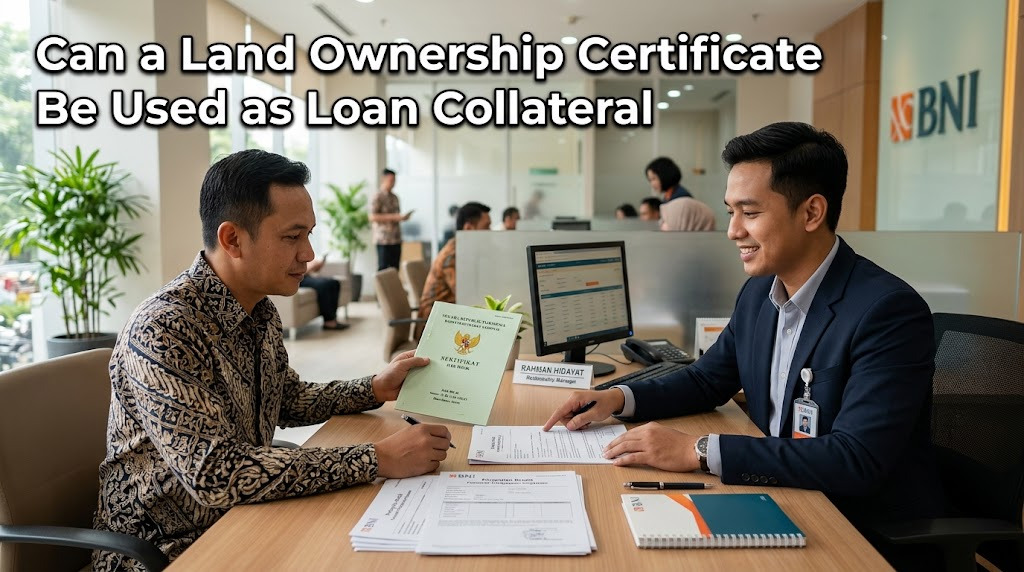
A Land Ownership Certificate can be an important asset for people who need financing. In Indonesia, land with Sertifikat Hak Milik (SHM) may, under certain circumstances, be used as collateral for a loan or other financing facility. However, owning an SHM does not automatically guarantee that a bank or financial institution will approve the application.
Before using land as loan collateral, the owner should understand the legal status of the property, the valuation process, required documents, and the risks involved. The lender will generally assess both the property and the applicant's ability to repay the financing.
SHM CAN BE USED AS LOAN COLLATERAL
A Sertifikat Hak Milik can potentially serve as collateral when it satisfies the requirements established by the lender and applicable regulations. Financial institutions may accept eligible land as security because it represents a valuable asset with a legally registered right.
However, the certificate itself is not the same as the loan. The lender still needs to evaluate the applicant's creditworthiness and the property's suitability as collateral. Approval depends on the lender's assessment, internal policies, and the specific circumstances of the property.
REQUIREMENTS FOR USING SHM AS COLLATERAL
Before accepting an SHM as collateral, a lender will generally examine the certificate and supporting documents. Important information can include the registered owner's identity, land area, location, and legal status. The lender may also require the original certificate and other property-related documents.
The owner should make sure that the information in the certificate matches the applicant's identity and the actual property. If the property belongs to another person, additional legal arrangements and approvals may be required. The exact documentation depends on the lender and the type of financing requested.
PROPERTY VALUATION PROCESS
The lender generally needs to determine the value of the land or property before deciding how much financing can be provided. The valuation may consider location, land area, accessibility, market conditions, building condition, and other relevant factors.
The loan amount is not necessarily equal to the property's market value. Lenders normally apply their own risk assessment and financing limits. Therefore, property owners should not assume that a high-value SHM will automatically result in an equally high loan amount.
LEGAL VERIFICATION OF THE CERTIFICATE
Before accepting the property as collateral, the lender will generally conduct legal and administrative checks. These checks help determine whether the certificate and the underlying land rights are suitable for use as security.
Information such as ownership, land status, existing encumbrances, and other relevant records can affect the assessment. If the property already has a legal issue or another registered interest, the financing process may require additional clarification or may not proceed.
THE ROLE OF HAK TANGGUNGAN
When land rights are used as security for certain debts, the legal mechanism commonly involved is Hak Tanggungan. It provides a security interest over qualifying rights to land in accordance with Indonesian law.
The establishment of Hak Tanggungan involves an official legal and administrative process. The owner should understand the documents and obligations before signing them, including the consequences of failing to meet the repayment terms.
RISKS IF THE LOAN IS NOT REPAID
Using an SHM as collateral creates an important financial obligation. If the borrower fails to repay the loan according to the agreement, the lender can take steps available under the financing agreement and applicable law to enforce its security.
This means the owner could potentially lose control of the property if the collateral is legally enforced following default. Therefore, borrowers should calculate their repayment capacity carefully and avoid taking a loan that is difficult to manage.
DOCUMENTS AND COSTS TO CONSIDER
The application may require several documents, such as identity documents, the original SHM, income information, property documents, and other supporting materials. The exact requirements depend on the lender and financing product.
There may also be administrative, appraisal, legal, insurance, or other applicable costs. Ask the lender for a complete breakdown before signing the financing agreement. Understanding the total cost is important because the amount borrowed is not the only financial obligation involved.
TIPS BEFORE USING SHM AS COLLATERAL
Before pledging an SHM as loan collateral, compare financing options from legitimate financial institutions. Pay attention to the interest or financing rate, repayment period, fees, penalties, and other contractual terms.
Most importantly, calculate whether the monthly payment fits comfortably within your financial capacity. Do not risk an important family property without carefully considering the consequences of default. Read the entire financing agreement and ask for clarification about any clause you do not understand.
CONCLUSION
A Land Ownership Certificate can potentially be used as loan collateral if the property and borrower meet the requirements of the lender and applicable regulations. The process generally involves certificate verification, property valuation, credit assessment, and the appropriate establishment of security rights such as Hak Tanggungan.
Before using an SHM as collateral, carefully consider the loan amount, repayment capacity, fees, legal status of the property, and consequences of default. Choosing a legitimate lender and understanding the financing agreement can help property owners use their land as collateral more responsibly.
About the Author
Gusti Ayu Tita P
Author — STEKOM University
An active author focused on academic issues, educational technology, and human resource development in the campus environment.