Can AI Animation Be Used to Create Short Films?
Gusti Ayu Tita P
31 Agustus 2026
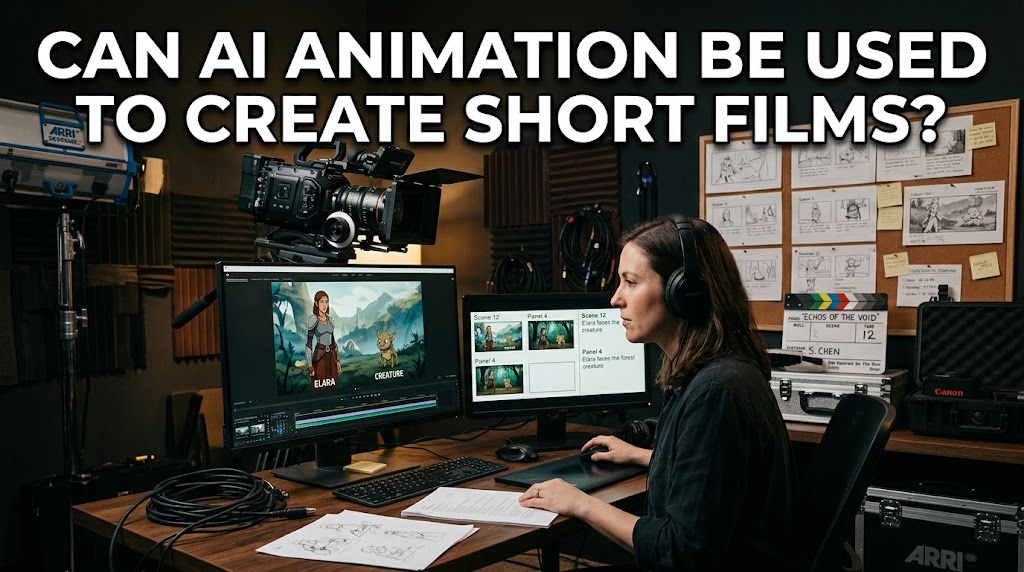
AI animation can be used to create short films, especially when creators want to develop visual stories with limited resources. AI tools can assist with character design, story visualization, backgrounds, motion, voice generation, and other parts of the production process. This makes animation more accessible to beginners, independent filmmakers, and content creators. Instead of creating every visual element manually, creators can use AI to speed up repetitive or time-consuming tasks. However, AI works best as a creative production assistant, rather than a complete replacement for human direction and storytelling.
The quality of an AI-generated short film depends heavily on the concept, prompts, visual consistency, editing, and creative decisions made by the filmmaker. A strong story still needs clear characters, meaningful conflict, good pacing, and an effective ending. AI can help produce visual material, but humans remain important for deciding what the audience should feel and understand. Therefore, AI animation for short films is most useful when technology and human creativity work together.
HOW AI CAN HELP DEVELOP A SHORT FILM IDEA
Creating a short film usually begins with an idea that develops into a script, storyboard, characters, and visual direction. AI can help creators explore these stages more quickly by generating story concepts, character descriptions, scene ideas, and visual references. For example, a filmmaker can start with a simple concept such as a student discovering a mysterious object and ask AI to help develop possible scenes. The creator can then select the most suitable ideas and adjust them according to the intended audience.
AI can also help transform written descriptions into visual concepts that make planning easier. A creator might describe a futuristic city, a fantasy character, or a dramatic night scene and use AI-generated visuals as references. These materials can help establish the film's atmosphere before full production begins. Even so, creators should review AI-generated ideas carefully because they may contain inconsistencies or details that do not fit the original story.
CREATING CHARACTERS AND VISUAL WORLDS WITH AI
One of the most useful applications of AI animation is developing characters and environments. AI tools can generate character concepts based on descriptions such as age, clothing, personality, hairstyle, and artistic style. Creators can also develop locations such as schools, futuristic cities, forests, offices, or fictional worlds. This can significantly reduce the amount of time required to create initial visual references.
The main challenge is visual consistency. A character may look different from one scene to another if the creator does not maintain consistent descriptions, references, poses, and styles. For a short film, viewers need to recognize the same character throughout the story. Creators should therefore establish a clear character design guide and maintain consistent visual instructions when generating scenes.
TURNING AI-GENERATED VISUALS INTO ANIMATED SCENES
After developing characters and environments, creators can use AI-powered animation tools to add movement to images or generate short video sequences. Depending on the tool, users may be able to create motion from text descriptions, animate still images, or control elements such as camera movement. This can help produce scenes without requiring traditional frame-by-frame animation for every moment.
However, AI-generated video clips often have limitations. Unnatural movement, changing facial features, inconsistent hands, and unwanted object changes can appear in generated footage. For this reason, creators should not expect every generated clip to be ready for immediate use. Selecting the strongest outputs and combining them through editing can produce a much more polished result.
USING AI VOICES MUSIC AND SOUND EFFECTS
A short film is not only about visuals. Voice acting, music, ambient sound, and sound effects strongly influence the emotional impact of a scene. AI can assist with generating narration, synthetic voices, background music, and certain sound effects, depending on the tools and licenses being used. This can be particularly useful for independent creators who do not have access to a large production team.
Even when AI handles some audio production, creators should pay attention to voice consistency and emotional delivery. A character's voice should fit the personality and mood of the story. Creators should also check the licensing terms of AI-generated audio before publishing a commercial project. Using properly licensed materials helps reduce potential copyright and distribution problems.
THE IMPORTANCE OF HUMAN CREATIVITY IN AI ANIMATED FILMS
Although AI can automate many technical processes, it does not eliminate the need for human creativity. A compelling short film still requires a strong narrative, believable characters, visual direction, pacing, and emotional purpose. AI can generate possibilities, but the filmmaker must decide which ideas are meaningful and which should be rejected. Human judgment is especially important when a story involves complex emotions, cultural context, or sensitive subjects.
Creators should therefore treat AI as a creative tool rather than an automatic filmmaker. The strongest results usually come from a workflow where humans create the concept, guide the visual style, review generated material, and perform the final editing. This approach provides greater control over the finished film while still benefiting from the speed of AI technology.
CHALLENGES AND LIMITATIONS OF AI ANIMATION FOR SHORT FILMS
Despite its advantages, AI animation for short films has several challenges. Generated scenes can sometimes lack consistency, physical realism, or precise control over character movement. Some AI systems may also struggle with complex interactions between multiple characters or objects. These limitations can make traditional animation or manual editing necessary for important scenes.
Another consideration is copyright and content ownership. Creators should understand the terms of the AI tools they use and verify whether generated assets can be used commercially. They should also avoid reproducing protected characters, copyrighted styles, or recognizable content without appropriate rights. Responsible use of AI is essential when producing films intended for public distribution or commercial purposes.
CONCLUSION
AI animation can absolutely be used to create short films, particularly for concept development, character creation, visual generation, animation, and supporting audio production. It can make filmmaking more accessible by reducing some technical and production barriers. Nevertheless, AI-generated material still requires human direction, editing, quality control, and storytelling skills. The best results come from combining AI animation technology with human creativity rather than depending entirely on automated generation. As AI tools continue to develop, they are likely to become an increasingly useful part of the independent short film production process.
About the Author
Gusti Ayu Tita P
Author — STEKOM University
An active author focused on academic issues, educational technology, and human resource development in the campus environment.