
Challenges And Solutions In Implementing The MBG Program
Gusti Ayu Tita P
20 Agustus 2026
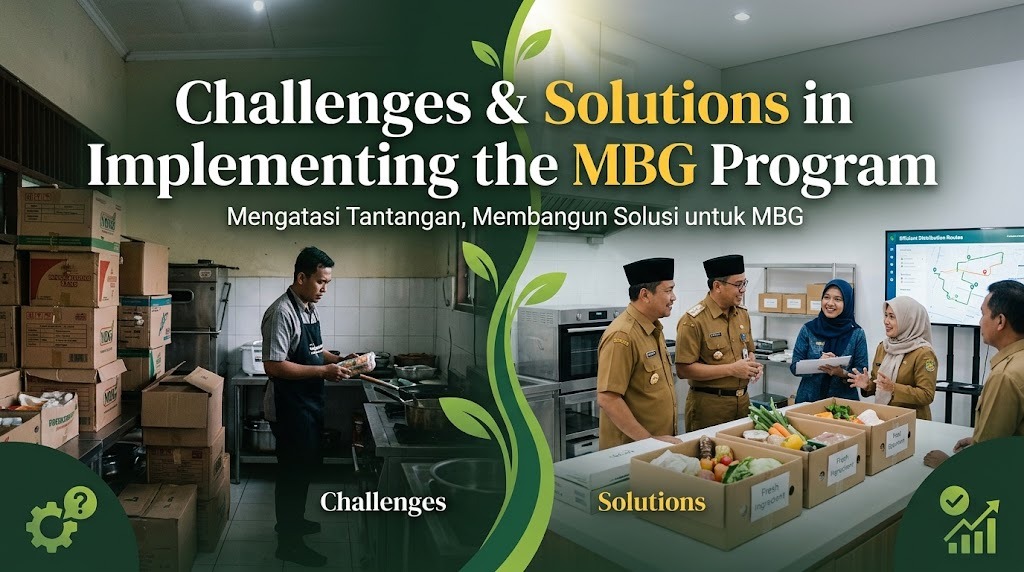
Makan Bergizi Gratis (MBG) is an important government program designed to improve access to nutritious meals for targeted beneficiaries, particularly children and students. The program has the potential to support child nutrition, healthy growth, learning readiness, and long term human resource development. However, implementing a large scale meal program across Indonesia is not simple. Differences in geography, infrastructure, food availability, human resources, and local conditions can create various challenges. Identifying these challenges and developing practical solutions is essential to ensure that MBG provides safe, nutritious, and sustainable benefits.
UNDERSTANDING THE MBG PROGRAM
Makan Bergizi Gratis aims to provide nutritious meals to eligible beneficiaries while supporting broader efforts to improve nutritional conditions. For school children, nutritious meals can provide additional sources of energy, protein, vitamins, minerals, and other essential nutrients. The program can also introduce students to balanced eating patterns and healthy food choices. When implemented effectively, MBG can become part of a broader strategy for improving children's wellbeing.
However, providing meals to a large number of beneficiaries requires more than preparing food. The program involves planning, procurement, food preparation, transportation, distribution, food safety, monitoring, and evaluation. Each stage needs clear standards and coordination. Weaknesses in one stage can affect the quality and effectiveness of the entire program.
CHALLENGE OF FOOD SAFETY AND HYGIENE
One of the most important challenges is maintaining food safety and hygiene throughout the entire supply chain. Ingredients need to be selected, stored, prepared, transported, and served safely. If proper procedures are not followed, food can become contaminated and potentially cause illness. This makes food safety a critical priority in every MBG location.
A practical solution is to establish strict food safety standards and regular monitoring. Food handlers should receive appropriate training in personal hygiene, safe preparation, storage, and sanitation. Kitchen facilities should meet suitable cleanliness and safety requirements. Schools and program managers should also have clear procedures for reporting and responding to suspected food safety incidents.
CHALLENGE OF NUTRITIONAL QUALITY
Providing food does not automatically mean that children are receiving adequate nutrition. Another challenge is ensuring that MBG meals contain balanced and appropriate nutrients. Children need different nutrients depending on their age, development, activity level, and individual circumstances. Menus that lack variety may not provide sufficient dietary diversity.
The solution is to involve qualified nutrition professionals in menu planning and evaluation. Meals should combine appropriate sources of carbohydrates, protein, vegetables, fruits, healthy fats, vitamins, and minerals. Menus can be adjusted according to local food availability while maintaining nutritional standards. Regular nutritional assessment can help ensure that the program continues to meet its objectives.
CHALLENGE OF GEOGRAPHICAL AND LOGISTICAL CONDITIONS
Indonesia has a large geographical area with many islands and regions that have different transportation and infrastructure conditions. Delivering meals to remote and difficult to access areas can therefore be challenging. Long transportation distances may affect delivery schedules, food quality, and operational costs. Some schools may also have limited facilities for receiving or handling meals.
Improving logistics requires careful local planning and coordination. Preparation facilities can be positioned strategically to reduce unnecessary transportation distances where feasible. Local suppliers can also contribute when they meet appropriate safety and quality requirements. Accurate data about school locations, student numbers, transportation routes, and delivery schedules can help improve distribution efficiency.
CHALLENGE OF FOOD AVAILABILITY AND SUPPLY
Large scale meal programs require a reliable supply of food ingredients. Sudden changes in food prices, seasonal availability, weather conditions, or supply disruptions can affect procurement. If certain ingredients become difficult to obtain, menus may need to be adjusted without reducing nutritional quality. Maintaining consistent supplies is therefore an important operational challenge.
One possible solution is to develop diverse and resilient local supply chains. MBG can work with qualified farmers, fishers, food producers, and suppliers in different regions. Using a variety of appropriate local ingredients can reduce excessive dependence on a limited number of food sources. Strong procurement planning can also help maintain supply continuity.
CHALLENGE OF HUMAN RESOURCES
The success of MBG depends on people who manage food preparation, nutrition planning, transportation, administration, and monitoring. A shortage of trained and competent personnel can reduce program effectiveness. Food handlers need practical knowledge about hygiene and safe food preparation. Managers also need skills in planning, coordination, reporting, and quality control.
The solution is to provide regular training and clear responsibilities for all personnel involved. Training should be appropriate to each role and updated when necessary. Supervisors can conduct routine checks to ensure that procedures are followed. Building a capable workforce can improve both food quality and program accountability.
CHALLENGE OF BUDGET AND RESOURCE MANAGEMENT
A program operating on a national scale requires significant resources. Managing the budget efficiently while maintaining nutritional quality and food safety can be challenging. Cost pressures should not result in lower-quality ingredients or unsafe food handling. At the same time, inefficient procurement or excessive food waste can reduce the value obtained from available resources.
Better resource management requires transparent budgeting, careful procurement, and regular auditing. Program managers can monitor spending, food quantities, waste, and operational performance. Efficient planning can help reduce unnecessary costs without compromising nutritional standards. Accountability is important to ensure that public resources are used responsibly.
CHALLENGE OF FOOD WASTE
Food waste can occur when students do not like certain menu items, portions are inappropriate, or meal distribution does not match actual needs. Excessive food waste can reduce program efficiency and increase environmental impacts. Understanding why food is left uneaten is therefore important. Schools can collect feedback from students to identify foods that are frequently wasted.
A practical solution is to use menu evaluation and student feedback. Menus can remain nutritionally balanced while considering local food preferences and culturally familiar ingredients. Portion planning can also be improved based on appropriate nutritional requirements and student characteristics. Reducing waste should never compromise the nutritional quality of meals.
CHALLENGE OF COORDINATION AND COMMUNICATION
MBG involves many stakeholders, including government institutions, schools, food providers, nutrition professionals, families, and local communities. Poor communication can lead to misunderstandings, delays, or inconsistent implementation. Each stakeholder needs to understand their responsibilities and reporting procedures. Clear coordination is especially important when problems occur.
The solution is to establish clear communication channels and defined responsibilities. Regular coordination meetings, reporting systems, and feedback mechanisms can help identify problems early. Digital tools may also support data collection and communication when suitable infrastructure is available. Strong coordination can make implementation more consistent across different regions.
CHALLENGE OF MONITORING AND EVALUATION
A large program needs reliable systems to determine whether its objectives are being achieved. Monitoring should examine food quality, safety, nutritional composition, distribution, meal acceptance, and program coverage. Without accurate information, it can be difficult to identify weaknesses and make informed improvements. Evaluation also needs to consider outcomes rather than focusing only on the number of meals delivered.
The solution is to establish regular and evidence based monitoring. Data can be collected from schools, food preparation facilities, suppliers, and other relevant stakeholders. Feedback from students, parents, teachers, and health professionals can provide additional information. Results should be used to improve menus, logistics, food safety procedures, and overall program management.
BUILDING COMMUNITY PARTICIPATION
Community involvement can strengthen the sustainability of MBG. Local communities understand their own food traditions, resources, geographical conditions, and practical needs. Their participation can help make the program more suitable for local circumstances. Communities can also support local food supply chains when suppliers meet required standards.
To strengthen participation, program managers can create appropriate opportunities for local collaboration and feedback. Families can be educated about the purpose of MBG and the importance of healthy nutrition at home. Local producers can participate in supply chains through transparent and quality controlled processes. Community involvement should complement, not replace, professional food safety and nutrition standards.
CREATING A SUSTAINABLE MBG PROGRAM
Long term sustainability requires MBG to balance nutrition, safety, efficiency, accessibility, and accountability. The program should be able to adapt to changing food prices, local conditions, nutritional needs, and operational challenges. Short term solutions are not enough if they cannot be maintained over time. Continuous improvement should therefore become part of program management.
A sustainable approach requires cooperation among government, schools, families, health professionals, suppliers, and communities. Reliable data can support evidence based decisions and help policymakers identify successful strategies. Regular evaluation can also ensure that resources are directed toward areas with the greatest need. With strong planning and accountability, MBG can become more resilient and effective.
CONCLUSION
The MBG program has significant potential to improve children's access to nutritious food, but its implementation involves complex challenges. Food safety, nutritional quality, logistics, supply chains, human resources, budgeting, food waste, coordination, and monitoring all require careful attention. Practical solutions include strong food safety standards, qualified nutrition planning, efficient logistics, local supply chains, staff training, transparent resource management, and continuous evaluation. Cooperation among government institutions, schools, families, communities, and professional stakeholders is essential for achieving sustainable results. By addressing its challenges systematically, MBG can provide safer, more nutritious, and more effective support for Indonesia's younger generation.
About the Author
Gusti Ayu Tita P
Author — STEKOM University
An active author focused on academic issues, educational technology, and human resource development in the campus environment.















