
Challenges of Sustainable Mining in the Modern Era
Gusti Ayu Tita P
20 Agustus 2026
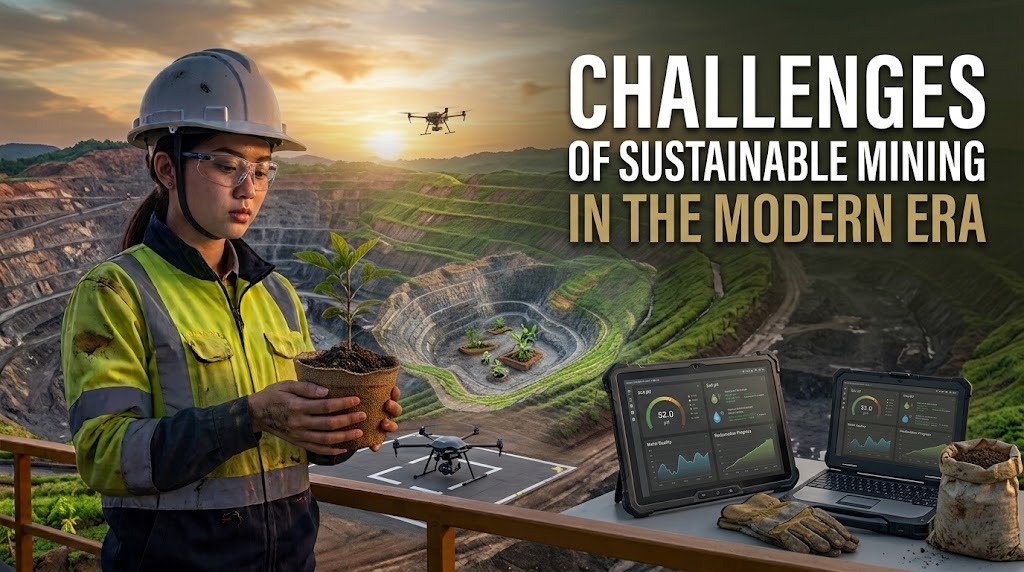
The mining industry remains essential for supplying minerals used in construction, manufacturing, energy systems, transportation, and modern technology. However, increasing demand for mineral resources also creates pressure to manage mining activities more responsibly. Modern mining must balance economic needs with environmental protection, worker safety, and community interests. This makes sustainable mining one of the most important challenges facing the industry today.
Sustainable mining does not mean eliminating mining activities. Instead, it focuses on using mineral resources responsibly while reducing negative impacts and maximizing long-term benefits. Achieving this goal requires better technology, effective regulations, skilled workers, transparent management, and cooperation among companies, governments, and local communities.
BALANCING ECONOMIC GROWTH AND ENVIRONMENTAL PROTECTION
One of the biggest challenges in sustainable mining is finding a balance between economic development and environmental protection. Mining can generate employment, government revenue, infrastructure, and industrial materials, but its activities can also affect land, water, air, and ecosystems. Companies therefore need to plan operations carefully to reduce unnecessary environmental impacts.
Environmental management should begin before mining production starts and continue throughout the life of a project. Companies need to monitor environmental conditions, manage waste, control emissions, and prepare appropriate land rehabilitation plans. A long-term approach can help ensure that economic benefits do not come at the expense of environmental quality.
REDUCING ENERGY USE AND EMISSIONS
Mining operations can require substantial amounts of energy for excavation, transportation, crushing, processing, and other activities. Heavy equipment and transportation systems may consume significant quantities of fuel. Reducing energy consumption is therefore an important part of improving mining efficiency and environmental performance.
Companies can improve efficiency through better equipment, optimized transportation routes, digital monitoring, and improved operational planning. Some mining operations may also explore lower-emission energy sources where technically and economically appropriate. These measures can reduce unnecessary energy use while supporting more efficient production.
MANAGING WATER AND MINING WASTE
Water management is another major challenge for modern mining operations. Mining activities may require water for processing, dust control, and other operational purposes. Poorly managed water systems can create environmental risks, making water management an essential part of responsible mining.
Mining waste also needs careful handling because different types of waste can have different physical and chemical characteristics. Companies must use appropriate storage, treatment, monitoring, and disposal systems. Effective waste management can reduce the risk of contamination and support safer long-term management of mining areas.
REHABILITATING MINED LAND
Mining can significantly change the physical characteristics of a site. Once an area is no longer required for mining activities, land rehabilitation becomes an important responsibility. Rehabilitation may involve reshaping land, managing topsoil, controlling erosion, restoring vegetation, and monitoring the recovery of the area.
Successful rehabilitation requires careful planning from the early stages of a mining project. Companies need to understand the original environmental conditions and determine realistic post-mining land uses. Continuous monitoring is also important because ecological recovery can take time and may require additional management.
PROTECTING WORKERS IN MODERN MINING
Worker safety remains a central issue in sustainable mining. Mining environments can involve heavy machinery, difficult terrain, transportation activities, and other operational hazards. Companies need effective safety systems to identify risks and protect mining workers throughout daily operations.
Modern technology can support safety through automated equipment, proximity detection, digital monitoring, communication systems, and remote operations. However, technology must be supported by proper procedures and training. A strong safety culture requires workers and management to consistently prioritize safe practices rather than focusing only on production targets.
PREPARING WORKERS FOR TECHNOLOGICAL CHANGE
The adoption of automation, artificial intelligence, sensors, and digital systems is changing the skills required in mining. Some traditional tasks are becoming automated, while new positions require technical, digital, and analytical abilities. Workforce development is therefore an important challenge for companies undergoing technological transformation.
Training and reskilling programs can help workers adapt to changing job requirements. Companies can work with educational institutions and training providers to develop relevant technical programs. Preparing workers for new technologies can make digital transformation more effective while creating opportunities for career development.
INVOLVING LOCAL COMMUNITIES
Mining projects can have significant effects on communities located near operational areas. Employment and business opportunities can provide economic benefits, but concerns may also arise regarding land use, environmental conditions, infrastructure, and changes in local livelihoods. Meaningful community engagement is therefore an important component of sustainable mining.
Companies need to communicate clearly with communities and provide appropriate opportunities for participation. Local development programs can support education, skills training, small businesses, and other community priorities. Building trust requires transparency and consistent communication rather than short-term engagement limited to individual project stages.
USING TECHNOLOGY RESPONSIBLY
Technology provides important opportunities to address many sustainability challenges. Sensors can monitor environmental conditions, drones can support land surveys, and data analytics can improve resource management. Mining technology can also help companies monitor equipment performance and reduce unnecessary fuel and material consumption.
However, technology is not a complete solution by itself. Digital systems require investment, skilled workers, reliable infrastructure, cybersecurity, and effective management. Companies must evaluate whether a technology genuinely improves safety, efficiency, or environmental performance instead of adopting new systems simply because they are advanced.
BUILDING A MORE SUSTAINABLE MINING FUTURE
Sustainable mining requires a long-term approach that considers economic, environmental, and social factors together. Companies need to improve operational efficiency while maintaining strong environmental controls and worker safety standards. Governments also play an important role through regulation, monitoring, licensing, and enforcement.
The future of sustainable mining will depend on cooperation and continuous innovation. Responsible resource management, technological development, workforce training, land rehabilitation, and community participation can help address the industry's major challenges. By combining these efforts, modern mining can continue supplying essential minerals while working toward a more balanced and responsible future.
About the Author
Gusti Ayu Tita P
Author — STEKOM University
An active author focused on academic issues, educational technology, and human resource development in the campus environment.















