Developing Hydropower While Protecting Local Ecosystems
Gusti Ayu Tita P
31 Agustus 2026
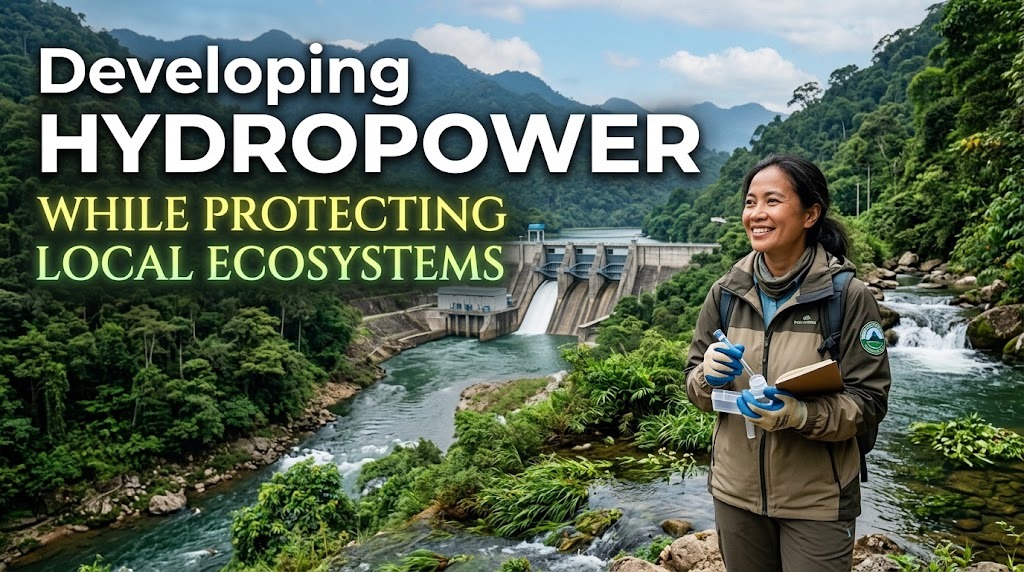
Hydropower development can provide renewable electricity and support the transition toward a cleaner energy system. Rivers and water resources can generate electricity without the direct combustion of fossil fuels during normal plant operation. However, rivers are also living ecosystems that support fish, plants, wildlife, agriculture, and local communities. Developing hydropower responsibly therefore requires a balance between energy production and environmental protection.
The environmental effects of a hydropower project depend on its location, size, design, construction methods, and operating practices. Large reservoirs can have extensive effects on landscapes and river systems, while smaller projects may have different challenges. Careful planning can reduce unnecessary impacts and improve long-term sustainability. The goal should not simply be to build more hydropower plants, but to develop suitable projects in responsible ways.
WHY ECOSYSTEM PROTECTION MATTERS?
Healthy river ecosystems provide many important functions. Rivers transport water and nutrients, support aquatic species, recharge surrounding environments, and provide resources for communities. Fish, insects, plants, birds, and other organisms depend on different parts of a river system to survive.
When hydropower infrastructure changes natural water conditions, these relationships can be disrupted. Changes in river flow, water temperature, sediment transport, and habitat connectivity may affect biodiversity. Protecting ecosystems is therefore important not only for nature but also for communities that depend on rivers. Environmental protection should be included from the earliest stage of hydropower planning.
CHOOSE SUITABLE PROJECT LOCATIONS
One of the most effective ways to reduce environmental impacts is selecting the right location. Developers should assess river characteristics, biodiversity, geology, existing land use, communities, and protected areas before deciding where a project should be built.
Areas with particularly sensitive habitats or high ecological value may require stronger protection or exclusion from development. Site selection should also consider the availability of existing infrastructure. Using locations near existing roads or transmission networks may reduce the need for additional construction. Good site selection can prevent environmental problems before they occur.
CONDUCT THOROUGH ENVIRONMENTAL ASSESSMENTS
An environmental assessment helps identify how a proposed project could affect ecosystems and communities. It can examine water quality, aquatic species, forests, wildlife, sediment, land use, and downstream conditions. The assessment should consider both construction impacts and long-term operation.
Environmental studies should use reliable field data and cover different seasons. River conditions can change significantly between wet and dry periods, so a short observation period may not provide a complete picture. The results can guide project design and mitigation measures. A strong environmental assessment is a foundation for responsible hydropower development.
MAINTAIN ENVIRONMENTAL FLOWS
Natural rivers experience changing flows throughout the year. Seasonal variations can influence fish reproduction, sediment movement, vegetation growth, and other ecological processes. Hydropower operations that significantly reduce or alter downstream flow can affect these functions.
Environmental flow management aims to maintain enough water and appropriate flow patterns to support important ecosystem functions. The required flow depends on the characteristics of each river and its species. Operators may need to adjust water releases according to seasonal conditions. Continuous monitoring can help determine whether environmental flow measures are achieving their intended results.
PROTECT FISH AND AQUATIC SPECIES
Dams can create physical barriers that interfere with fish movement. Some fish species migrate between different parts of a river during their life cycles. Turbines can also create risks for fish passing through certain hydropower facilities.
Mitigation measures can include fish passages, screens, improved turbine designs, and appropriate water management. However, no single solution works for every river. The effectiveness of these measures depends on local species, river conditions, and project design. Environmental monitoring should therefore continue after a plant begins operation.
MANAGE SEDIMENT RESPONSIBLY
Sediment is a natural part of river systems. Sand, gravel, and silt help shape river channels and support downstream habitats. Reservoirs can trap sediment, potentially reducing the amount transported downstream and gradually reducing storage capacity.
Effective sediment management can help maintain reservoir performance and downstream ecological processes. Possible approaches include sediment monitoring, watershed conservation, controlled sediment release, and other site-specific engineering methods. The most appropriate strategy depends on reservoir design and river characteristics. Long-term management is more effective than waiting until sediment accumulation becomes a major problem.
PROTECT WATERSHEDS AND FORESTS
The condition of the surrounding watershed strongly influences river health. Deforestation and land degradation can increase erosion and sediment entering rivers. Healthy forests can help regulate water movement, protect soil, and support biodiversity.
Hydropower development should therefore be connected with watershed conservation. Reforestation, erosion control, riparian vegetation protection, and responsible land management can improve water quality and reduce sediment problems. Protecting upstream ecosystems can also support more stable water resources. A hydropower plant cannot be managed sustainably if the wider river basin is neglected.
CONTROL CONSTRUCTION IMPACTS
Construction can temporarily create significant environmental disturbance. Excavation, road building, tunneling, vegetation clearing, and heavy machinery can affect soil, water quality, wildlife, and nearby communities. Poorly managed construction can increase erosion and sediment runoff.
Developers can reduce these effects through erosion control, careful waste management, construction scheduling, habitat protection, and restoration activities. Sensitive areas should be clearly identified before construction begins. Temporary infrastructure should be removed or restored when it is no longer required. Construction management is therefore an important part of environmental protection.
INVOLVE LOCAL COMMUNITIES
People living near rivers often have extensive knowledge about local environmental conditions. They may understand seasonal flooding, fishing areas, agricultural patterns, wildlife habitats, and important cultural locations. Including this knowledge can improve project planning.
Community participation should begin before major decisions are finalized. People should receive clear information about potential impacts, benefits, compensation, and environmental measures. Consultation should also continue during construction and operation. Meaningful participation can help identify problems early and build greater trust between developers and communities.
PROTECT CULTURAL AND NATURAL HERITAGE
Some river areas contain sites with cultural, historical, or spiritual importance. These locations may be connected to local traditions and community identity. A hydropower project should identify such sites during the planning process.
Where possible, important locations should be protected from direct impacts. Developers can work with communities and relevant authorities to document cultural resources and establish appropriate protection measures. Environmental sustainability also includes respect for cultural heritage.
USE MODERN ENVIRONMENTAL MONITORING
Technology can make environmental management more effective. Sensors and monitoring systems can measure river flow, water temperature, water quality, sediment, and reservoir conditions. Data collected over time can help operators understand how plant operations affect the surrounding environment.
Remote sensing and geographic information systems can also help monitor changes across large areas. Early detection of environmental problems allows operators to respond before impacts become more serious. Data-driven environmental management can therefore improve both operational decisions and ecosystem protection.
DESIGN MORE ENVIRONMENTALLY RESPONSIBLE TURBINES
Turbine technology continues to improve. Engineers are developing equipment that can operate efficiently under different water conditions while reducing certain risks to aquatic organisms. Improved designs can also reduce mechanical stress and increase overall plant performance.
Choosing appropriate turbines should consider both energy efficiency and ecological conditions. The best equipment depends on the river, hydraulic head, flow rate, and species present. Technology alone cannot eliminate environmental impacts, but it can become an important part of a broader mitigation strategy.
CONSIDER CLIMATE CHANGE FROM THE START
Climate change can alter rainfall, drought patterns, extreme precipitation, and river flows. These changes can affect both electricity generation and ecosystems. A project designed only around historical water conditions may face greater uncertainty over its operating lifetime.
Future hydropower projects should therefore include climate resilience in their design and management. Developers can use climate projections, improved hydrological forecasting, flexible reservoir operations, and stronger infrastructure. Watershed protection can also help increase resilience. Planning for changing conditions is essential for both energy reliability and ecosystem health.
MODERNIZE EXISTING HYDROPOWER PLANTS
Environmental protection does not always require building new facilities. Existing hydropower plants can sometimes be modernized with more efficient turbines, improved control systems, and better environmental monitoring. Upgrades can increase electricity production or flexibility without creating an entirely new reservoir.
Modernization can also provide an opportunity to improve environmental performance. Operators can introduce better fish protection, flow monitoring, sediment management, and digital control systems. This can increase the value of existing infrastructure while limiting additional land disturbance. Using existing assets more effectively can be an important sustainability strategy.
BALANCE ENERGY PRODUCTION AND RIVER HEALTH
Hydropower operators must balance electricity generation with environmental requirements. Maximizing generation at every moment may not always be compatible with maintaining healthy river conditions. Water may also be needed for agriculture, drinking water, ecosystems, and other community uses.
A balanced operating strategy can consider electricity demand, reservoir levels, seasonal conditions, and environmental requirements. Adaptive management allows operators to adjust practices when monitoring shows that conditions are changing. Sustainable hydropower requires long-term balance rather than short-term optimization alone.
PLAN FOR LONG TERM MONITORING
Environmental management should not end when construction is completed. River ecosystems can respond gradually to changes in water flow and habitat conditions. Some effects may only become visible after several years of operation.
Long-term monitoring can track biodiversity, water quality, sediment, fish populations, vegetation, and community conditions. If unexpected impacts appear, management strategies can be adjusted. This approach is known as adaptive management. It recognizes that environmental systems are complex and that management decisions should improve as new information becomes available.
THE FUTURE OF RESPONSIBLE HYDROPOWER
Future hydropower development will increasingly depend on combining energy technology with environmental responsibility. Careful site selection, strong environmental assessments, community participation, ecological flow management, watershed protection, and modern monitoring can help reduce negative impacts.
Hydropower can also work alongside other renewable technologies. Solar, wind, geothermal, batteries, and pumped storage can diversify electricity systems and reduce pressure to maximize production from individual rivers. A broader clean-energy strategy can therefore support both energy security and environmental protection.
CONCLUSION
Developing hydropower while protecting local ecosystems requires careful planning, responsible design, and continuous monitoring. Rivers provide valuable ecological and social functions that must be considered alongside electricity generation. Environmental flows, fish protection, sediment management, watershed conservation, and community participation can help reduce potential impacts.
The future of hydropower should focus on quality rather than capacity alone. Projects that are technically feasible but create unacceptable environmental or social risks may not be appropriate. By combining modern technology, climate resilience, strong environmental safeguards, and meaningful community involvement, hydropower can contribute to clean electricity while preserving the health of local ecosystems.
About the Author
Gusti Ayu Tita P
Author — STEKOM University
An active author focused on academic issues, educational technology, and human resource development in the campus environment.