
Difference Between Land Ownership Certificate and Building Use Rights Certificate
Gusti Ayu Tita P
28 Agustus 2026
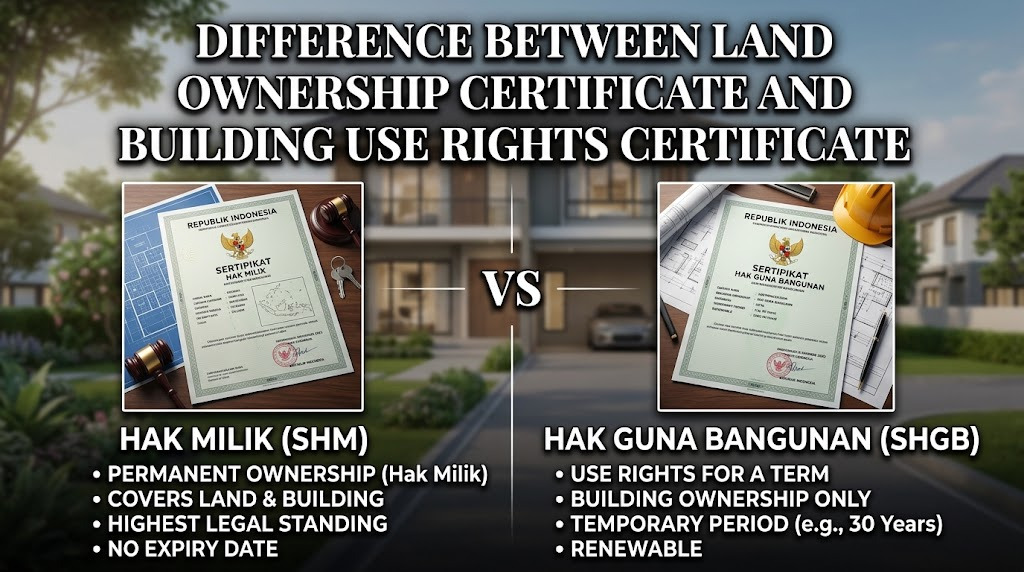
Understanding the difference between a Land Ownership Certificate and a Building Use Rights Certificate is important before buying land or property. In Indonesia, these terms generally refer to different types of land rights, namely Hak Milik (HM) and Hak Guna Bangunan (HGB). Although both can be evidenced through land certificates, the rights, duration, and legal characteristics are different.
Many people assume that owning a building automatically means owning the land underneath it. In reality, ownership of a building and rights over the land can have different legal arrangements. Therefore, prospective buyers should carefully examine the type of land right stated in the certificate before completing a property transaction.
UNDERSTANDING LAND OWNERSHIP RIGHTS
A Land Ownership Certificate, commonly associated with Sertifikat Hak Milik (SHM), is evidence of registered Hak Milik over a particular plot of land. Hak Milik is a strong form of land right under Indonesian agrarian law and is generally associated with Indonesian citizens and certain legal entities permitted by law. The certificate identifies the registered rights holder and relevant information about the land.
Hak Milik does not mean the owner can disregard other regulations. Land use must still comply with applicable laws and spatial planning requirements. Therefore, property owners should understand not only the certificate but also the permitted use and obligations associated with the land.
UNDERSTANDING BUILDING USE RIGHTS
Hak Guna Bangunan (HGB) is a right to establish and own buildings on land that is not necessarily owned by the HGB holder. This means the holder can have rights over the building while the underlying land may have a different legal status. HGB is therefore different from Hak Milik in terms of its legal characteristics.
HGB is also subject to a limited period and applicable renewal or extension provisions. The exact duration depends on the legal basis and type of land involved. Because of this, anyone purchasing property with HGB should check the remaining period and understand what procedures may be required when the right approaches its expiry.
KEY DIFFERENCES BETWEEN SHM AND HGB
The main difference is the nature of the land right. Hak Milik represents ownership of the land, while HGB provides a right to establish and own buildings on land for a particular period under applicable regulations. This distinction can affect how the property is used, transferred, financed, and managed.
Another difference concerns duration and eligible holders. Hak Milik has a different legal character from HGB, which has a defined period and may be subject to extension or renewal. Prospective buyers should therefore examine the certificate carefully instead of judging a property solely by its building, location, or selling price.
DIFFERENCES IN PROPERTY TRANSACTIONS
When buying a property with SHM, the buyer generally obtains the land right recorded as Hak Milik if the transfer is legally completed and registered. The transaction still requires proper documentation and compliance with applicable requirements. Verification of the certificate and land status should be completed before the transaction.
For an HGB property, the buyer needs to understand that the land right being transferred is HGB rather than Hak Milik. The remaining validity period is particularly important. Buyers should ask about the status of the HGB and any relevant conditions before agreeing to the purchase.
DIFFERENCES IN FINANCING AND COLLATERAL
Both SHM and HGB can potentially be used as collateral for certain forms of financing when they meet the requirements of the lender and applicable law. However, acceptance is not automatic. Financial institutions generally assess the legal status, market value, ownership, location, and other characteristics of the property.
For HGB, the remaining term of the right can be an important consideration in the lender's assessment. A property with a short remaining period may be treated differently from one with a longer period. Therefore, borrowers should understand the certificate status before using the property as loan collateral.
CAN HGB BE CONVERTED INTO HAK MILIK?
Under certain circumstances, an HGB may be changed into Hak Milik if the property and applicant meet the applicable requirements. The process is not automatic simply because the property is occupied as a private residence. The applicant must follow the official land administration procedure.
The eligibility and requirements can depend on factors such as the type of land, land area, use of the property, and status of the rights holder. Anyone considering conversion should confirm the latest requirements with the relevant ATR/BPN Land Office. This helps prevent mistakes caused by relying on outdated information.
WHAT BUYERS SHOULD CHECK BEFORE PURCHASING
Before buying property, always check whether the certificate is SHM, HGB, or another type of land right. Compare the certificate information with the seller's identity, the actual property, and available land records. It is also important to check the land area, location, boundaries, and any relevant legal records.
Buyers should not rely solely on the seller's explanation. Official verification and professional assistance from a PPAT when appropriate can help ensure that the transaction is properly documented. Understanding the type of land right before signing an agreement can prevent misunderstandings and unexpected costs later.
CONCLUSION
A Land Ownership Certificate associated with Hak Milik and a Building Use Rights Certificate associated with HGB represent different types of land rights. Hak Milik provides ownership rights over land, while HGB provides the right to establish and own buildings on land for a defined period under applicable regulations.
Before purchasing a property, buyers should carefully examine the type of certificate, registered owner, land area, legal status, remaining HGB period, and applicable transaction requirements. Understanding these differences can help buyers make better decisions and avoid legal or administrative problems in the future.
About the Author
Gusti Ayu Tita P
Author — STEKOM University
An active author focused on academic issues, educational technology, and human resource development in the campus environment.















