
Differences Between Hindu and Buddhist Temples You Should Know
Gusti Ayu Tita P
4 September 2026
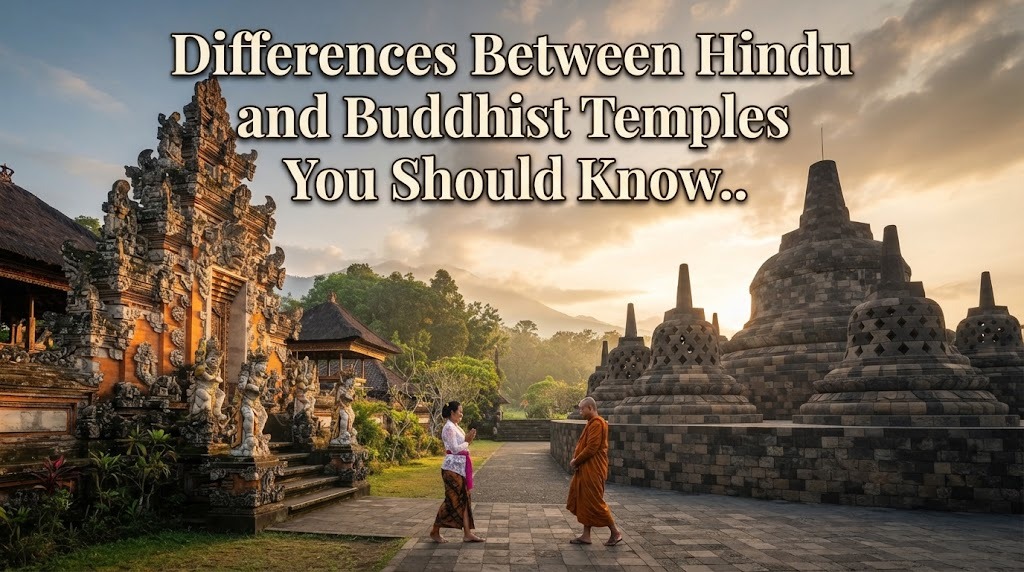
Indonesia has a rich history of Hindu and Buddhist civilization, which can be seen through its many ancient temples. Although Hindu and Buddhist temples can sometimes look similar because both use stone architecture, they have different religious backgrounds, symbols, layouts, and artistic features. Understanding these differences can make visits to historical temples more meaningful.
Famous sites such as Borobudur and Prambanan show how diverse religious traditions developed in ancient Indonesia. Their architecture reflects different beliefs while also showing how local culture influenced religious buildings. By learning their characteristics, visitors can better understand Indonesia's historical and cultural heritage.
RELIGIOUS BACKGROUND
The most basic difference between Hindu and Buddhist temples is their religious background. Hindu temples were built as sacred places connected with Hindu beliefs and worship, while Buddhist temples were designed for Buddhist religious practices and spiritual activities. The religious traditions behind each temple influenced its architecture, statues, decorations, and overall layout.
In Indonesia, both Hinduism and Buddhism played important roles in the development of ancient kingdoms. Their influence can be seen in many historical sites across Java and other parts of the archipelago. However, local communities often adapted these traditions to their own cultural environment.
DIFFERENCES IN TEMPLE ARCHITECTURE
Hindu temples often have tall and vertically emphasized structures. Their main buildings may feature multiple towers representing sacred mountains in Hindu cosmology. Prambanan is a clear example of this architectural approach, with its tall central temples creating a strong vertical appearance.
Buddhist temples can have different architectural forms depending on their tradition and historical period. Borobudur, for example, has a large stepped structure with square and circular levels rather than a collection of tall central towers. Its design represents a spiritual journey and reflects important Buddhist concepts.
DIFFERENCES IN RELIGIOUS SYMBOLS
Religious symbols are another important way to distinguish Hindu and Buddhist temples. Hindu temples may contain representations of deities such as Shiva, Vishnu, and Brahma, as well as symbols connected with Hindu mythology. These figures and symbols often appear in statues, reliefs, and architectural decorations.
Buddhist temples commonly feature Buddha statues and symbols associated with Buddhist teachings. Stupas are also strongly associated with Buddhist architecture and can be found in various forms. The presence of these symbols helps visitors understand the religious purpose and cultural background of a temple.
DIFFERENCES IN STATUES
Statues in Hindu temples often represent gods, goddesses, and mythological figures. Their poses, objects, and physical characteristics may provide clues about the identity of each figure. At Prambanan, for example, statues and reliefs are connected with major Hindu deities and stories.
Buddhist temples generally feature statues of Buddha or other figures associated with Buddhist traditions. The position of the hands, known as mudras, can have particular meanings. Buddha statues at different temples may therefore appear similar at first glance but can contain different symbolic details.
DIFFERENCES IN RELIEFS
Reliefs are important features of both Hindu and Buddhist temples, but their stories and themes can differ. Hindu temple reliefs may depict stories from texts and traditions such as the Ramayana and other Hindu mythology. These carvings often show gods, heroes, animals, and dramatic scenes.
Buddhist temple reliefs can illustrate teachings, moral stories, previous lives of the Buddha, and scenes connected with Buddhist traditions. Borobudur is particularly famous for its extensive relief panels. These carvings provide both religious information and valuable images of life in ancient Java.
DIFFERENCES IN TEMPLE LAYOUT
The layout of Hindu and Buddhist temples can also reflect different religious concepts. Hindu temple complexes may be organized around sacred buildings dedicated to particular deities. The arrangement can represent a sacred universe and the relationship between different divine figures.
Buddhist temple layouts can emphasize a spiritual path or symbolic journey. Borobudur is an important example because visitors traditionally move through different levels as they progress toward the upper part of the monument. The physical journey can be understood alongside Buddhist ideas about spiritual development.
BOROBUDUR AS A BUDDHIST TEMPLE
Borobudur is one of the most famous examples of Buddhist architecture in Indonesia. Built during the Sailendra period, the monument contains numerous Buddha statues, stupas, and relief panels. Its large stepped structure is designed according to Buddhist concepts and symbolism.
The monument is particularly notable for its three major symbolic levels. The lower sections are associated with the world of desire, the middle section with the world of forms, and the upper section with the formless world. This symbolic structure contributes to Borobudur's importance as both a religious monument and a historical masterpiece.
PRAMBANAN AS A HINDU TEMPLE
Prambanan is one of the most prominent Hindu temple complexes in Indonesia. Its main temples are dedicated to Shiva, Vishnu, and Brahma, with Shiva receiving the central position in the complex. The tall structures create an impressive skyline and demonstrate the architectural achievements of ancient Java.
The temple walls contain reliefs related to the Ramayana and other Hindu traditions. These carvings make Prambanan valuable for understanding both Hindu mythology and ancient Javanese artistic traditions. Its architecture also reflects the religious and political environment of the period when it was constructed.
SIMILARITIES BETWEEN HINDU AND BUDDHIST TEMPLES
Despite their differences, Hindu and Buddhist temples in Indonesia also share several similarities. Both can contain detailed stone carvings, statues, religious symbols, and carefully planned architectural structures. Both traditions also influenced art, literature, architecture, and political culture in ancient Indonesia.
Another important similarity is the influence of local culture. Indonesian temples are not simply copies of buildings from other parts of Asia. Ancient Indonesian communities adapted religious ideas to their own traditions, environment, artistic styles, and social conditions.
WHY THE DIFFERENCES MATTER
Understanding the differences between Hindu and Buddhist temples helps visitors appreciate their historical meaning. Without this knowledge, it can be easy to assume that all ancient temples serve the same purpose. Learning about their symbols and architecture allows people to recognize the unique identity of each site.
This knowledge is also useful for students and anyone interested in Indonesian history. Temples provide physical evidence of religious diversity and cultural development in the past. Studying them can help explain how different traditions interacted with local society.
THE IMPORTANCE OF PRESERVING BOTH HERITAGES
Hindu and Buddhist temples are important parts of Indonesia's cultural heritage. Their structures, statues, and reliefs contain information that cannot easily be replaced if they are damaged or lost. Conservation is therefore essential for maintaining their historical and cultural value.
Visitors can contribute to preservation by following site regulations, avoiding damage to structures, keeping the surroundings clean, and respecting religious activities. Responsible tourism allows people to enjoy these historical sites while helping protect them for future generations.
CONCLUSION
Hindu and Buddhist temples in Indonesia have different religious backgrounds, architectural styles, symbols, statues, reliefs, and layouts. Prambanan represents an important example of Hindu architecture, while Borobudur demonstrates the distinctive characteristics of Buddhist architecture.
Although they have clear differences, both traditions have contributed greatly to Indonesia's cultural history. Learning about their similarities and differences provides a better understanding of ancient Indonesian civilization and encourages greater appreciation for the country's valuable historical heritage.
About the Author
Gusti Ayu Tita P
Author — STEKOM University
An active author focused on academic issues, educational technology, and human resource development in the campus environment.















