
Differences Between LRT and MRT You Should Know
Gusti Ayu Tita P
11 Agustus 2026
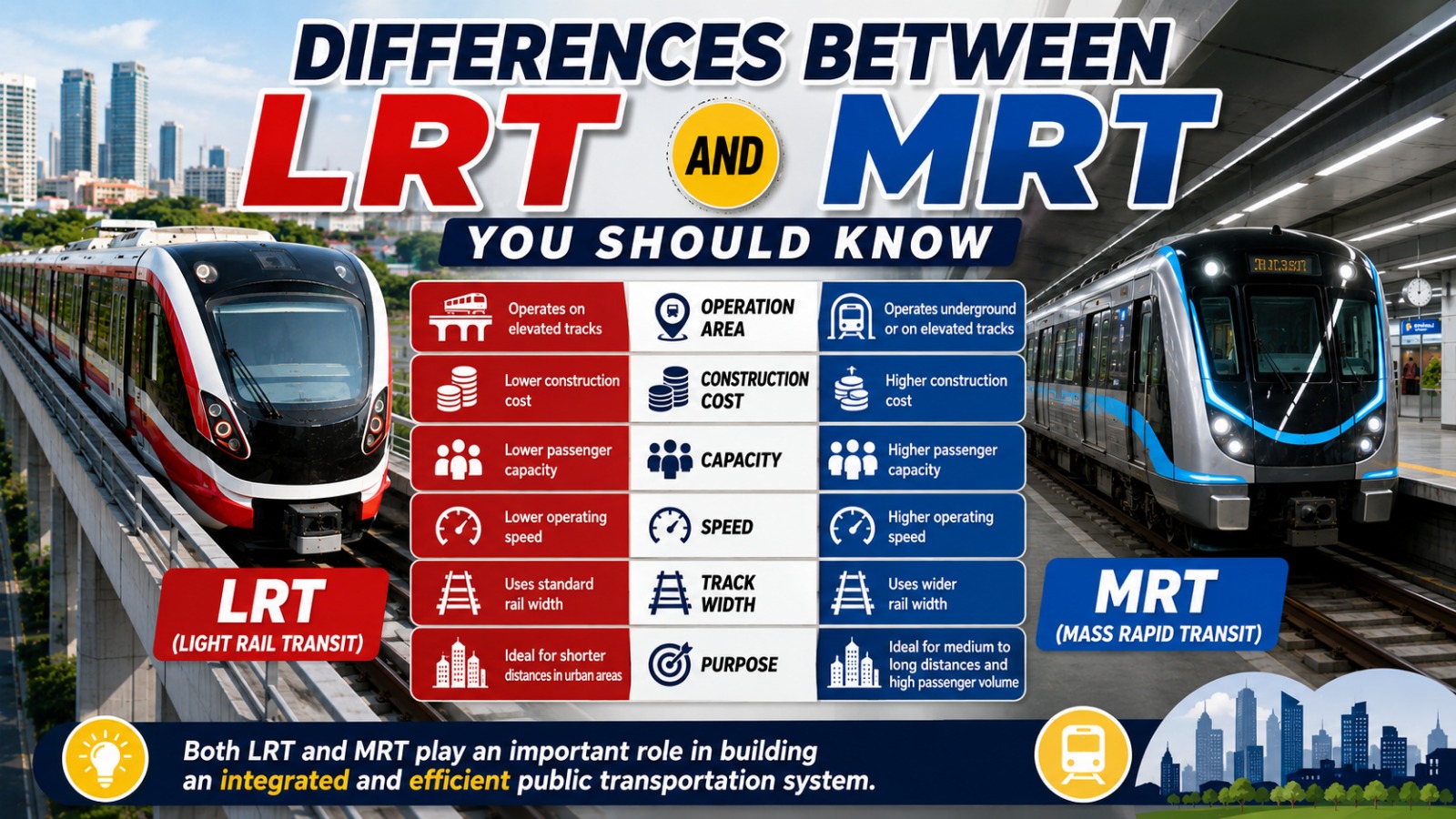
LRT and MRT are modern rail based transportation systems designed to improve mobility in busy urban areas. Both use electric trains and dedicated rail infrastructure, but they are not exactly the same. Their differences can be seen in passenger capacity, route design, train size, station layout, and the type of travel demand they are intended to serve. Understanding these differences can help passengers choose the most suitable transportation option for their journey.
WHAT ARE LRT AND MRT
LRT stands for Light Rail Transit, a rail transportation system generally designed for urban and suburban travel with lighter trains and moderate passenger capacity. LRT systems can operate on elevated, surface, or other dedicated alignments depending on local infrastructure. In Indonesia, LRT Jabodebek is an example of a modern LRT system connecting Jakarta with surrounding areas. Its electric operation and dedicated infrastructure make it suitable for regular urban and metropolitan travel.
MRT stands for Mass Rapid Transit and is designed to provide high capacity transportation in densely populated urban corridors. MRT systems can operate underground, at ground level, or on elevated tracks depending on the design of the network. MRT Jakarta, for example, serves important areas of Jakarta through a combination of underground and elevated sections. Its network is designed to move large numbers of passengers efficiently through major urban corridors.
DIFFERENCES IN PASSENGER CAPACITY
One of the most noticeable differences between LRT and MRT is passenger capacity. MRT systems are generally designed to handle larger passenger volumes, making them suitable for heavily traveled urban corridors. Their trains and stations can be designed around high passenger demand and frequent services. This makes MRT particularly useful in major metropolitan areas where many people travel along the same routes every day.
LRT usually has a lower capacity than a typical high capacity MRT system, although the exact capacity varies between networks. The number of cars, train configuration, station design, and service frequency all affect how many passengers an LRT system can carry. Lower capacity does not mean that LRT is less effective. Instead, it allows the system to serve transportation corridors where demand may not require the larger capacity of an MRT system.
DIFFERENCES IN TRAIN SIZE
MRT trains are generally larger and designed to accommodate a high number of passengers. They may have longer train formations, wider passenger areas, and station platforms designed for large crowds. Their design supports frequent boarding and exiting during busy periods. These characteristics make MRT suitable for high demand routes in densely populated areas.
LRT trains are generally smaller and lighter than MRT trains. Their dimensions and capacity are designed according to the needs of the specific LRT network. Because LRT systems can use shorter train formations, they can be suitable for corridors with moderate passenger demand. However, the exact specifications differ between cities and operators, so LRT and MRT cannot always be compared based only on physical size.
DIFFERENCES IN TRACKS AND ROUTES
LRT and MRT can both use dedicated tracks, but their route structures can differ depending on the city and transportation plan. MRT systems are commonly developed along major urban corridors where passenger demand is particularly high. Some MRT networks include extensive underground sections to pass through dense city centers. Others may use elevated or surface sections where appropriate.
LRT systems can also use elevated, surface, or other dedicated alignments. Some LRT networks are designed to connect city centers with suburban or metropolitan areas. LRT Jabodebek, for example, provides connections between Jakarta and surrounding areas. The route design therefore depends more on local transportation needs and urban planning than simply on whether a system is called LRT or MRT.
DIFFERENCES IN STATIONS
MRT stations are often built to accommodate large passenger flows. They may include wide platforms, multiple entrances, ticketing areas, passenger information systems, and extensive safety facilities. Underground MRT stations can also require additional infrastructure such as ventilation and emergency systems. Station design is closely connected to the expected passenger volume and the characteristics of the surrounding area.
LRT stations are generally designed around the capacity and structure of the LRT network. Many modern LRT systems use elevated stations, although surface and other configurations are also possible. Their facilities can include ticketing systems, platforms, passenger information, accessibility features, and safety equipment. The size and design of each station depend on passenger demand and local infrastructure requirements.
DIFFERENCES IN TRAVEL PURPOSE
MRT is generally intended to serve major urban travel corridors with high passenger demand. It is particularly useful for commuters traveling between important business, residential, commercial, and educational areas. Frequent services allow large numbers of passengers to travel throughout the day. This makes MRT an important part of mass transit in large cities.
LRT can serve a wider range of urban and metropolitan travel needs depending on the system. It can connect developing areas, residential districts, suburban locations, and major activity centers. Some LRT systems are also designed to complement larger rail networks. Therefore, the best option depends on the route, destination, and overall transportation network rather than simply choosing the system with the larger train.
WHICH IS BETTER LRT OR MRT
There is no universal answer to whether LRT or MRT is better. MRT can be more suitable for corridors with very high passenger demand, while LRT can be an efficient choice for routes with moderate demand or specific metropolitan connections. Both systems can provide reliable and efficient transportation when properly planned and operated. The most important factor is whether the system matches the transportation needs of the area it serves.
Passengers should consider the location of stations, route connections, operating schedules, fares, and transfer options when choosing between LRT and MRT. A nearby LRT station may be more convenient than a distant MRT station, even if MRT has a larger capacity. Similarly, MRT may be preferable when its route provides a direct connection to a destination. Understanding the network is therefore more useful than judging a transportation mode solely by its name.
CONCLUSION
The main differences between LRT and MRT can be seen in their typical capacity, train size, route design, station characteristics, and transportation roles. MRT is generally designed for high passenger demand in major urban corridors, while LRT can serve moderate-demand routes and metropolitan connections. Both can operate using dedicated infrastructure and electric trains, providing an efficient alternative to private vehicles. Neither system is automatically better because their effectiveness depends on local transportation needs and network design. By understanding these differences, passengers can choose the most convenient rail transportation for their daily journeys.
About the Author
Gusti Ayu Tita P
Author — STEKOM University
An active author focused on academic issues, educational technology, and human resource development in the campus environment.















