
Different Beliefs About the Supernatural World Across Indonesian Regions
Gusti Ayu Tita P
9 September 2026
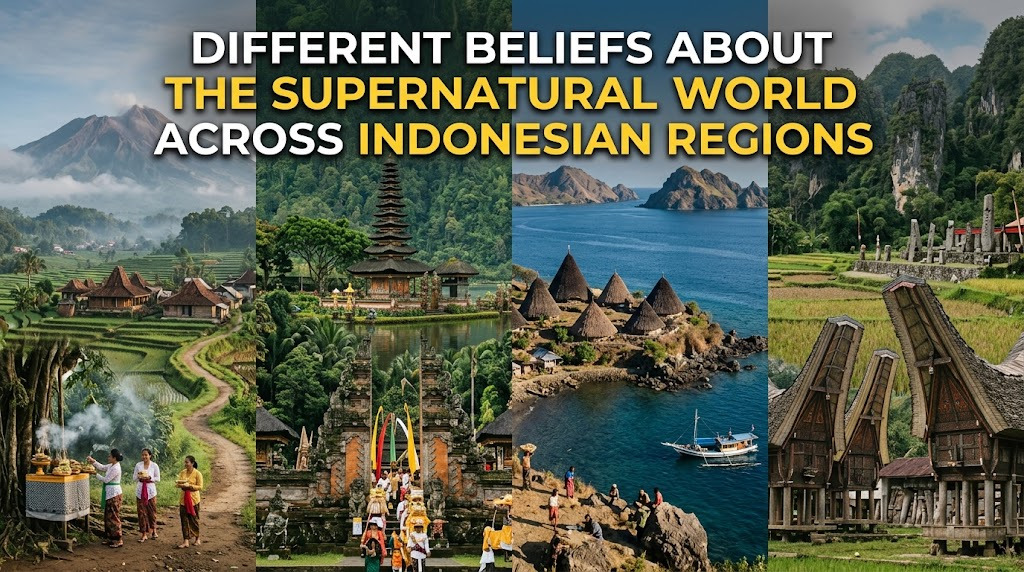
Different Beliefs About the Supernatural World Across Indonesian Regions
Indonesia is known for its cultural diversity, and this diversity can also be seen in beliefs about the supernatural world. Different communities have developed stories, traditions, and interpretations about spirits, supernatural creatures, sacred places, and mysterious events. These beliefs are often influenced by local history, environment, religion, and ancestral traditions. As a result, supernatural folklore in one region can be very different from that of another. Exploring these differences provides a useful way to understand the richness of Indonesian culture.
REGIONAL DIVERSITY SHAPES SUPERNATURAL BELIEFS
The geographical diversity of Indonesia has contributed to the development of many forms of supernatural beliefs. Communities living near mountains, forests, rivers, islands, and coastal areas may have stories connected to their surroundings. Natural environments can become important settings for legends about spirits, mysterious creatures, or sacred locations. These stories are often passed down through oral traditions and adapted over time. Therefore, Indonesian supernatural folklore cannot be understood as a single uniform tradition.
Local history also influences how communities interpret mysterious events. Traditional customs, ancestral stories, and community values can shape the way people understand the unseen world. Some stories function as warnings about dangerous places or inappropriate behavior, while others are connected to ceremonies and cultural practices. The meaning of a supernatural story may therefore extend beyond fear or entertainment. It can become part of a community's cultural identity.
SUPERNATURAL BELIEFS IN JAVA AND BALI
Java has a long tradition of stories involving spirits, sacred places, and supernatural creatures. Popular figures such as the kuntilanak, pocong, genderuwo, and other legendary beings frequently appear in Javanese folklore and modern popular culture. Some Javanese traditions also connect certain places with spiritual significance and ancestral heritage. These beliefs can vary considerably between communities and should not be treated as identical across the entire island. Their continued presence demonstrates how traditional narratives can adapt to changing social conditions.
Bali also has distinctive traditions influenced by local religious and cultural practices. Concepts concerning spiritual balance, sacred spaces, rituals, and unseen forces can appear in Balinese cultural life. Traditional ceremonies may involve symbolic practices that reflect relationships between humans, nature, ancestors, and the divine. These traditions are broader than horror stories and are closely connected with community identity. Understanding them requires respect for their cultural and religious context rather than viewing them only through a supernatural entertainment perspective.
BELIEFS ABOUT THE UNSEEN WORLD IN SUMATRA
Various communities in Sumatra have developed their own local folklore and supernatural traditions. Stories may involve spirits, legendary figures, magical objects, sacred forests, and places associated with unusual events. In some areas, these narratives are connected to oral histories and traditional customs. The details can differ significantly from one ethnic community to another. This diversity shows how local culture influences interpretations of the unseen world.
Some traditional stories also contain social lessons. Warnings about respecting elders, protecting nature, avoiding forbidden places, or following community customs can be incorporated into supernatural narratives. Such messages may have helped communities communicate important values before formal education became widely accessible. Even when people no longer interpret the stories literally, their cultural meaning can remain relevant. Folklore can therefore function as both entertainment and a method of preserving collective memory.
SUPERNATURAL TRADITIONS IN SULAWESI, KALIMANTAN, AND OTHER REGIONS
Sulawesi and Kalimantan contain many communities with distinct cultural traditions and oral histories. Their folklore may include stories about spirits, ancestors, supernatural beings, sacred forests, and unusual natural locations. In some traditions, relationships between humans and nature are especially important to the meaning of local stories. The surrounding environment can influence the characters, settings, and lessons found in traditional narratives. These differences demonstrate the connection between folklore and local ways of life.
Other Indonesian regions, including Nusa Tenggara, Maluku, and Papua, also have diverse traditions concerning the spiritual or unseen world. These traditions should not be generalized because each community has its own history, language, customs, and worldview. Local beliefs are often more complex than the supernatural characters commonly presented in popular media. Studying them carefully can help prevent cultural traditions from being reduced to simple horror stories.
THE ROLE OF RELIGION, ANCESTRAL TRADITIONS, AND COMMUNITY VALUES
Religion has influenced how many Indonesian communities understand the relationship between the visible and unseen worlds. Over centuries, religious teachings and local traditions have interacted in different ways, producing diverse cultural expressions. Some traditional practices have been reinterpreted through religious perspectives, while other customs continue as cultural heritage. The relationship between these elements can be complex and varies from one community to another. It is therefore important to distinguish religious teachings from local folklore and popular supernatural stories.
Ancestral traditions can also influence community identity. Stories about ancestors, sacred locations, and traditional ceremonies may carry meanings that go beyond supernatural explanations. Respect for elders, community harmony, and cultural continuity can be important themes within these narratives. Younger generations may preserve some traditions while changing the way they interpret them. This process allows cultural heritage to survive while adapting to modern society.
MODERN INTERPRETATIONS OF INDONESIAN SUPERNATURAL BELIEFS
Technology and social media have changed how people encounter Indonesian supernatural stories. Stories that were once shared mainly through family conversations or local gatherings can now reach national and international audiences. Videos, podcasts, online articles, and social media posts frequently discuss mysterious experiences and traditional legends. This wider exposure can help preserve cultural stories, but it can also introduce exaggerated or fictional details. As a result, digital audiences should consider the source and context of supernatural content.
Modern education and scientific thinking have also encouraged people to examine unusual experiences from different perspectives. Psychology, environmental factors, sleep experiences, and ordinary physical causes can sometimes provide alternative explanations for events interpreted as supernatural. Considering these possibilities does not necessarily mean disrespecting cultural traditions. People can appreciate folklore as part of cultural heritage while recognizing that supernatural claims are not automatically scientific facts. This balanced approach supports both cultural appreciation and critical thinking.
CONCLUSION
The supernatural world across Indonesian regions reflects the country's extraordinary cultural diversity. Java, Bali, Sumatra, Sulawesi, Kalimantan, and other regions have developed different stories and traditions influenced by local environments, history, religion, and community values. These beliefs may involve supernatural creatures, ancestral traditions, sacred places, and mysterious events. Although many narratives have changed through generations, they continue to contribute to Indonesia's cultural identity.
Understanding these traditions requires respect, cultural awareness, and critical thinking. Supernatural folklore can be appreciated as an important part of history and storytelling without automatically treating every supernatural claim as scientifically proven. By learning about regional differences, people can better understand the meanings behind Indonesian Folklore, Local Traditions, Supernatural Beliefs, Cultural Heritage, and Spiritual Traditions. In this way, the study of supernatural stories becomes not only a discussion about mystery but also an exploration of Indonesia's rich cultural heritage.
About the Author
Gusti Ayu Tita P
Author — STEKOM University
An active author focused on academic issues, educational technology, and human resource development in the campus environment.















