
Does Academic Competition Achievement Guarantee Workforce Readiness
Gusti Ayu Tita P
20 Agustus 2026
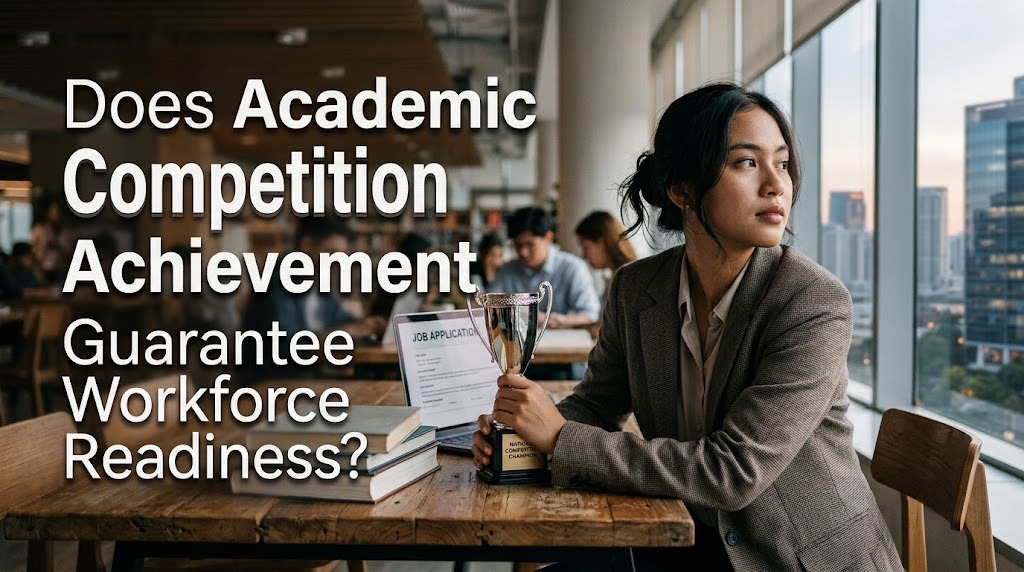
Academic competition is often considered a valuable achievement for university students. Winning a research contest, debate, business competition, or academic olympiad can demonstrate knowledge, discipline, and determination. Such achievements may strengthen a student's academic profile and provide useful experiences before entering the workforce. However, winning competitions does not automatically guarantee that a graduate is fully prepared for professional life. Workforce readiness requires a broader combination of knowledge, practical skills, communication, adaptability, and professional attitudes.
WHAT ACADEMIC COMPETITION ACHIEVEMENT CAN PROVIDE
Academic competitions encourage students to work toward clear goals. Preparing for a competition often requires research, practice, time management, and careful evaluation. These activities can develop discipline, analytical thinking, problem solving, and persistence. Students also learn how to perform under deadlines and respond to evaluation. These experiences can become valuable foundations for professional development.
Competition achievements may also provide evidence of a student's ability to complete challenging tasks. Awards and recognition can strengthen a resume or portfolio, particularly when they are relevant to the student's field. However, employers may also want to know what the student actually learned from the experience. The skills behind an achievement are often more important than the award itself. Students should therefore be able to explain their contributions, challenges, and results clearly.
DEVELOPING CRITICAL THINKING FOR THE WORKPLACE
Many academic competitions require participants to analyze problems and develop logical solutions. Students may need to evaluate data, compare arguments, or identify the most effective strategy. These activities can strengthen critical thinking and analytical skills. Such skills are useful in professional environments where employees must make decisions based on information. They can help graduates approach workplace problems more systematically.
However, workplace problems are often less structured than competition questions. Employees may have incomplete information, conflicting priorities, or changing expectations. Graduates therefore need to combine critical thinking with practical judgment and adaptability. Academic competition can provide a strong foundation, but real workplace experience is still necessary. Students must learn how to transfer their analytical abilities into practical situations.
PRACTICAL EXPERIENCE STILL MATTERS
One of the biggest limitations of academic competition achievement is that competitions may not fully represent real workplace conditions. Professional work often involves customers, supervisors, budgets, organizational policies, and long term responsibilities. Students need opportunities to experience these situations directly. Internships, part time work, projects, volunteering, and organizational activities can provide practical experience that complements academic achievements.
Practical experience also teaches students how to apply knowledge under real constraints. A solution that works well in an academic competition may need significant adjustment when applied to an actual organization. Students learn about workplace expectations, professional communication, deadlines, and accountability. Theory becomes more useful when combined with real experience. Therefore, workforce readiness should be developed through both academic and practical learning.
EMPLOYERS LOOK FOR MORE THAN AWARDS
Employers generally need employees who can contribute to organizational goals, not simply collect achievements. A strong academic record or competition award can attract attention, but employers may also consider communication, teamwork, problem solving, adaptability, responsibility, and technical competence. These qualities determine how effectively a graduate can perform in real situations. Students should therefore avoid relying entirely on competition certificates when preparing for employment.
A competition achievement becomes more valuable when students can explain the skills behind it. For example, a student can describe how they managed a research project, solved a difficult problem, collaborated with teammates, or presented results. Showing evidence of skills can make an achievement more meaningful during interviews. This approach helps employers understand what the student can actually contribute.
BUILDING A BALANCED STUDENT PROFILE
Students can improve workforce readiness by combining academic competitions with other forms of development. They can participate in internships, student organizations, research projects, community service, professional courses, or portfolio projects. Each activity can develop different abilities. A balanced profile demonstrates that students can apply knowledge in various situations. It also allows students to discover which skills they need to improve.
Universities can support this process by connecting competition programs with career preparation. Mentoring, internships, career workshops, and practical projects can help students understand how academic skills transfer to professional environments. Students should also reflect on their experiences instead of simply collecting certificates. Reflection helps turn experiences into transferable skills. This can make their transition from university to employment more effective.
ACADEMIC SUCCESS IS A FOUNDATION NOT A GUARANTEE
Academic competition achievement can be a strong foundation for workforce readiness, but it should not be treated as a guarantee. A competition demonstrates that students can work toward a specific objective under particular conditions. The workforce requires broader abilities and the capacity to deal with situations that may be unpredictable. Academic achievement is one part of professional preparation, not the complete measure of a graduate's capability.
True workforce readiness develops through continuous practice and exposure to different environments. Students need to combine academic knowledge with technical skills, interpersonal abilities, practical experience, and professional attitudes. The ability to keep learning and adapting is especially important in a changing labor market. Therefore, competition achievements should be used as a starting point for further development.
CONCLUSION
Academic competition achievement does not guarantee workforce readiness, although it can provide valuable preparation. Competitions can strengthen critical thinking, communication, teamwork, discipline, creativity, resilience, and problem solving. However, graduates also need practical experience, adaptability, professional communication, technical competence, and continuous learning to succeed in the workplace. The strongest preparation comes from combining academic achievements with internships, projects, organizations, community activities, and other real world experiences. Ultimately, a competition award can open an opportunity, but the ability to apply skills effectively is what helps graduates become truly workforce ready.
About the Author
Gusti Ayu Tita P
Author — STEKOM University
An active author focused on academic issues, educational technology, and human resource development in the campus environment.















