
Does Academic Competition Really Improve Students’ Skills
Gusti Ayu Tita P
24 Agustus 2026
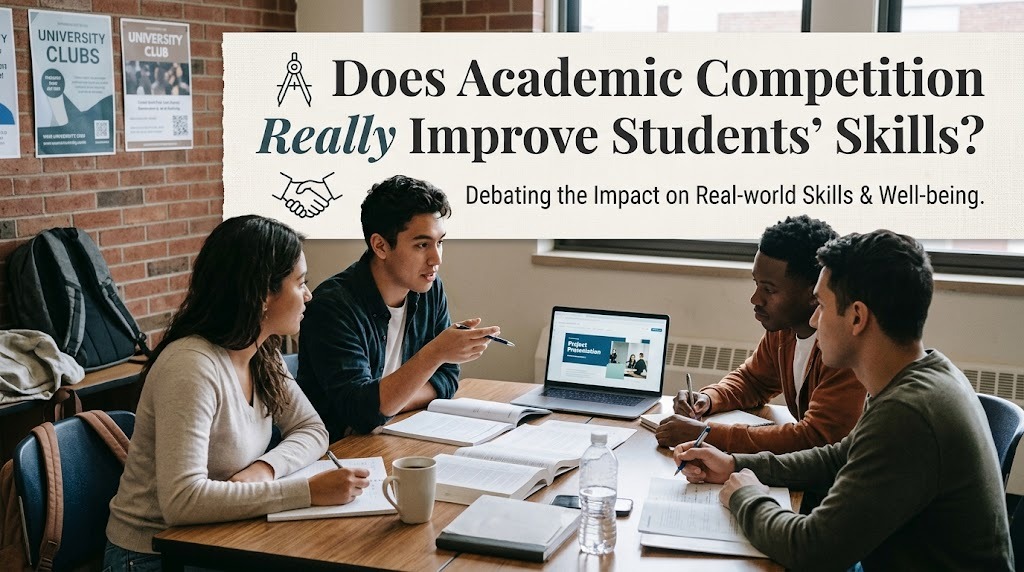
Academic competition is common in schools and universities. Students may compete through grades, academic contests, scholarships, research projects, or other achievements. Competition can encourage students to work harder, but its effects are not always the same for everyone. Healthy competition can motivate learning, while excessive competition may create pressure and reduce genuine interest in education. Therefore, academic competition should be viewed as one factor that can support skill development rather than the only measure of student quality.
HOW ACADEMIC COMPETITION CAN BUILD MOTIVATION
Academic competition can encourage students to set clearer goals. When students have a target to achieve, they may become more motivated to study, practice, and improve their performance. Competition can also encourage students to recognize their strengths and weaknesses. A clear challenge can make learning feel more purposeful and encourage students to make consistent efforts.
However, motivation should not depend entirely on defeating other students. Students who focus only on rankings may become disappointed when their results are lower than expected. A healthier approach is to use competition as a reference for personal improvement. The most valuable competition is often the effort to become better than one's previous performance.
COMPETITION CAN DEVELOP PROBLEM SOLVING SKILLS
Academic contests often require students to analyze information and find solutions within limited conditions. Students may need to identify patterns, evaluate evidence, and choose an effective approach. These activities can strengthen problem solving skills when students are encouraged to understand the process rather than simply seek correct answers. Competition can therefore create opportunities to practice thinking under pressure.
The benefits become stronger when students reflect on their mistakes after completing a challenge. A wrong answer can provide information about which concepts or strategies need improvement. Teachers can support this process by discussing different approaches instead of focusing only on winners. Learning from mistakes turns competition into a meaningful learning experience.
COMPETITION CAN STRENGTHEN DISCIPLINE
Preparing for academic competitions often requires regular practice and careful preparation. Students may need to organize study schedules, complete exercises, and review difficult materials repeatedly. These activities can develop discipline and consistency. Students learn that improvement usually requires sustained effort rather than instant results.
This habit can be useful beyond academic settings. Consistency is important in university projects, professional training, and future careers. However, discipline should be developed without creating unhealthy pressure. A good academic environment encourages commitment while still allowing students to maintain balance.
ACADEMIC COMPETITION CAN IMPROVE TIME MANAGEMENT
Many academic challenges require students to complete tasks within specific deadlines. Students therefore need to determine which activities deserve immediate attention. This can encourage the development of time management skills. Learning how to divide study time between different subjects can also improve overall organization.
Time management becomes more valuable when students learn to balance competition with other responsibilities. Academic achievement should not require students to ignore sleep, relationships, or personal well being. Effective time management means using available time wisely rather than simply spending more hours studying.
COMPETITION CAN DEVELOP COMMUNICATION AND TEAMWORK
Not every academic competition is individual. Many contests involve group research, presentations, debates, scientific projects, or collaborative problem solving. These activities require students to communicate ideas, listen to teammates, and divide responsibilities. Team based competition can therefore develop communication and collaboration skills.
Students may also learn how to handle different opinions. Successful teamwork requires compromise and respectful discussion, especially when members have different approaches. These experiences can prepare students for environments where cooperation is necessary. Academic competition can be valuable when it creates opportunities for students to compete while still learning how to cooperate.
EXCESSIVE COMPETITION CAN CREATE UNHEALTHY PRESSURE
Competition does not always produce positive results. When students believe that their value depends on grades or rankings, academic activities can become a source of excessive stress. They may become afraid of failure and avoid challenging tasks because they do not want to perform poorly. Too much pressure can reduce the enjoyment of learning and discourage healthy risk taking.
Students may also compare themselves constantly with classmates. This comparison can make them focus on other people's achievements rather than their own progress. A supportive environment should recognize effort, improvement, and learning rather than only final rankings. Competition works best when achievement does not become the only definition of success.
NOT ALL STUDENTS BENEFIT FROM COMPETITION IN THE SAME WAY
Students have different personalities, learning styles, interests, and circumstances. Some students become more motivated when they have a competitive challenge, while others perform better in cooperative or individual environments. Therefore, a single competitive approach may not work equally well for everyone. Student development requires different learning opportunities rather than one universal method.
Teachers can provide a combination of individual goals, teamwork, projects, discussions, and competitions. This allows students to discover which methods help them learn most effectively. Competition can remain part of education without dominating the entire learning experience. A balanced educational environment gives students multiple ways to demonstrate their abilities.
HEALTHY COMPETITION SHOULD FOCUS ON IMPROVEMENT
The purpose of academic competition should be connected to learning and development. Students should understand what they can gain from the experience, including new knowledge, better strategies, and greater confidence. Winning can be satisfying, but it should not be the only meaningful outcome. Personal growth should remain more important than simply achieving a higher ranking.
Teachers and institutions can support healthy competition by setting fair rules and recognizing different forms of achievement. Feedback should explain how students can improve instead of merely identifying who performed best. This approach makes competition more educational and less threatening. Constructive feedback can transform competition into an opportunity for continuous improvement.
SKILLS ARE DEVELOPED THROUGH MORE THAN COMPETITION
Academic competition is only one method for developing student skills. Research projects, internships, practical assignments, volunteering, student organizations, creative activities, and collaborative projects can also provide valuable experiences. These activities allow students to develop skills that may not be visible through academic rankings. Student quality cannot be measured through competition alone.
Some important abilities, such as empathy, adaptability, leadership, creativity, and communication, may develop through real world experiences. Students also need opportunities to make decisions and solve practical problems. A strong education system should therefore combine academic challenges with meaningful experiences outside traditional competition. A broad learning environment produces more well rounded students.
CONCLUSION
So, does academic competition really improve students' skills? Yes, it can, especially when competition encourages motivation, discipline, problem solving, time management, communication, and continuous learning. However, its benefits depend greatly on how competition is designed and experienced. Competition that emphasizes learning and improvement can be constructive, while excessive pressure and constant comparison can create negative effects.
The best approach is to create a balance between healthy competition and collaboration. Students should be encouraged to challenge themselves without believing that their worth depends on rankings. Academic contests can provide valuable learning experiences, but they should work alongside projects, teamwork, practical activities, and personal development. True student quality comes from a combination of knowledge, skills, character, adaptability, and the willingness to keep learning.
About the Author
Gusti Ayu Tita P
Author — STEKOM University
An active author focused on academic issues, educational technology, and human resource development in the campus environment.















