
Does Community Service Program Really Transform Student Perspectives
Gusti Ayu Tita P
20 Agustus 2026
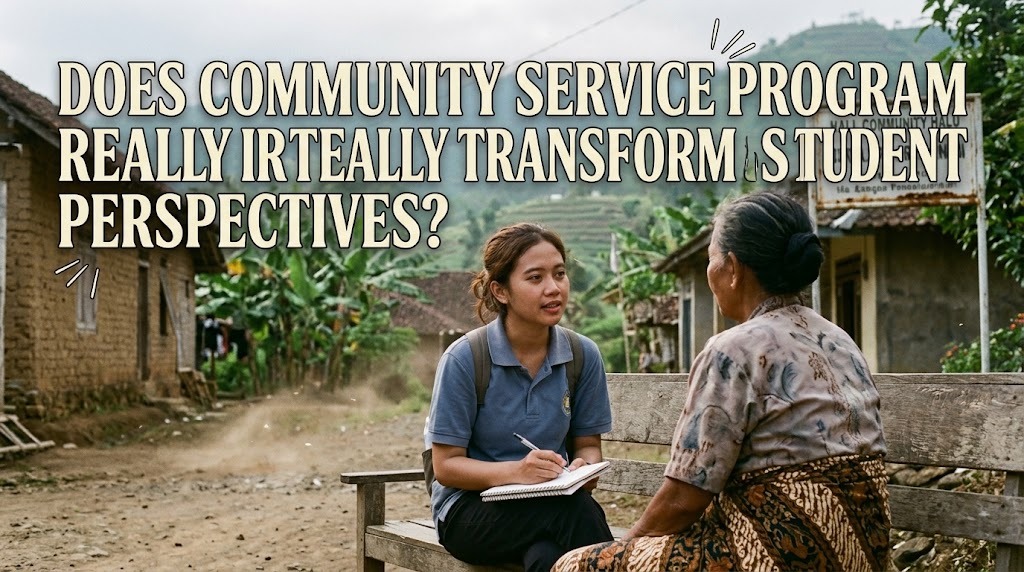
A community service program gives university students an opportunity to move beyond classroom learning and interact directly with society. In Indonesia, programs such as KKN allow students to participate in community activities while applying knowledge from their academic fields. These experiences can expose students to different social conditions, local challenges, and ways of thinking. As a result, community service has the potential to influence how students understand society and their own responsibilities. However, whether it truly transforms student perspectives depends on the quality of participation, reflection, and interaction during the program.
EXPERIENCING REAL COMMUNITY CONDITIONS
One of the strongest ways community service can change student perspectives is by exposing them to real situations. Classroom discussions often present social problems through theories, statistics, or case studies. Community service allows students to see how these issues affect people in their daily lives. Students may discover that real community problems are often more complex than they appear in textbooks. This experience can encourage them to think more carefully before making assumptions.
Direct interaction can also help students understand the different priorities people have. A solution that seems practical from a university perspective may not always fit the community's circumstances. Students learn to consider local resources, traditions, economic conditions, and existing community practices. Real experience can make academic knowledge more practical and meaningful. This can gradually change the way students view social issues.
DEVELOPING A STRONGER SENSE OF SOCIAL RESPONSIBILITY
Community service can encourage students to think about their responsibilities beyond academic achievement. Students may begin to understand that education can also be used to contribute to society. Working directly with communities can strengthen social responsibility and civic awareness. Students may become more interested in issues that affect people outside their immediate environment. This can influence how they view their role as educated members of society.
Social responsibility does not require students to solve every community problem. Instead, it involves recognizing problems, contributing according to one's abilities, and respecting the efforts of others. Students can learn that meaningful change often requires cooperation and long term commitment. Small contributions can have value when they respond to genuine needs. This perspective can remain useful after students return to campus.
LEARNING TO ADAPT TO DIFFERENT PERSPECTIVES
Community service often places students in unfamiliar environments. They may encounter different communication styles, traditions, schedules, and expectations. These differences require students to become more adaptable and open minded. Instead of expecting everyone to behave according to campus norms, students learn to adjust their approach. This experience can reduce rigid thinking and encourage greater flexibility.
Adaptability also means accepting that a planned program may need to change. Community conditions can make some activities difficult or even impossible to implement as originally designed. Students need to listen, evaluate the situation, and develop alternatives. Flexibility is an important part of effective community engagement. These experiences can influence how students respond to differences in other parts of their lives.
UNDERSTANDING THE LIMITS OF SHORT TERM PROGRAMS
Community service can transform student perspectives, but students also need to understand its limitations. A short program cannot automatically solve complex social problems that have existed for years. Students may initially expect visible results, but meaningful community development often requires long term involvement. Recognizing this reality can develop more realistic expectations about social change. Students learn that sustainable progress usually requires continuous cooperation.
This understanding can also change how students define success. Instead of measuring success only by the number of activities completed, they may pay greater attention to relevance, participation, and sustainability. Students can ask whether the community can continue an activity after the program ends. Sustainable impact is often more valuable than temporary results. This perspective can encourage students to think more responsibly about future community projects.
REFLECTION DETERMINES THE DEPTH OF TRANSFORMATION
Participation alone does not guarantee that students will experience a major change in perspective. Reflection is necessary for students to understand what they have experienced and why it matters. Students can write reflection journals, discuss challenges with teammates, or evaluate their assumptions before and after the program. Reflection turns experience into deeper learning. Without reflection, students may complete activities without fully understanding the lessons behind them.
Students should consider questions such as what they learned from the community, which assumptions changed, and which skills they developed. They can also examine mistakes and identify better approaches for future activities. This process helps connect community experiences with personal growth. Self evaluation can make perspective changes more conscious and lasting. In this way, community service becomes more than a temporary activity.
CONCLUSION
A community service program can genuinely transform student perspectives when students actively interact with communities, listen to local experiences, and reflect on what they learn. The experience can develop empathy, social awareness, adaptability, practical thinking, respect for local knowledge, and social responsibility. Students may also develop a more realistic understanding of the complexity of community problems and the limits of short term solutions. However, transformation does not happen automatically simply because students participate in a program. The strongest changes are more likely when students approach community service with openness, active participation, meaningful reflection, and respect for the people they work with.
About the Author
Gusti Ayu Tita P
Author — STEKOM University
An active author focused on academic issues, educational technology, and human resource development in the campus environment.















