Exploring the Early Civilizations in Indonesian History
Gusti Ayu Tita P
8 Agustus 2026
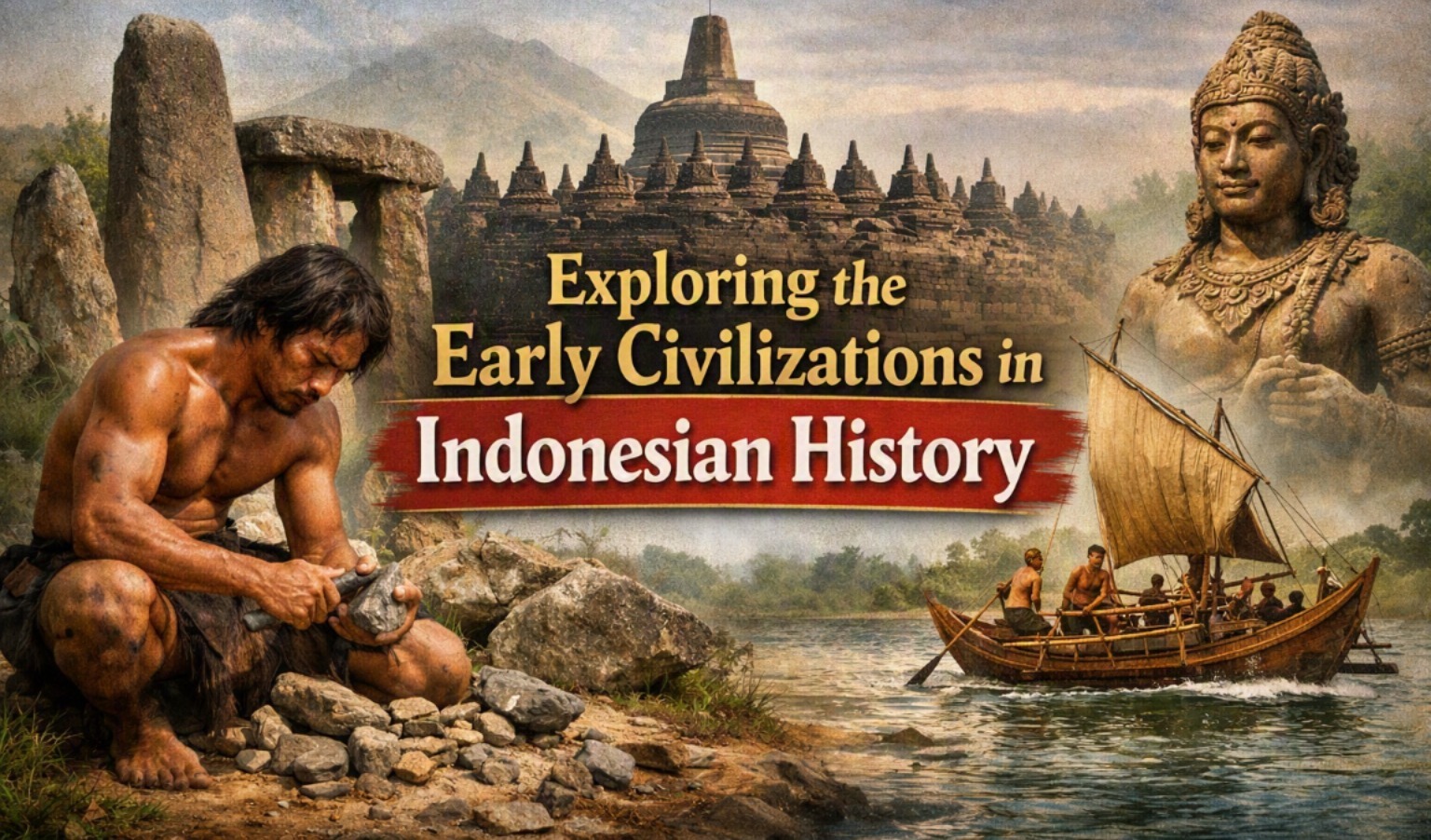
Indonesia has a long and diverse history shaped by early human communities, ancient kingdoms, maritime trade, and cultural exchange. Long before the modern Indonesian state existed, different societies developed settlements, agricultural practices, religious traditions, and trading networks across the archipelago. The geographical position of Indonesia between Asia and the Indian Ocean made the region an important meeting point for people and cultures. Understanding these early civilizations helps explain how Indonesian society developed its rich cultural heritage. It also shows that the history of Indonesia was influenced by both local innovation and connections with other regions.
EARLY HUMAN SETTLEMENTS IN INDONESIA
The history of human settlement in Indonesia reaches back hundreds of thousands of years. One of the most important discoveries is Homo erectus, whose fossils were found in Java, particularly around the Sangiran area. These discoveries provide valuable evidence about early human life and human evolution in Southeast Asia. Early communities depended heavily on hunting, gathering, and using simple stone tools to survive. Over time, human groups developed more advanced ways of adapting to different environments across the Indonesian islands.
Later communities gradually developed farming, fishing, and permanent settlements. The Neolithic period brought important changes, including the wider use of polished stone tools and the development of agriculture. People began growing crops and keeping domesticated animals, which supported more stable communities. These developments created the foundation for more complex social organization. The ability to produce food also allowed populations to grow and encouraged communities to exchange goods and knowledge.
THE RISE OF EARLY AGRICULTURAL COMMUNITIES
Agriculture played a major role in the development of early Indonesian societies. Communities cultivated crops such as rice and other local plants, while coastal populations also depended on fishing and marine resources. The development of farming encouraged people to live in more permanent settlements rather than constantly moving in search of food. As villages became more established, people developed specialized skills such as pottery, weaving, toolmaking, and farming. These activities helped create stronger economic and social relationships within communities.
Early agricultural societies also developed traditions that can be seen in archaeological discoveries. Megalithic cultures, for example, produced large stone structures associated with social and religious practices. Examples include stone monuments, burial structures, and other ceremonial objects found in different parts of Indonesia. These remains suggest that ancient communities had complex beliefs about ancestors, death, and the spiritual world. Although these societies did not form a single civilization, their traditions contributed to the cultural diversity of the Indonesian archipelago.
THE INFLUENCE OF INDIAN CULTURE
From the early centuries of the first millennium CE, Indonesian societies became increasingly connected with South Asian cultural and religious traditions. Trade across the Indian Ocean and Southeast Asian seas created opportunities for merchants, travelers, and religious specialists to interact with local communities. Hindu and Buddhist ideas gradually became influential in several parts of the archipelago. However, these traditions were not simply copied from India. Local communities adapted foreign ideas to their own customs, political systems, and cultural traditions.
This cultural interaction contributed to the development of early Hindu and Buddhist kingdoms. Sanskrit and Indian-inspired political concepts appeared in inscriptions, while local rulers adopted religious symbols that strengthened their authority. At the same time, Indonesian artists and craftsmen developed distinctive styles in architecture, sculpture, and literature. This process created a unique combination of local traditions and outside influences. The result can still be seen in Indonesia's ancient temples, inscriptions, and cultural practices.
EARLY MARITIME KINGDOMS AND TRADE
Indonesia's location between the Indian Ocean and the Pacific region made maritime activity extremely important. Ancient communities used sea routes to exchange spices, forest products, metals, textiles, and other valuable goods. Ports became important centers where merchants from different regions could meet and conduct trade. Maritime connections also helped spread languages, religions, technologies, and artistic ideas throughout the archipelago. These networks demonstrate that early Indonesian societies were active participants in regional trade rather than isolated communities.
One of the most influential maritime powers was Srivijaya, which developed around the seventh century and was centered in Sumatra. Srivijaya controlled or influenced important maritime routes and became an important center of Buddhist learning. Its strategic position allowed it to benefit from trade between India and China. Historical records and inscriptions provide evidence of its political and commercial influence. Srivijaya became an important example of how control over maritime networks could support the growth of a powerful Southeast Asian kingdom.
THE GROWTH OF HINDU AND BUDDHIST KINGDOMS
Another important stage in Indonesian history was the development of Hindu and Buddhist states in Java and other regions. One early example is Tarumanagara, a kingdom in western Java known from several inscriptions dating to around the fifth century. Its inscriptions provide information about its ruler and religious traditions. Later, other kingdoms developed more sophisticated political institutions and cultural achievements. These kingdoms helped shape the foundations of classical Indonesian civilization.
In Central Java, the Sailendra dynasty became associated with major Buddhist monuments, while the Mataram kingdom supported important Hindu and Buddhist traditions. The construction of Borobudur represents one of the greatest achievements of Buddhist architecture in the region. Hindu temples such as Prambanan also demonstrate the high level of artistic and architectural development achieved during this period. These monuments show that ancient Indonesian societies possessed advanced knowledge of construction, religious symbolism, and artistic design.
MAJAPAHIT AND THE CLASSICAL PERIOD
The Majapahit Kingdom, which emerged in East Java in the late thirteenth century, became one of the most significant political powers in Indonesian history. Its influence expanded through political relationships, trade, and alliances across parts of the Indonesian archipelago. The kingdom reached a major period of influence during the fourteenth century, particularly under Hayam Wuruk and the administration of Gajah Mada. Historical sources such as the Nagarakretagama provide important information about Majapahit's political world and relationships with other regions.
Majapahit also contributed to the development of literature, art, architecture, and political traditions. Its history is important because it demonstrates the complexity of political organization in the Indonesian archipelago before the arrival of European colonial powers. However, historians carefully distinguish between direct political control and broader influence when discussing Majapahit's reach. After the fifteenth century, Majapahit's political power weakened as new centers of power developed. Its legacy nevertheless remained important in later ideas about Indonesian history and cultural identity.
CONCLUSION
The early civilizations of Indonesia demonstrate that the archipelago had a dynamic and interconnected history long before modern Indonesia was established. Communities developed their own technologies, economic systems, religious traditions, and forms of political organization. At the same time, they interacted with people from India, China, mainland Southeast Asia, and other regions through trade and migration. These interactions created cultural diversity without completely replacing local traditions. Indonesian civilization therefore developed through a long process of adaptation and exchange.
Studying early Indonesian history also helps people understand the origins of many cultural traditions found today. Ancient inscriptions, archaeological sites, temples, artifacts, and historical texts provide important evidence for reconstructing the past. Some evidence remains incomplete, so historians continue to compare archaeological discoveries with written and environmental evidence. This approach helps avoid oversimplifying the history of the Indonesian archipelago. Exploring these civilizations allows modern generations to appreciate the depth and diversity of Indonesia's historical heritage.
About the Author
Gusti Ayu Tita P
Author — STEKOM University
An active author focused on academic issues, educational technology, and human resource development in the campus environment.