
Famous Temples in Indonesia with Great Historical Value
Gusti Ayu Tita P
4 September 2026
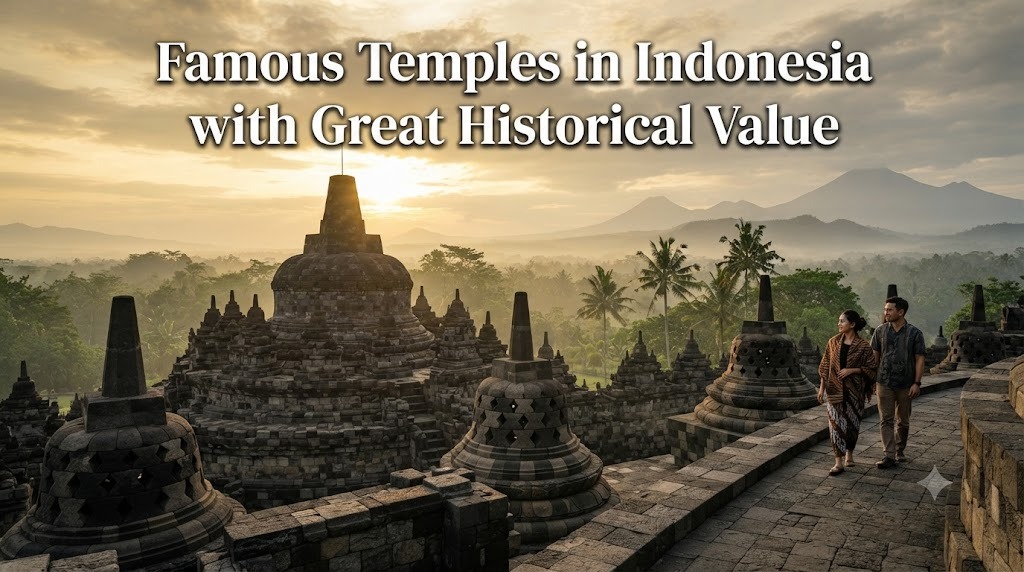
Indonesia is home to many ancient temples that reflect the country's rich history and cultural diversity. These temples were built centuries ago and are closely connected to the development of Hinduism, Buddhism, and ancient kingdoms in the Indonesian archipelago. Today, they are not only important historical sites but also popular destinations for cultural tourism.
Each temple has its own architectural style, religious background, and historical story. From the magnificent Borobudur Temple to the impressive Prambanan Temple, these sites provide valuable insights into the achievements of ancient Indonesian societies. Learning about them can help visitors better appreciate Indonesia's cultural heritage.
BOROBUDUR TEMPLE
Borobudur Temple is one of the most famous Buddhist monuments in Indonesia. Built during the Sailendra dynasty around the eighth and ninth centuries, the temple features multiple levels, numerous stupas, Buddha statues, and detailed relief panels.
The reliefs contain religious stories as well as images that provide information about life in ancient Java. Its unique structure represents important concepts in Buddhist tradition. Because of its historical, cultural, and architectural significance, Borobudur has become one of Indonesia's most important heritage attractions.
PRAMBANAN TEMPLE
Prambanan Temple is one of the largest Hindu temple complexes in Indonesia. The complex is known for its tall and elegant structures dedicated to major Hindu deities, including Shiva, Vishnu, and Brahma.
Prambanan is also famous for its detailed reliefs, including scenes from the Ramayana. The architecture demonstrates the advanced artistic and construction skills of ancient Javanese society. Its historical importance makes it a major destination for people interested in Indonesian history and Hindu culture.
DIENG TEMPLES
Dieng Temple Complex is a group of ancient Hindu temples located on the Dieng Plateau. These temples are believed to date from an early period of Hindu development in Java and are among the oldest surviving temple structures in the region.
The buildings have relatively simple designs compared with larger temple complexes such as Borobudur and Prambanan. However, their historical value is significant because they provide evidence of early Hindu traditions and architectural development in Central Java.
MENDUT TEMPLE
Mendut Temple is a Buddhist temple located near Borobudur. The temple is particularly known for its large Buddha statues and distinctive architectural features.
Mendut is often discussed together with Borobudur and Pawon because of their close geographical and historical relationship. The site provides additional insight into the development of Buddhist culture in ancient Java. Its reliefs and statues also demonstrate the artistic skills of craftsmen from the period.
PAWON TEMPLE
Pawon Temple is another important Buddhist temple located in Central Java. Although smaller than Borobudur, Pawon has a distinctive design and detailed decorative elements.
Its location between Borobudur and Mendut makes it an important part of the historical landscape around Borobudur. Studying Pawon can help visitors understand how several religious structures may have been connected within the same cultural area.
SEWU TEMPLE
Sewu Temple is a large Buddhist temple complex located near Prambanan. Its existence is particularly interesting because Hindu and Buddhist temples developed in close proximity in the same region.
The complex consists of a main temple surrounded by numerous smaller structures. Its layout demonstrates the careful planning and architectural skills of ancient builders. Sewu Temple is therefore an important example of the religious diversity that existed in ancient Java.
SINGOSARI TEMPLE
Singosari Temple is associated with the Singasari Kingdom in East Java. The temple is believed to have been built in connection with the historical period of King Kertanegara, one of the most important rulers of Singasari.
Its architecture and decorative elements reflect the artistic development of East Java during the period. The temple provides an opportunity to learn about the political and religious history of the Singasari Kingdom. It is also an important historical destination in the Malang region.
KIDAL TEMPLE
Kidal Temple is another historical temple connected with the Singasari Kingdom. It is traditionally associated with King Anusapati and is known for its distinctive structure and carved decorations.
One of its most interesting features is the Garudeya relief, which tells a story involving Garuda. The relief demonstrates how ancient artists used stone carvings to communicate stories and cultural values. This makes Kidal an important site for understanding ancient Javanese art and mythology.
JAGO TEMPLE
Jago Temple is a historical temple associated with the Singasari period. The temple has a distinctive terraced structure and numerous reliefs depicting stories from religious and literary traditions.
Its reliefs are particularly valuable for studying the artistic traditions of ancient East Java. The detailed carvings show the skill of craftsmen who worked on the temple. Jago Temple is therefore important not only for its historical background but also for its artistic heritage.
PENATARAN TEMPLE
Penataran Temple is one of the largest temple complexes in East Java. The complex developed over a long period and is associated with several phases of East Javanese history, particularly during the later Hindu period.
Penataran contains several structures, reliefs, and decorative elements within one large complex. Its long development reflects changes in religious practices and political conditions over time. The site is valuable for understanding the cultural history of East Java.
BAJANG RATU
Bajang Ratu is a distinctive structure associated with the Majapahit period. Unlike many temples designed primarily as religious buildings, Bajang Ratu is generally understood as a gateway structure.
Its tall form and detailed decorations demonstrate the architectural style of the Majapahit era. The structure is located in Trowulan, an area strongly associated with the historical center of the Majapahit Kingdom. Visiting the site can provide a broader understanding of Majapahit architecture and history.
TIKUS TEMPLE
Tikus Temple is another important archaeological site in the Trowulan area. The structure has a distinctive design that resembles a small water complex, with a central structure surrounded by a basin.
Its design makes it different from many other temples in Indonesia. The site is important for understanding the relationship between architecture, water management, and religious practices during the Majapahit period. Its unusual form also makes it one of the most interesting historical sites in East Java.
WHY THESE TEMPLES ARE HISTORICALLY IMPORTANT
Indonesian temples are valuable because they preserve evidence of ancient civilizations. Their architecture reveals construction techniques, artistic traditions, and religious concepts from different periods. Their reliefs can also provide information about stories, social life, clothing, nature, and cultural practices.
These temples also demonstrate the diversity of Indonesia's historical development. Hindu and Buddhist traditions influenced different regions and periods, while local communities adapted these influences into distinctive cultural forms. As a result, Indonesian temples represent a combination of religion, local culture, art, and history.
TEMPLES AS CULTURAL TOURISM DESTINATIONS
Ancient temples have become important destinations for cultural and historical tourism. Visitors can enjoy impressive architecture while learning about the societies that built these structures centuries ago. This makes temple tourism different from ordinary recreational travel.
However, tourism must be balanced with conservation. Visitors should follow site regulations, avoid touching or climbing protected structures, keep the area clean, and respect the cultural significance of each location. Responsible tourism helps ensure that these historical sites remain available for future generations.
THE IMPORTANCE OF PRESERVING TEMPLE HERITAGE
Many Indonesian temples have survived for hundreds or even thousands of years. Nevertheless, they remain vulnerable to weather, environmental conditions, natural disasters, and human activity. Conservation and careful management are therefore essential to protect their historical value.
Public awareness is equally important. When people understand the significance of ancient temples, they are more likely to respect and protect them. Preservation is not only about maintaining old buildings but also about protecting the knowledge and cultural identity connected to them.
CONCLUSION
Famous temples in Indonesia such as Borobudur, Prambanan, Dieng, Mendut, Pawon, Sewu, Singosari, Kidal, Jago, and Penataran hold great historical and cultural value. Each site provides a different perspective on the development of religion, architecture, art, kingdoms, and society in ancient Indonesia.
These temples are more than beautiful tourist attractions. They are historical records made of stone that allow modern generations to learn about the achievements and traditions of the past. Protecting them through responsible tourism and conservation is essential so their stories can continue to be understood and appreciated in the future.
About the Author
Gusti Ayu Tita P
Author — STEKOM University
An active author focused on academic issues, educational technology, and human resource development in the campus environment.















