
Governor Powers in Regional Government
Gusti Ayu Tita P
12 Agustus 2026
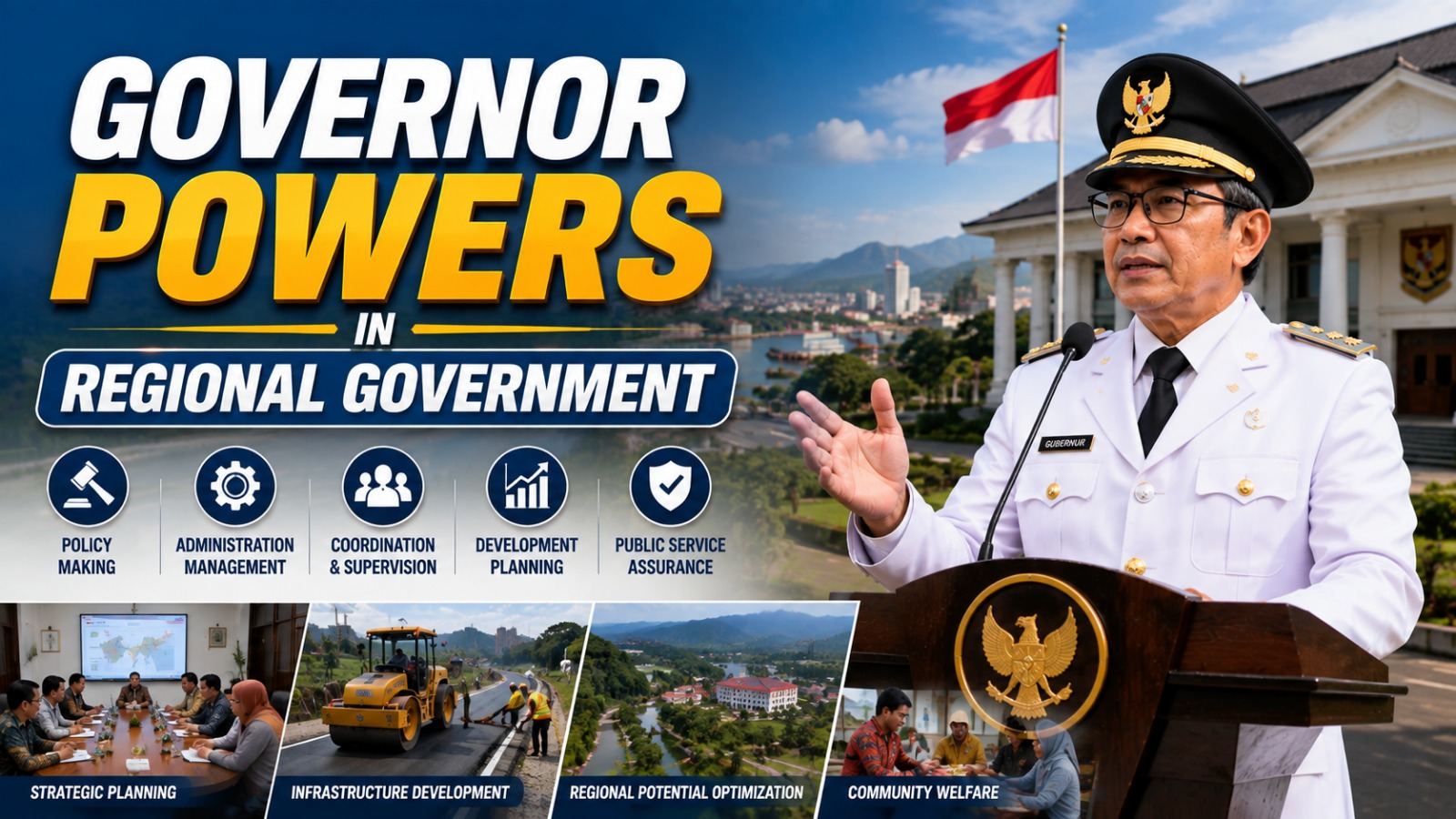
Governors play an important role in Indonesia’s regional government system. A governor serves as the head of a province and also acts as the representative of the Central Government within the province. These two positions give governors responsibilities that cover regional administration, development, public services, coordination, and supervision. Understanding governor powers is important because their decisions can directly influence regional development and public welfare.
Governor powers are not unlimited. They must be exercised according to Indonesian laws and the division of responsibilities between the Central Government, provincial governments, and regency or city governments. The main legal framework is Law Number 23 of 2014 on Regional Government, while Government Regulation Number 33 of 2018 provides further rules concerning governors as representatives of the Central Government.
GOVERNOR AS THE HEAD OF A PROVINCE
As the head of a province, the governor leads the implementation of government affairs that fall under provincial authority. The governor works with regional government agencies to implement development programs and public services. This role requires the governor to establish regional policies in accordance with applicable laws and regional needs. The governor is also responsible for ensuring that provincial government programs are implemented effectively.
The governor does not govern alone. Provincial government administration involves the Regional House of Representatives and regional government agencies, each with their respective functions. Cooperation between these institutions is important for creating effective and accountable regional government. Through this position, the governor becomes one of the main figures responsible for translating regional priorities into government programs.
GOVERNOR AS A CENTRAL GOVERNMENT REPRESENTATIVE
One of the distinctive features of the Indonesian system is that a governor also acts as a representative of the Central Government in the province. This role is different from the governor's position as the head of the provincial government. As a Central Government representative, the governor has responsibilities related to coordination, supervision, monitoring, evaluation, and facilitation of regency and city governments. These functions help maintain consistency between national policies and regional administration.
The governor can also coordinate the implementation of Central Government policies within the province. This position creates an important link between national government institutions and local governments. However, the governor does not automatically take over all responsibilities belonging to regency or city governments. Each level of government continues to operate according to its legally assigned authority.
POWERS IN REGIONAL DEVELOPMENT
Governors have an important role in directing development priorities at the provincial level. Development programs can cover infrastructure, education, healthcare, transportation, economic development, environmental management, and other areas within provincial authority. The governor must consider regional conditions and community needs when establishing development priorities. Effective planning is necessary to ensure that public resources are used efficiently.
Regional development also requires coordination between provincial institutions and regency or city governments. Some issues, such as transportation networks, environmental management, and economic connectivity, cross administrative boundaries. The governor can help coordinate these interests so that development programs do not operate independently. This coordination can support more balanced and integrated regional development.
POWERS IN PUBLIC SERVICES
Public services are another important area of regional government. Governors are responsible for ensuring that provincial services under their authority are delivered properly and according to applicable standards. These services can include areas such as education, healthcare, transportation, and other public services assigned to the provincial level. Good public services should be accessible, transparent, and responsive to community needs.
The governor can also evaluate the performance of provincial government agencies to identify areas that need improvement. Complaints and feedback from citizens can provide valuable information about service quality. Improvements should be based on regulations, available resources, and actual conditions in the region. Effective public services can strengthen public trust in regional government.
POWERS IN COORDINATION AND SUPERVISION
Coordination is an important part of the governor's role because regional government involves several institutions and levels of administration. Governors can coordinate provincial agencies and facilitate cooperation among regency and city governments. This is especially important when a problem affects more than one administrative area. Strong coordination can prevent overlapping programs and improve the effectiveness of government policies.
As representatives of the Central Government, governors also have functions related to the supervision of regency and city governments. Government Regulation Number 33 of 2018 provides a legal basis for duties such as monitoring, evaluation, supervision, and facilitation. These functions are intended to ensure that regional administration follows applicable laws and national policies. Supervision does not mean that governors have unlimited authority over autonomous regency and city governments.
POWERS IN REGIONAL BUDGET MANAGEMENT
Governors have an important role in managing provincial regional finances. One of their responsibilities is submitting the draft Regional Revenue and Expenditure Budget to the provincial Regional House of Representatives for joint discussion. The budget provides funding for government programs, development projects, and public services. Therefore, budget planning must reflect regional priorities and financial capacity.
Governors can also propose amendments to the regional budget when required under applicable regulations. At the end of the budget period, the governor is involved in the process of reporting and accounting for the implementation of the regional budget. Financial management must be transparent, accountable, efficient, and compliant with legal requirements. Responsible budget management helps ensure that public funds provide meaningful benefits to citizens.
LIMITATIONS OF GOVERNOR POWERS
Although governors have broad responsibilities, their authority is clearly limited by law. The Indonesian government system divides responsibilities among the Central Government, provincial governments, and regency or city governments. A governor cannot simply take over an affair that legally belongs to another level of government. Every decision must therefore be based on the governor's legal authority.
These limitations are important for maintaining regional autonomy and preventing overlapping powers. The governor must distinguish between actions taken as the head of a province and actions taken as the representative of the Central Government. Clear boundaries also make government responsibilities easier to understand and monitor. Legal compliance, accountability, and public interest should remain the foundation of every governmental decision.
WHY GOVERNOR POWERS MATTER TO CITIZENS
Governor powers have a direct connection with people's daily lives. Regional policies can influence infrastructure, public transportation, education, healthcare, economic opportunities, and other public services within provincial authority. Effective leadership can help regional programs respond to local challenges and opportunities. For this reason, citizens benefit from understanding what governors can and cannot do.
Public participation is also important in regional government. Citizens can monitor government programs, provide feedback, and communicate their needs through appropriate channels. A well-informed public can better evaluate whether regional policies are being implemented effectively. Cooperation between government and citizens can ultimately support more transparent, responsive, and accountable regional administration.
CONCLUSION
Governor powers in regional government cover a wide range of responsibilities. As provincial heads, governors lead provincial government affairs, development, public services, and regional administration within their legal authority. As representatives of the Central Government, they also perform coordination, supervision, monitoring, evaluation, and facilitation functions involving regency and city governments.
However, governor powers are not absolute. They must be exercised according to Indonesian laws and the division of government responsibilities. Understanding these powers helps citizens recognize the governor's role and distinguish it from the responsibilities of the Central Government, regents, and mayors. Effective use of these powers can support better public services, stronger coordination, and sustainable regional development.
About the Author
Gusti Ayu Tita P
Author — STEKOM University
An active author focused on academic issues, educational technology, and human resource development in the campus environment.















