
History of the 1945 Constitution From Drafting to Amendments
Gusti Ayu Tita P
4 Agustus 2026
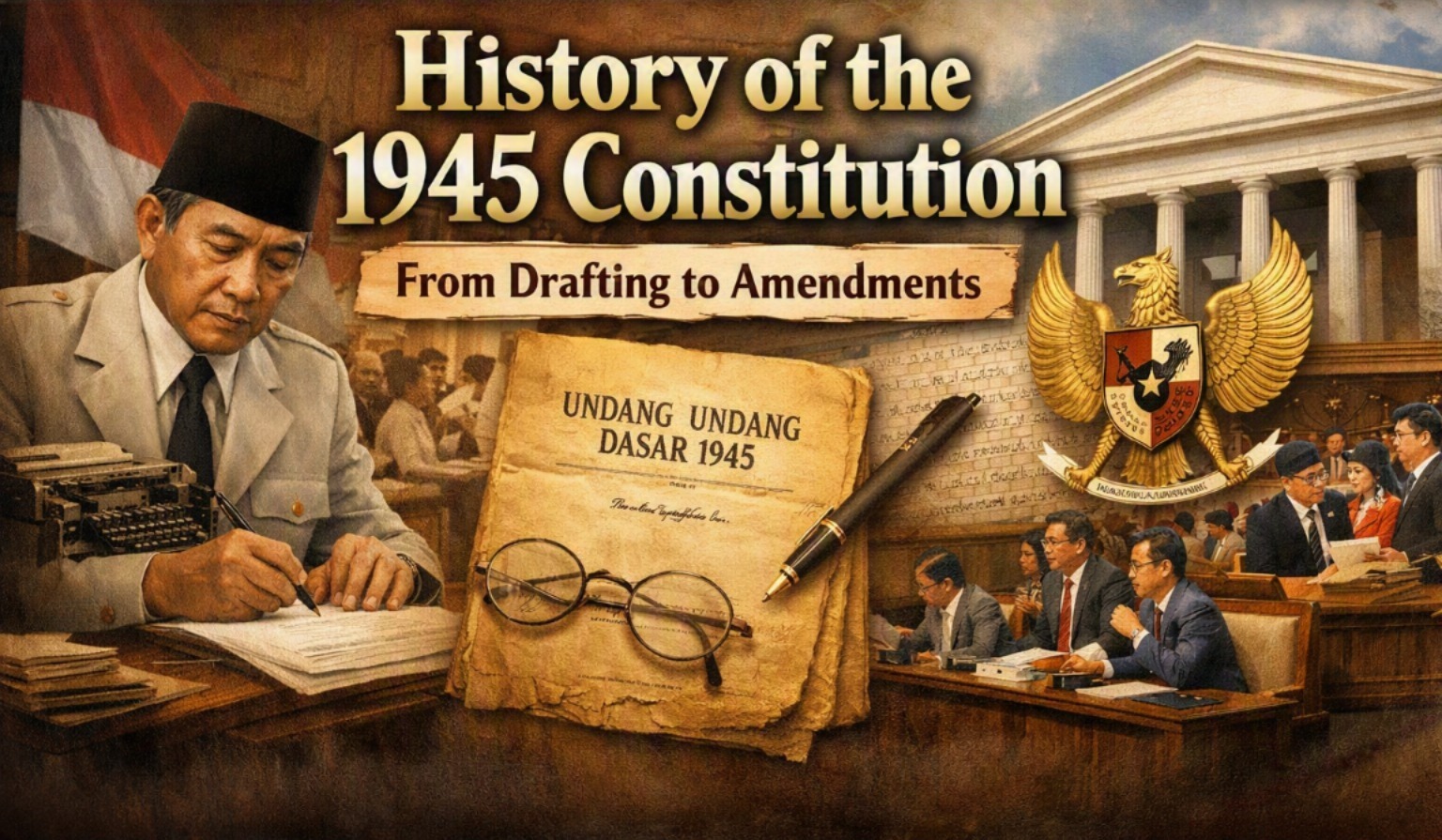
The 1945 Constitution is the highest legal foundation of the Republic of Indonesia and serves as the basis for the country's government, legal system, and democratic principles. Since its adoption in 1945, the Constitution has undergone significant developments to adapt to political, social, and economic changes. Understanding the history of the 1945 Constitution, from its drafting to its amendments, provides valuable insight into how Indonesia has strengthened its constitutional framework while maintaining its national identity. This article explains the journey of the Constitution in a clear and informative way, making it easy for readers to understand its historical importance.
THE DRAFTING OF THE 1945 CONSTITUTION
The drafting of the 1945 Constitution began during the final months of the Japanese occupation of Indonesia. To prepare for independence, the Japanese government established the Investigating Committee for Preparatory Work for Independence (BPUPKI) in 1945. This committee consisted of Indonesian leaders, scholars, and national figures who discussed the future structure of the independent nation. Their main objective was to create a constitutional foundation that reflected the aspirations of the Indonesian people. The drafting process involved careful debates on the principles of government, citizens' rights, and the role of the state.
One of the most influential figures in the drafting process was Soekarno, who introduced the concept of Pancasila as the philosophical foundation of Indonesia on June 1, 1945. Other prominent leaders, including Mohammad Hatta, Soepomo, and Muhammad Yamin, also contributed important ideas to the constitutional framework. After several discussions and revisions, the draft Constitution was finalized to become the legal basis of the soon-to-be independent nation.
THE ADOPTION OF THE CONSTITUTION AFTER INDEPENDENCE
Indonesia officially proclaimed its independence on August 17, 1945, marking a historic turning point for the nation. The following day, on August 18, 1945, the Preparatory Committee for Indonesian Independence (PPKI) formally adopted the 1945 Constitution as the country's supreme law. This decision provided Indonesia with a clear governmental structure and legal foundation immediately after independence.
The Constitution established the President as the head of state and government while outlining the responsibilities of legislative and judicial institutions. It also included the Preamble, which expresses the nation's goals, values, and commitment to justice, unity, and prosperity. The adoption of the Constitution ensured that Indonesia had a strong legal framework during its early years as an independent country.
CHANGES IN THE CONSTITUTIONAL SYSTEM
Although the 1945 Constitution became Indonesia's constitutional foundation, the country experienced several constitutional changes in the following years. Between 1949 and 1950, Indonesia temporarily adopted different constitutional arrangements due to political developments after the struggle for sovereignty. During this period, the Federal Constitution of the Republic of the United States of Indonesia (RIS) and the Provisional Constitution of 1950 replaced the original Constitution.
However, political instability and disagreements within the constitutional assembly made it difficult to establish a permanent constitution. As a result, President Soekarno issued the Presidential Decree of July 5, 1959, which restored the 1945 Constitution as the official Constitution of Indonesia. This decision marked the beginning of a new constitutional era that continued for several decades.
THE CONSTITUTIONAL AMENDMENTS
Following the Reform Era that began in 1998, Indonesia entered a period of major constitutional reform. Many believed that the Constitution needed improvements to strengthen democracy, human rights, and the rule of law. Between 1999 and 2002, the People's Consultative Assembly (MPR) carried out four constitutional amendments while maintaining the original Preamble and the principle of Pancasila.
These amendments significantly improved Indonesia's constitutional system. They introduced direct presidential elections, strengthened the separation of powers, expanded the protection of human rights, and clarified the responsibilities of state institutions. The amendments also enhanced public participation in governance and promoted greater accountability within government institutions.
CONCLUSION
Today, the 1945 Constitution continues to serve as the foundation of Indonesia's democratic system. It provides guidance for the operation of government institutions while protecting the rights and obligations of citizens. Every law enacted in Indonesia must comply with the principles established in the Constitution, ensuring consistency within the national legal system.
Learning about the history of the 1945 Constitution helps citizens appreciate the nation's constitutional development and democratic progress. It also encourages greater respect for the rule of law, constitutional values, and national unity. As Indonesia continues to develop, the Constitution remains a living document that supports stability, justice, and sustainable governance for future generations.
About the Author
Gusti Ayu Tita P
Author — STEKOM University
An active author focused on academic issues, educational technology, and human resource development in the campus environment.















