How Can Academic Competition Improve The Quality Of University Students?
Gusti Ayu Tita P
20 Agustus 2026
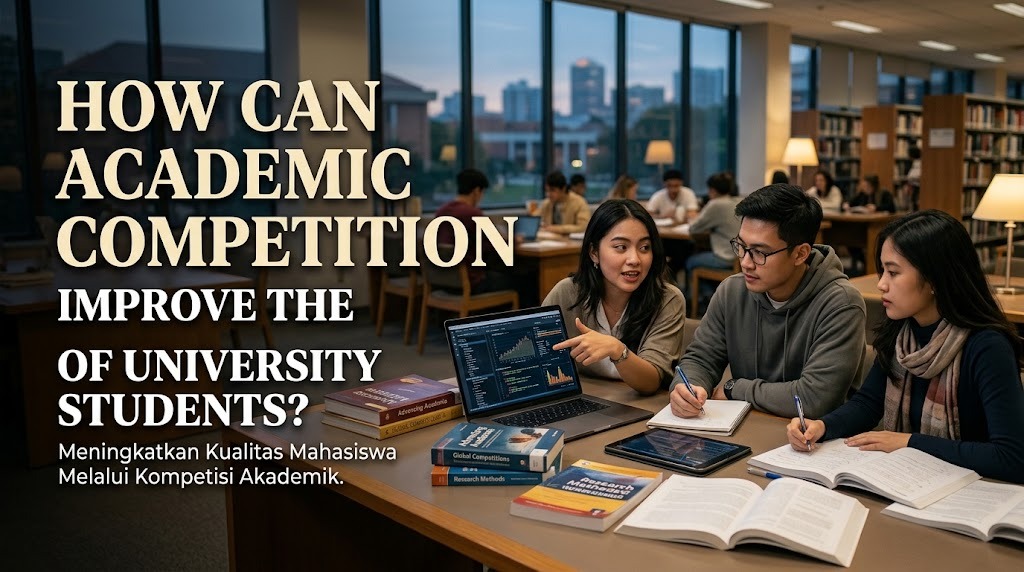
Academic competition is one of the activities that can provide university students with valuable learning experiences beyond regular classroom activities. Competitions such as debates, academic writing, research contests, olympiads, presentations, and innovation challenges encourage students to apply their knowledge in practical situations. Students are required to think carefully, solve problems, communicate ideas, and work toward specific goals. These experiences can support both academic development and personal growth. Therefore, academic competition can become an important tool for improving the quality of university students when it is managed in a healthy and educational way.
DEVELOPING CRITICAL THINKING SKILLS
Academic competition encourages students to analyze information before making decisions. Participants often need to understand a problem, identify relevant information, and develop solutions based on logical reasoning. This process helps improve critical thinking and analytical skills. Students become more accustomed to questioning information instead of accepting every statement without evaluation. These skills are useful not only for academic assignments but also for solving problems in everyday and professional situations.
Competitions such as debates and research contests also require students to support their arguments with reliable evidence. Students learn to compare different perspectives and choose the strongest arguments. This experience strengthens their problem solving abilities and helps them make decisions based on evidence. Over time, students can develop a more systematic approach to difficult situations. Academic competition therefore tests not only what students know but also how effectively they use their knowledge.
BUILDING TEAMWORK AND LEADERSHIP
Not every academic competition is individual. Many competitions require students to work in teams and divide responsibilities among members. This process develops teamwork, coordination, communication, and responsibility. Students learn how to contribute to a common goal while respecting the abilities of other team members. They may also face disagreements and learn how to find solutions through discussion. These experiences are useful because many professional environments require effective teamwork.
Academic competition can also provide opportunities to practice leadership. A team leader may need to organize tasks, manage deadlines, and maintain communication among members. However, good leadership is not only about giving instructions. It also involves listening, supporting team members, accepting different opinions, and taking responsibility for decisions. These experiences can help students develop leadership skills that are useful beyond university.
DEVELOPING TIME MANAGEMENT AND DISCIPLINE
Preparing for an academic competition can be challenging because students still have lectures, assignments, and other responsibilities. They need to schedule time for studying, practicing, researching, teamwork, and rest. This situation can strengthen time management and discipline. Students learn to identify priorities and complete tasks according to deadlines. These habits can improve their productivity in other academic activities.
Good time management also teaches students to avoid unnecessary procrastination. Competition preparation often requires several stages, so delaying one task can affect the entire preparation process. However, students should maintain a healthy balance between competition, academic responsibilities, and rest. Consistent productivity is more sustainable than excessive pressure. This experience can prepare students for professional environments where deadlines and multiple responsibilities are common.
BUILDING CONFIDENCE AND RESILIENCE
Academic competition allows students to test their abilities in challenging situations. Successfully completing a difficult task or receiving positive feedback can increase self confidence. On the other hand, losing a competition can teach students how to evaluate mistakes and improve their performance. Students learn that failure does not necessarily mean that their efforts were meaningless. Instead, failure can provide useful information for future improvement.
Students also learn how to respond to criticism and evaluation. Constructive feedback can help them identify weaknesses that may not have been noticed before. Resilience and the ability to learn from failure are important qualities for university students and future professionals. Competition can therefore teach students how to handle challenges without giving up easily. This experience can strengthen their mental readiness for uncertain situations.
EXPANDING KNOWLEDGE AND NETWORKS
Academic competitions can introduce students to participants, lecturers, researchers, mentors, and students from different universities. These interactions provide opportunities to exchange knowledge and experiences. Students may discover new perspectives, learning methods, or ideas related to their fields. Meeting people from different academic backgrounds can also broaden their understanding of the subject they study. These experiences can contribute to personal and academic development.
The relationships developed during competitions may also become useful professional or academic networks. Students may find opportunities for research collaboration, projects, internships, or other educational activities. Academic and professional networks can become valuable resources after graduation. However, students should build these relationships through mutual respect and meaningful communication. Networking is most useful when it is based on genuine cooperation rather than simply collecting contacts.
PREPARING STUDENTS FOR THE PROFESSIONAL WORLD
The professional world requires more than academic knowledge. Graduates need to communicate effectively, solve problems, work with others, manage deadlines, and adapt to changes. Academic competition can provide opportunities to develop technical and interpersonal skills through challenging tasks. Students become accustomed to working toward goals, receiving feedback, and presenting their work. These experiences can contribute to better preparation for future careers.
However, academic competition is not the only way to prepare for professional life. Internships, research, student organizations, community projects, and practical experiences can provide equally valuable learning opportunities. The most important goal is to combine academic knowledge with practical skills and strong character. When competition becomes part of a broader learning experience, its benefits can become more meaningful. Students can then graduate with a more balanced set of abilities.
CONCLUSION
Academic competition can improve the quality of university students by providing meaningful challenges and opportunities to learn through experience. It can develop critical thinking, learning motivation, creativity, communication, teamwork, leadership, discipline, confidence, and resilience. Competitions can also expand students' knowledge and networks while helping them prepare for professional environments. However, competition should be conducted in a healthy way so that students do not experience unnecessary pressure. Ultimately, academic competition should be viewed not simply as a way to win awards, but as a learning opportunity that helps students become more skilled, adaptable, confident, and prepared for the future.
About the Author
Gusti Ayu Tita P
Author — STEKOM University
An active author focused on academic issues, educational technology, and human resource development in the campus environment.