
How Can Community Service Programs Strengthen Student Social Engagement?
Gusti Ayu Tita P
20 Agustus 2026
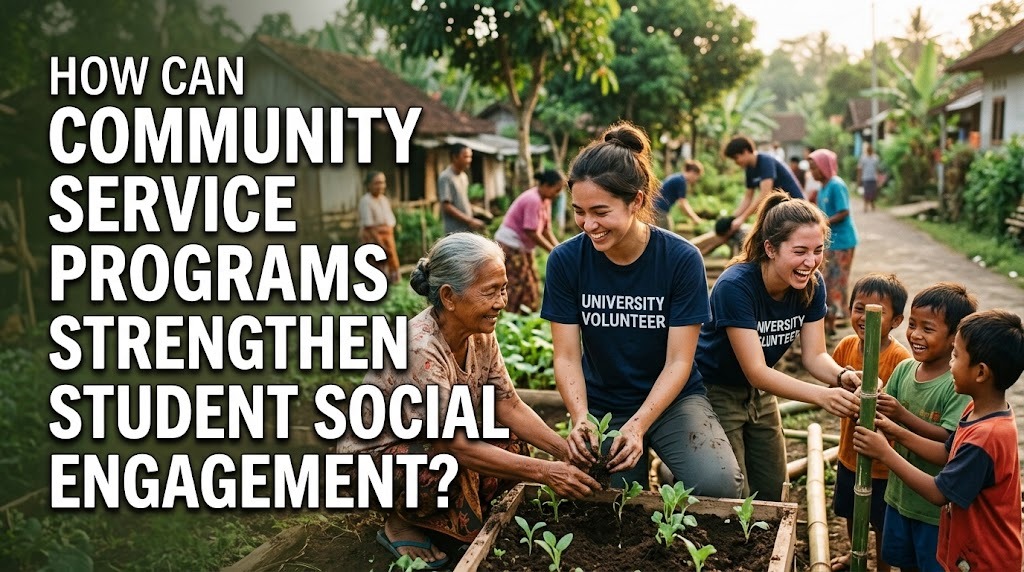
Community service programs give university students opportunities to interact directly with communities and participate in activities that address local needs. Unlike classroom learning, these programs place students in real social environments where communication, cooperation, and responsibility are essential. Through activities such as education, environmental projects, health awareness, digital literacy, and small business support, students can understand how their knowledge can benefit others. These experiences can strengthen student social engagement by encouraging active participation rather than passive observation. When designed properly, community service can also help students become more aware of their role as members of society.
CREATING DIRECT INTERACTION WITH COMMUNITIES
Direct interaction is one of the most important ways community service strengthens student social engagement. Students communicate with residents, community leaders, local organizations, and other groups while carrying out their programs. These interactions allow students to understand people's needs, concerns, and expectations more clearly. Face to face communication can also reduce assumptions that students might make when they only learn about social problems from academic sources. As a result, students can develop a more realistic understanding of community life.
Regular interaction also gives students opportunities to build relationships based on trust. Students need to listen carefully and respect local perspectives before proposing activities. Meaningful relationships can encourage residents to participate more actively in community programs. At the same time, students become more comfortable communicating with people from different backgrounds. This experience can strengthen their social confidence and interpersonal skills.
DEVELOPING EMPATHY AND SOCIAL AWARENESS
Community service exposes students to different social conditions and life experiences. Students may encounter challenges related to education, employment, health, the environment, or access to technology. Seeing these situations directly can help them understand that social problems affect real people and families. Empathy and social awareness can develop when students listen to community members and learn about their experiences. This can influence how students view social issues after the program ends.
Empathy also encourages students to avoid judging situations too quickly. They learn that communities often have their own reasons for maintaining certain habits or choosing particular solutions. Students can become more willing to understand a problem before suggesting an answer. Respectful listening is therefore an important part of social engagement. It helps create interactions where both students and community members can learn from one another.
ENCOURAGING SOCIAL RESPONSIBILITY
Community service can help students understand that higher education also involves responsibility toward society. Their academic knowledge can be used to support communities in practical ways. Students may begin to see themselves not only as learners but also as potential contributors to social development. This awareness can encourage them to become more involved in community activities. Social responsibility can therefore become part of their personal development.
Students also learn that social responsibility is not limited to large projects. Small actions, such as helping children with learning activities or supporting local environmental efforts, can provide meaningful benefits. What matters is that the contribution responds to a genuine need. Consistent participation and responsible action can gradually strengthen students' commitment to their communities. These values can continue to influence their behavior after graduation.
CONNECTING ACADEMIC KNOWLEDGE WITH SOCIAL NEEDS
Community service provides a practical environment for students to apply what they learn at university. Students from different fields can contribute according to their knowledge and abilities. Marketing students, for example, may help local businesses improve basic promotional strategies, while technology students may support digital literacy activities. This process demonstrates how academic knowledge can address real community needs. It also helps students understand the practical limitations of theoretical solutions.
Students may discover that applying knowledge requires flexibility. A strategy that works in a classroom example may need modification when used in a real community. They must consider available resources, local culture, community priorities, and participation levels. Practical learning can make academic knowledge more meaningful. At the same time, students can identify new skills they need to develop.
DEVELOPING LEADERSHIP AND INITIATIVE
Community service provides opportunities for students to take responsibility for activities and projects. They may coordinate teams, organize schedules, communicate with stakeholders, or manage specific tasks. These responsibilities can develop leadership and initiative. Students learn that leadership requires accountability and the ability to support others. They also gain experience making decisions in situations that may not have simple answers.
Initiative is especially important when students encounter unexpected problems. Instead of waiting for instructions, they may need to identify alternatives and coordinate solutions. This encourages students to become more proactive and independent. Such qualities can strengthen social engagement because students are more willing to contribute without being forced. These skills can also be valuable in future workplaces and organizations.
PROMOTING LONG TERM SOCIAL ENGAGEMENT
A community service program should ideally encourage students to remain socially engaged after the program ends. Students may continue participating in volunteering, community organizations, environmental activities, or educational initiatives. Positive experiences can motivate them to seek other ways of contributing to society. Long term engagement is more meaningful than participation that ends when the program officially finishes. It can turn a temporary experience into a lasting habit.
Students can also maintain relationships with communities when appropriate. Continued communication can help them understand whether their previous activities created useful outcomes. It may also provide opportunities for future collaboration. Sustainable relationships can strengthen both student learning and community development. This makes social engagement an ongoing process rather than a one time obligation.
REFLECTING ON SOCIAL EXPERIENCES
Reflection is essential for turning community service into meaningful personal development. After completing activities, students can evaluate what they learned about communities, communication, teamwork, and their own attitudes. They can identify assumptions that changed and skills that still need improvement. Self reflection helps students understand the meaning behind their experiences. Without reflection, students may complete activities without fully recognizing their social and educational value.
Students can use journals, group discussions, reports, or feedback sessions to reflect on their experiences. They can ask what worked, what did not work, and how they could contribute more effectively in the future. This process encourages continuous learning and personal growth. It also helps students connect social experiences with their academic and professional goals.
CONCLUSION
Community service programs can significantly strengthen student social engagement by creating opportunities for direct interaction, active participation, communication, teamwork, and community collaboration. Students can develop empathy, social awareness, leadership, initiative, and social responsibility while applying academic knowledge to real situations. The benefits become stronger when community members are treated as partners and their perspectives are respected. Students should also reflect on their experiences and look for opportunities to remain involved after the program ends. Ultimately, meaningful community service can help students become more socially aware, responsible, collaborative, and prepared to contribute positively to society.
About the Author
Gusti Ayu Tita P
Author — STEKOM University
An active author focused on academic issues, educational technology, and human resource development in the campus environment.















