
How Can Game Developers Create Games That Increase Player Satisfaction?
Gusti Ayu Tita P
5 Agustus 2026
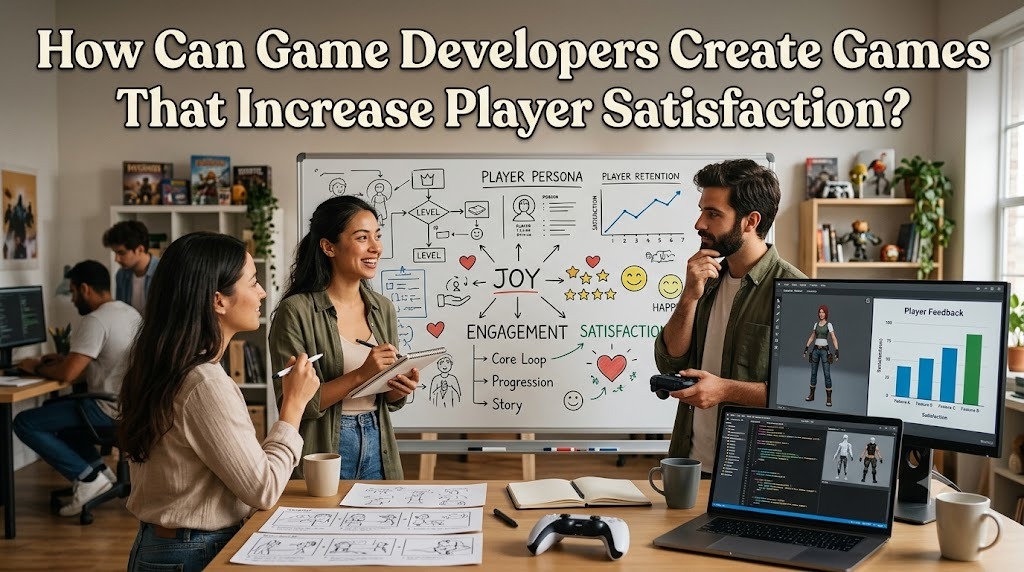
Creating a successful game is not only about producing attractive graphics or advanced technology. Player satisfaction is strongly influenced by how enjoyable, fair, comfortable, and meaningful the overall gaming experience feels. Game developers need to understand what players expect and transform those expectations into effective gameplay systems. By combining creative design with technical quality, developers can create games that encourage players to return and recommend the experience to others.
Player satisfaction can be influenced by many factors, including gameplay, controls, difficulty, performance, accessibility, progression, storytelling, and community features. Every game has a different target audience, so developers should avoid using a single formula for every project. Instead, they should research their audience, test their ideas, collect feedback, and continuously improve the game. A player-focused development process can help create a more enjoyable and sustainable gaming experience.
UNDERSTANDING THE TARGET PLAYERS
The first step in creating a satisfying game is understanding the people who are expected to play it. Developers should identify the target audience based on factors such as gaming preferences, experience level, platform, and interests. Player research can be conducted through surveys, interviews, community discussions, market research, and early playtesting. These methods help developers understand what players enjoy and what problems may discourage them.
Developers should also recognize that players have different motivations. Some players enjoy competition, while others prefer exploration, storytelling, creativity, social interaction, or relaxation. A successful game should clearly communicate what type of experience it offers. Understanding these motivations allows developers to design features that support the intended player experience.
DESIGNING ENJOYABLE GAMEPLAY
Gameplay is the foundation of player satisfaction because it determines what players actually do during the game. Developers should create mechanics that are easy to understand but provide enough depth to remain interesting. Players should have clear objectives and receive meaningful feedback when they make decisions. A strong gameplay loop can encourage players to continue because the actions they perform feel rewarding.
Developers should test the core gameplay before investing heavily in additional content. Prototypes can help determine whether movement, combat, puzzles, exploration, or other central mechanics are enjoyable. If the main gameplay is not engaging, adding more characters or visual effects may not solve the underlying problem. Early playtesting allows developers to identify weaknesses and make changes before production becomes too expensive.
CREATING RESPONSIVE AND INTUITIVE CONTROLS
Controls have a direct effect on how players interact with a game. Responsive controls make players feel that their actions are accurately reflected on screen. Delayed inputs, confusing button layouts, or inconsistent movement can quickly reduce satisfaction. Developers should test controls repeatedly and adjust them according to the game's genre and target platform.
Different platforms require different control approaches. A PC game may rely on keyboard and mouse input, while console games commonly use controllers and mobile games use touchscreens. Developers can improve accessibility by providing customizable controls, sensitivity settings, and clear control instructions where appropriate. Players should be able to understand important controls without unnecessary difficulty.
BALANCING CHALLENGE AND FAIRNESS
A satisfying game should provide challenges that feel difficult but fair. If the game is too easy, players may lose interest, while excessive difficulty can create frustration. Developers can introduce challenges gradually so players have time to understand the game's systems. Difficulty should increase in a way that reflects player learning and progression.
Fairness is equally important. Players should understand why they failed and have a reasonable opportunity to improve. Randomness can be useful in some game designs, but it should not make important outcomes feel completely uncontrollable. Clear feedback and consistent rules help players understand the relationship between their decisions and the results.
BUILDING MEANINGFUL PROGRESSION
Progression gives players a sense that their time and effort are producing results. Developers can use levels, abilities, equipment, achievements, story progression, or cosmetic rewards to create a feeling of advancement. Rewards should support the game's core experience rather than simply encouraging players to repeat tasks. Players should understand what they are working toward and why the reward matters.
Progression also needs an appropriate pace. If rewards arrive too quickly, they may lose their value, while extremely slow progression can feel like unnecessary grinding. Developers should use playtesting and player feedback to identify a suitable balance. A well-designed progression system can create long-term motivation without making the game feel repetitive.
IMPROVING PERFORMANCE AND GAME STABILITY
Technical quality is an essential part of player satisfaction. A game with frequent crashes, severe frame-rate drops, long loading times, or connection problems can quickly frustrate players. Developers should perform quality assurance testing and optimization throughout production. Testing should cover different hardware configurations and operating conditions whenever possible.
Performance problems should also be monitored after launch. Players may discover technical issues that were not found during internal testing. Developers can use crash reports, performance data, and player feedback to identify important problems. Stable performance builds trust because players can enjoy the game without constantly worrying about technical interruptions.
MAKING GAMES ACCESSIBLE
Accessibility helps more people enjoy a game by reducing barriers that are not part of the intended challenge. Developers can consider features such as subtitles, adjustable text size, color options, remappable controls, audio controls, visual indicators, and difficulty assistance. The appropriate features depend on the game and its target audience. Accessibility should be treated as an important part of user experience rather than an afterthought.
Accessibility is easier to implement when considered early in development. Developers can identify potential barriers during design and build suitable options into the game's systems. Testing with different players can reveal accessibility problems that the development team may not notice. A more accessible game can provide a better experience for a broader range of players.
CREATING A CLEAR USER INTERFACE
A clear user interface or UI helps players understand information without interrupting the gameplay experience. Important elements such as health, objectives, maps, inventory, menus, and controls should be presented logically. Players should not have to spend excessive time searching for basic information. Consistent icons, labels, layouts, and visual feedback can make the interface easier to understand.
Developers should test UI designs with new players because experienced developers already understand how their own systems work. Testing can reveal confusing menus, unclear icons, unnecessary steps, or missing information. Simplifying the interface can reduce cognitive load and make the game easier to learn. Good UI design supports gameplay rather than competing with it.
SUPPORTING A HEALTHY PLAYER COMMUNITY
A strong community can make players feel more connected to a game. Developers can encourage positive interaction through events, community challenges, developer updates, social features, and creative activities. Communities can also provide useful feedback and help players discover strategies or content. A positive social environment can increase engagement beyond the core gameplay.
Developers should also establish clear rules against harassment, cheating, and disruptive behavior. Appropriate moderation can help protect players and maintain a welcoming environment. Communication should be consistent, especially when developers need to explain major changes or problems. Trust between developers and players can become an important part of long-term player satisfaction.
CONTINUOUSLY IMPROVING THE PLAYER EXPERIENCE
Player satisfaction should not be treated as a goal that ends when the game launches. Developers should continue evaluating the experience through player feedback, analytics, technical reports, and community discussions. Updates can address bugs, improve balance, optimize performance, or introduce carefully planned content. Continuous improvement can help keep a game relevant and enjoyable over time.
Developers should prioritize changes based on their potential impact. Serious bugs and major usability problems may need to be addressed before cosmetic improvements or optional features. Every update should also be tested to reduce the risk of creating new problems. A structured improvement process allows developers to respond to player needs while maintaining the game's overall vision.
CONCLUSION
Game developers can increase player satisfaction by focusing on the complete player experience rather than one individual feature. Enjoyable gameplay, responsive controls, fair challenges, meaningful progression, strong performance, accessibility, clear interfaces, and reliable feedback systems all contribute to a better game. These elements should be considered throughout development rather than added only shortly before release.
The most effective approach is to understand the target audience, test ideas early, listen to players, and continuously improve the product. Developers should also maintain fairness and transparency, especially when designing monetization and community systems. By combining player-centered design, technical quality, thoughtful testing, and continuous improvement, developers can create games that are enjoyable, trustworthy, and more likely to build long-term player satisfaction.
About the Author
Gusti Ayu Tita P
Author — STEKOM University
An active author focused on academic issues, educational technology, and human resource development in the campus environment.















