
How Can Schools Improve Student Readiness for ANBK?
Gusti Ayu Tita P
29 Agustus 2026
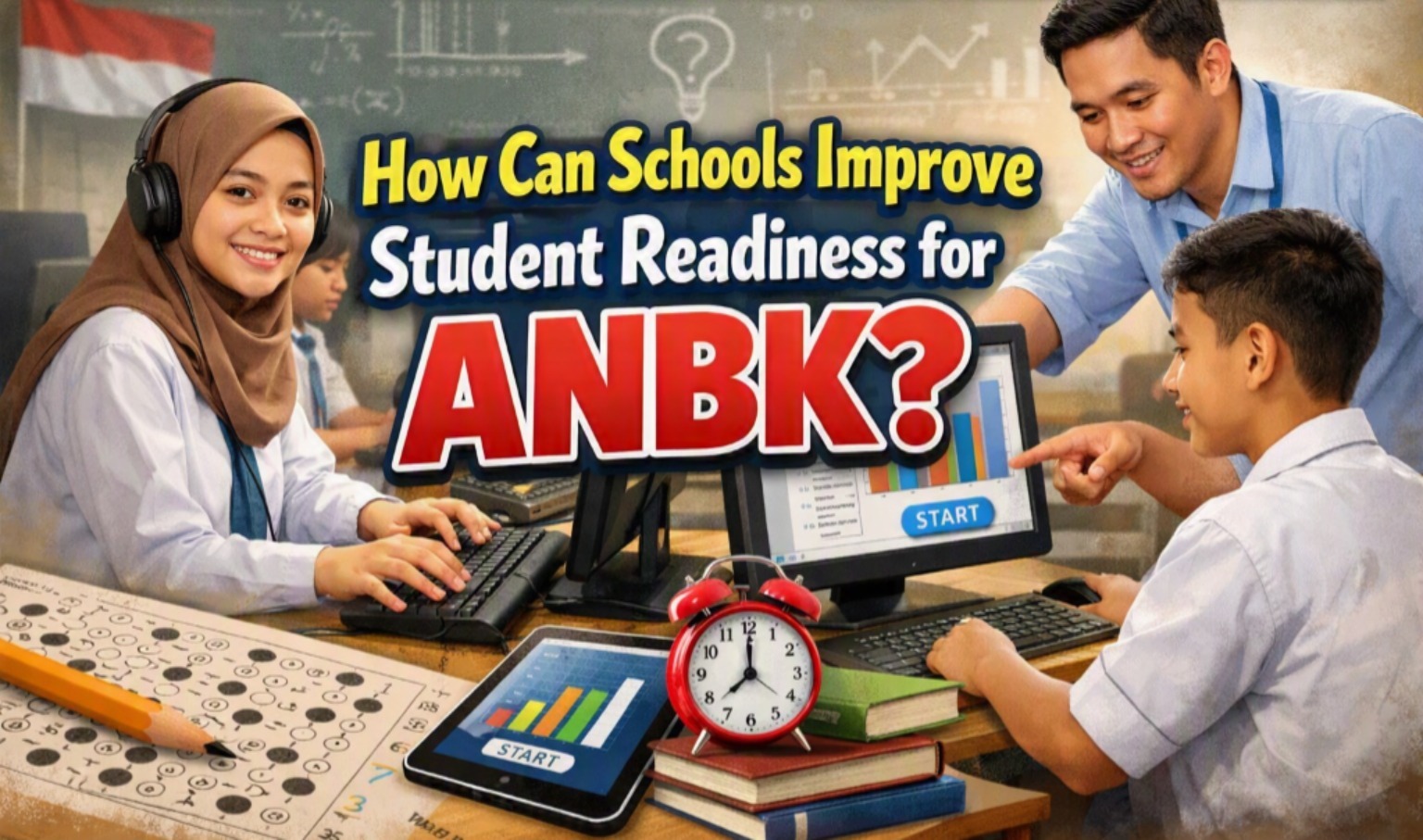
The Asesmen Nasional Berbasis Komputer (ANBK) is an important national assessment designed to provide an overview of education quality in Indonesia. Unlike a conventional exam that focuses mainly on individual student scores, ANBK assesses several aspects of learning, including literacy, numeracy, character, and learning environment. Therefore, schools need to prepare students not only to understand test questions but also to develop the skills required to solve problems effectively.
Improving student readiness should be carried out through consistent learning activities, appropriate practice, digital preparation, and emotional support. With a structured approach, students can become more confident when participating in ANBK without experiencing excessive pressure.
UNDERSTAND THE ANBK ASSESSMENT
The first step schools can take is to help students understand the purpose and structure of ANBK. Students should know that ANBK is not simply a test of memorized knowledge. The assessment includes components such as the Minimum Competency Assessment or AKM, which focuses on reading literacy and numeracy, as well as the character survey and learning environment survey. Understanding these components can make students more familiar with what they may encounter during the assessment.
Teachers should explain the assessment using simple language and practical examples. Students can be introduced to different types of questions, reading-based problems, numerical reasoning, and situations that require logical thinking. This approach can reduce confusion and help students build realistic expectations before the assessment takes place.
STRENGTHEN LITERACY AND NUMERACY SKILLS
Schools should make literacy and numeracy development part of everyday learning rather than treating them as special preparation only before ANBK. Literacy activities can include reading articles, interpreting information, identifying the main idea, comparing sources, and drawing conclusions from a text. These activities help students become more comfortable with questions that require understanding and reasoning, rather than simply remembering information.
Numeracy can also be integrated into different subjects and real-life situations. Teachers can use problems involving percentages, measurements, graphs, tables, comparisons, and basic calculations to encourage students to apply mathematical concepts. Regular practice with contextual problems can improve students' ability to analyze information and select the most appropriate solution.
PROVIDE REGULAR PRACTICE QUESTIONS
Regular practice is another effective way to improve ANBK readiness. Schools can provide practice questions that resemble the reasoning demands and digital format of ANBK without turning preparation into excessive drilling. After completing exercises, teachers should discuss the answers and explain why a particular answer is correct.
Students should also be encouraged to learn from mistakes. Instead of focusing only on the final score, teachers can identify areas where students have difficulty and provide additional guidance. This method allows practice sessions to become part of the learning process, helping students gradually improve their accuracy and confidence.
IMPROVE DIGITAL SKILLS
Because ANBK is conducted using computers, students need sufficient digital skills before assessment day. Schools should provide opportunities for students to practice using computers, including logging in, navigating assessment screens, selecting answers, and moving between questions. Students who are unfamiliar with digital testing may spend unnecessary time dealing with technical difficulties instead of focusing on the questions.
Schools can organize computer-based practice sessions periodically. These sessions should also introduce students to responsible device use and basic troubleshooting procedures. If possible, schools should check the condition of computers, internet connections, and other technical equipment in advance so that students can participate in the assessment more comfortably.
TRAIN STUDENTS TO MANAGE TIME
Good time management is essential when students complete a computer-based assessment. Some questions may require more reading and reasoning than others, so students need to learn how to distribute their time appropriately. Teachers can train students to read questions carefully, identify important information, and avoid spending too much time on a single difficult question.
Practice sessions can include simple time-management strategies. For example, students can be encouraged to answer questions they understand first and return to more challenging questions when appropriate. This does not mean rushing through the assessment, but rather learning how to maintain a balance between speed, accuracy, and careful reasoning.
BUILD STUDENT CONFIDENCE
Academic preparation alone is not enough if students experience excessive anxiety or fear about ANBK. Schools should create a supportive environment where students understand that the assessment is part of evaluating education quality rather than a reason to feel pressured. Teachers and parents can provide encouragement and remind students to focus on preparation instead of worrying excessively about results.
Students should also be taught simple ways to stay calm, such as taking short pauses, reading questions carefully, and maintaining a positive mindset. Teachers can recognize students' progress and effort rather than constantly emphasizing performance. A supportive approach can help students approach ANBK with greater confidence and emotional readiness.
INVOLVE TEACHERS AND PARENTS
Effective ANBK preparation requires cooperation between teachers, school leaders, and parents. Teachers can identify students' learning difficulties and design appropriate support based on classroom observations and practice results. School leaders can provide the necessary facilities, coordinate preparation programs, and ensure that students receive consistent guidance.
Parents can support the process by creating a comfortable study environment at home. They can encourage regular reading, help students maintain healthy routines, and provide motivation without placing unnecessary pressure on them. When schools and families communicate effectively, students are more likely to receive consistent academic and emotional support.
EVALUATE PREPARATION REGULARLY
Schools should evaluate their preparation program instead of assuming that practice automatically leads to improvement. Teachers can review students' performance to identify common difficulties in literacy, numeracy, reasoning, digital skills, and time management. The results can then be used to adjust learning activities and provide targeted assistance.
Evaluation should focus on progress rather than comparison between students. Every student may have different strengths and weaknesses, so support should be adjusted to individual needs whenever possible. Through continuous evaluation, schools can build a more effective preparation strategy and help students become better prepared for ANBK.
CONCLUSION
Improving student readiness for ANBK requires more than providing practice questions shortly before the assessment. Schools should develop literacy, numeracy, reasoning, digital competence, time management, and confidence through consistent activities. Teachers and parents also have an important role in creating a supportive environment that encourages students to learn without excessive pressure.
With structured preparation and continuous evaluation, students can become more familiar with computer-based assessment and the reasoning skills required by ANBK. The ultimate goal is not simply to prepare students for one assessment, but to strengthen skills that are useful for their future learning and everyday life.
About the Author
Gusti Ayu Tita P
Author — STEKOM University
An active author focused on academic issues, educational technology, and human resource development in the campus environment.















