
How Can Students Balance Academic Success With Real Knowledge?
Gusti Ayu Tita P
21 Agustus 2026
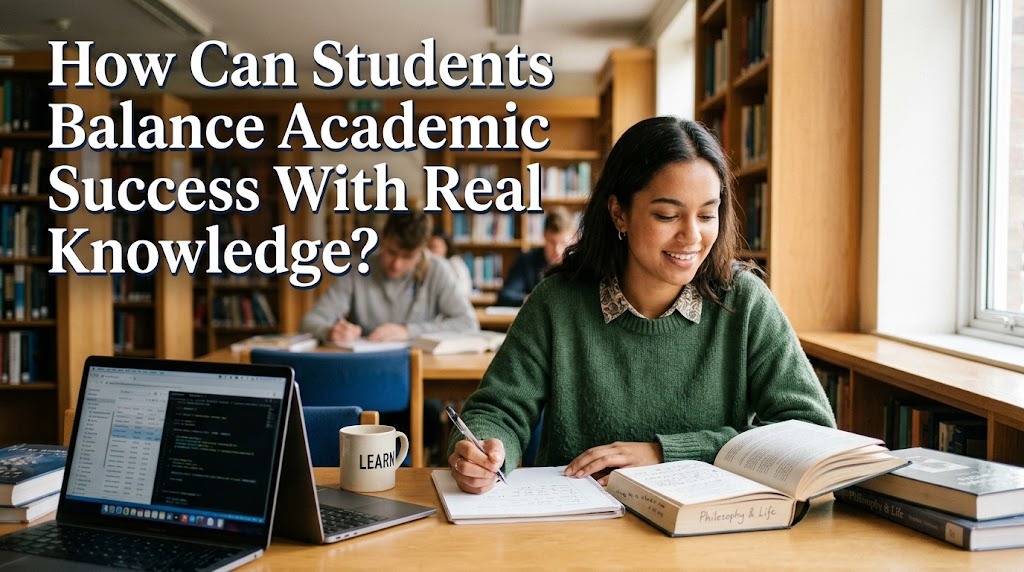
Academic success is often associated with high grades, completed assignments, and strong examination results. These achievements are important because they can support scholarships, further education, and career opportunities. However, good grades do not always mean that students have developed a deep understanding of what they study. Real knowledge requires students to understand concepts, apply information, ask questions, and connect learning with real situations. The best approach is to pursue academic achievement while building meaningful and practical knowledge.
UNDERSTAND THAT GRADES AND KNOWLEDGE ARE DIFFERENT
Grades usually measure how well students perform according to specific academic requirements. They can reflect preparation, understanding, writing ability, problem solving, and performance in examinations or assignments. However, grades cannot always capture curiosity, practical ability, creativity, or the ability to apply knowledge outside the classroom. Therefore, students should treat grades as one indicator of learning, rather than the complete definition of knowledge.
Real knowledge develops when students understand the reasons behind information. Instead of memorizing an answer only for an examination, students can ask why the answer is correct and how the concept works in another situation. This approach helps create deeper understanding that can remain useful after a course ends. Students can achieve strong grades while still focusing on meaningful learning.
FOCUS ON UNDERSTANDING INSTEAD OF MEMORIZATION
Memorization can be useful for learning important facts, definitions, formulas, and terminology. However, relying only on memorization can make it difficult to apply knowledge to unfamiliar problems. Students should therefore combine memorization with understanding, analysis, and practical application. They can explain concepts in their own words to check whether they genuinely understand them.
Students can also use examples to connect theoretical information with everyday situations. Asking questions such as how, why, and what would happen if can encourage deeper thinking. Practice problems and case studies can further demonstrate whether students can apply what they have learned. This approach supports long term knowledge retention rather than short term examination preparation.
CONNECT CLASSROOM LEARNING WITH REAL LIFE
One of the best ways to build real knowledge is to connect academic concepts with practical situations. Students can gain experience through internships, projects, volunteering, student organizations, competitions, and part time work. These activities allow them to apply classroom concepts in situations that may be more complex than textbook examples. Practical experience can also reveal which skills need further development.
For example, an accounting student can practice financial concepts by working on a real business project. A communication student can improve their abilities through presentations, organizational activities, or public speaking events. These experiences help students understand why their academic knowledge matters. Practical application can make learning more memorable and useful.
DEVELOP CRITICAL THINKING SKILLS
Critical thinking is essential for balancing academic achievement with real knowledge. Students should learn to evaluate evidence, compare different perspectives, identify assumptions, and reach logical conclusions. These skills help them understand subjects rather than simply accepting information as fact. They are also valuable when completing research papers and academic discussions.
Critical thinking can be practiced through debates, case studies, research activities, and problem solving exercises. Students can question whether evidence is reliable and consider whether there are alternative explanations. This encourages them to become more independent learners. Strong critical thinking skills can benefit students both inside and outside the classroom.
USE ASSIGNMENTS AS LEARNING OPPORTUNITIES
Assignments should not be treated only as tasks that need to be submitted before a deadline. Students can use them as opportunities to explore topics, practice skills, and develop deeper understanding. Instead of doing the minimum required work, they can consider what additional knowledge they can gain from the assignment. This mindset can turn routine academic tasks into meaningful learning experiences.
Students should also pay attention to feedback from lecturers. Feedback can reveal weaknesses in reasoning, writing, research, or technical skills. Reviewing mistakes instead of simply looking at the final grade can provide valuable lessons. In this way, assignments become part of a continuous learning process.
MANAGE TIME WITHOUT SACRIFICING LEARNING
Balancing grades and knowledge also requires effective time management. Students who leave assignments until the last minute may focus primarily on finishing the work rather than understanding the material. Creating an early schedule allows students to research, practice, revise, and reflect. It also reduces unnecessary stress before examinations and deadlines.
Students can divide large academic tasks into smaller activities and set priorities based on deadlines and importance. They should also reserve time for practical learning, reading, and personal development. Adequate sleep and breaks are important because exhaustion can reduce concentration and learning efficiency. A balanced schedule supports both academic performance and healthy learning habits.
READ BEYOND THE REQUIRED MATERIAL
Course materials provide a foundation, but students can develop stronger knowledge by exploring reliable sources beyond their assignments. They can read books, academic journals, research papers, professional publications, and credible educational resources. Different sources can introduce students to new perspectives and more detailed explanations.
Reading beyond the syllabus does not mean students need to study everything available. They can select materials related to their interests or areas they find difficult. Learning to compare sources also improves research skills and information literacy. This habit can encourage intellectual curiosity and help students become lifelong learners.
USE GRADES AS FEEDBACK NOT AS THE FINAL GOAL
Grades can provide useful information about academic performance. A low grade may indicate that a student needs to improve their understanding, study methods, or assignment quality. A high grade can show that the student has met particular academic expectations. However, students should use grades as feedback for improvement rather than treating them as the only measure of personal ability.
After receiving a grade, students can ask what they learned and what they could improve. They can review incorrect answers, lecturer comments, and areas where their reasoning was weak. This approach turns academic evaluation into an opportunity for growth. Growth oriented learning helps students focus on progress instead of constantly comparing themselves with others.
CONCLUSION
Students can balance academic success with real knowledge by pursuing good grades while focusing on understanding, practical application, critical thinking, and continuous improvement. Grades are valuable, but they should not become the only purpose of education. Setting meaningful learning goals, connecting theory with real experiences, using assignments effectively, and reading beyond required materials can create deeper knowledge. Good time management can also help students maintain academic performance without sacrificing health or meaningful learning. Ultimately, the strongest form of academic success combines excellent results with knowledge and skills that students can apply throughout their education, careers, and everyday lives.
About the Author
Gusti Ayu Tita P
Author — STEKOM University
An active author focused on academic issues, educational technology, and human resource development in the campus environment.















