
How Can Students Improve Their Knowledge While Working Toward A Degree?
Gusti Ayu Tita P
21 Agustus 2026
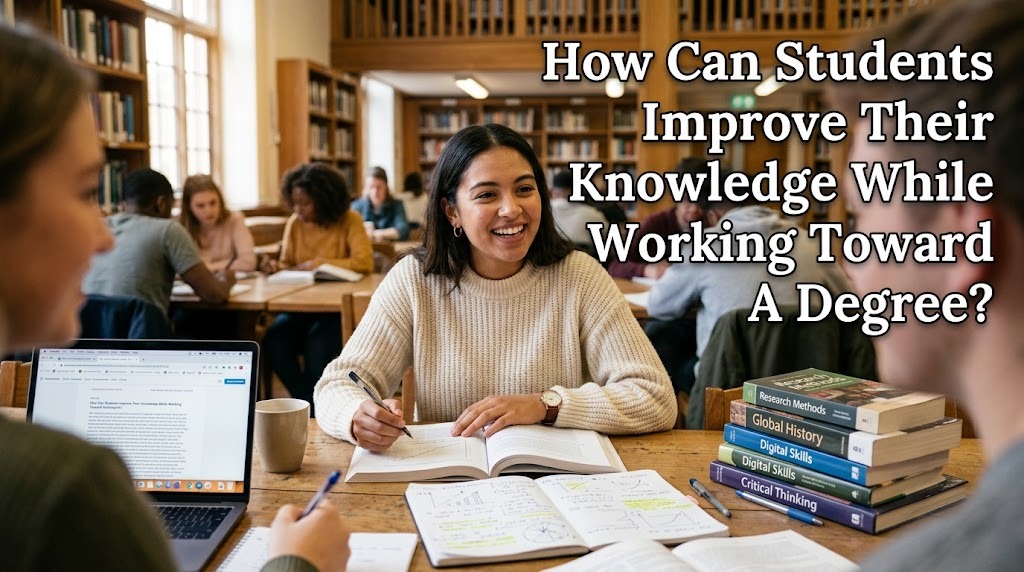
Earning a college degree is not only about completing courses and passing examinations. Students also need to develop deep knowledge, practical skills, and the ability to think independently. The learning process becomes more valuable when students actively explore ideas instead of only memorizing information for tests. By using effective learning strategies, students can gain knowledge that remains useful beyond graduation. Developing strong learning habits can also prepare them for future careers and lifelong learning.
SET CLEAR LEARNING GOALS
Students can improve their knowledge by setting clear and realistic learning goals. Instead of simply aiming for good grades, they can identify what they want to understand or become capable of doing. For example, a business student may want to understand how marketing strategies influence consumer behavior. Specific goals give students a clear direction and make learning more purposeful.
Learning goals can be divided into short term and long term objectives. A student might set a weekly goal to understand one difficult concept and a semester goal to master an important subject area. Reviewing these goals regularly can help students recognize their progress and identify areas that need improvement. Consistent learning goals can make academic development more organized and measurable.
DEVELOP CRITICAL THINKING SKILLS
Improving knowledge requires more than collecting facts. Students should develop critical thinking, which involves analyzing information, evaluating evidence, comparing perspectives, and reaching logical conclusions. When reading an argument, students can ask whether the evidence supports the claim and whether other explanations are possible. This habit helps them understand subjects more deeply.
Critical thinking can also improve academic assignments and discussions. Students who analyze information carefully are more likely to produce thoughtful arguments instead of simply repeating information. They can identify strengths and weaknesses in different ideas while remaining open to new evidence. Critical thinking skills are also valuable in professional environments where employees must make informed decisions.
LEARN WITH OTHER STUDENTS
Learning with classmates can provide perspectives that students may not discover when studying alone. Study groups and academic discussions allow students to explain concepts, ask questions, compare interpretations, and solve problems together. Teaching a concept to another person can be especially useful because it requires the student to understand the material clearly.
However, group study should remain focused on learning rather than becoming a social distraction. Students can establish specific topics or goals for each session. They can also divide difficult subjects among group members and explain their findings to one another. Collaborative learning can strengthen both knowledge retention and communication skills.
USE DIGITAL RESOURCES WISELY
Technology provides students with access to a wide range of educational resources. Online courses, digital libraries, educational videos, academic databases, and learning platforms can supplement classroom instruction. These resources can be especially useful when students need another explanation of a difficult concept. However, students should prioritize credible educational sources rather than accepting every piece of online information as fact.
Digital tools should support learning instead of creating additional distractions. Students can use note-taking applications, calendars, flashcards, and educational platforms to organize their studies. They can also use technology to practice skills through simulations and interactive exercises. When used responsibly, digital learning can make education more flexible and accessible.
REVIEW AND REFLECT REGULARLY
Regular review helps students maintain knowledge over time. Instead of studying only before examinations, students can review important concepts periodically through practice questions, summaries, flashcards, and self-testing. Spreading learning sessions across time can make it easier to remember information than relying entirely on last-minute study.
Reflection is equally important because students need to understand how they learn best. After completing a course or project, they can consider which strategies worked well and which areas still need improvement. They can then adjust their learning methods for future subjects. Continuous reflection encourages students to become more independent and effective learners.
CONCLUSION
Students can improve their knowledge while working toward a degree by becoming active, curious, and consistent learners. Setting clear goals, participating in class, reading reliable sources, gaining practical experience, and developing critical thinking can deepen their understanding. Collaboration with classmates and responsible use of digital resources can provide additional learning opportunities. Regular review and reflection can also help students retain knowledge and improve their learning strategies. Ultimately, a college degree becomes more valuable when students focus not only on completing requirements but also on building knowledge and skills that remain useful throughout their careers and lives.
About the Author
Gusti Ayu Tita P
Author — STEKOM University
An active author focused on academic issues, educational technology, and human resource development in the campus environment.















