
How Can Type AB Blood Receive Different Blood Types?
Gusti Ayu Tita P
14 September 2026
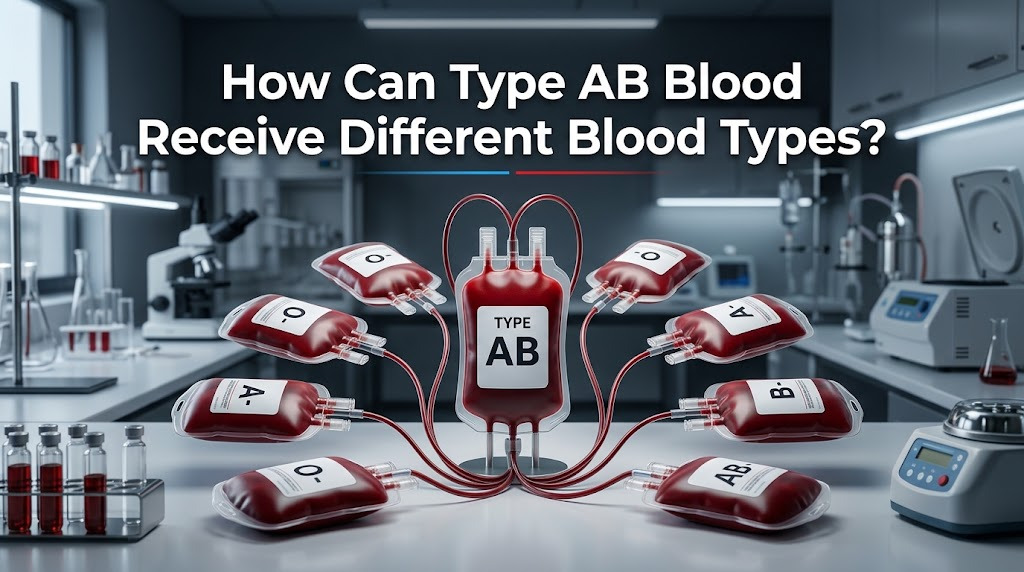
Type AB blood is unique because its red blood cells have both A and B antigens on their surface. At the same time, people with type AB blood normally do not have anti-A or anti-B antibodies in their plasma. This combination allows a person with AB blood to receive red blood cells from several ABO blood groups. That is why type AB is often described as having broad receiving compatibility.
However, this does not mean that every type AB patient can receive any blood without testing. The Rh factor, other blood group antibodies, and the type of blood component being transfused must also be considered. Compatibility rules for red blood cells are different from those for plasma. Healthcare professionals therefore use laboratory testing to determine the safest blood for each patient.
WHY CAN TYPE AB RECEIVE A, B, AB, AND O RED BLOOD CELLS?
The main reason is that type AB plasma normally lacks anti-A and anti-B antibodies. If a type AB patient receives type A red blood cells, there are no normal anti-A antibodies in the patient's plasma to attack those cells. The same principle applies to type B and type AB red blood cells. Type O red blood cells also lack A and B antigens, so they can generally be received by a person with type AB blood.
For this reason, a person with type AB blood can generally receive A, B, AB, or O red blood cells when the Rh type and other compatibility requirements are appropriate. This is commonly described as being an ABO universal recipient for red blood cells. Nevertheless, hospitals still perform blood typing and other compatibility tests before transfusion. The term does not mean that blood from every donor is automatically safe.
HOW DOES THE RH FACTOR AFFECT TYPE AB BLOOD?
The Rh factor adds another important part to the blood type. A person with AB blood can be either AB-positive or AB-negative, depending on whether the RhD antigen is present. This difference affects which red blood cells are generally preferred during transfusion. AB-positive patients can usually receive Rh-positive or Rh-negative red blood cells when other compatibility requirements are met.
AB-negative patients are generally given Rh-negative red blood cells when possible to reduce the chance of developing anti-D antibodies. An Rh-negative person who is exposed to Rh-positive blood may become sensitized and produce antibodies against the RhD antigen. Therefore, knowing that someone is simply type AB is not enough. Their complete blood type and laboratory results are important when selecting donor blood.
CAN TYPE AB RECEIVE TYPE O BLOOD?
Yes, type AB recipients can generally receive type O red blood cells because O red blood cells do not carry A or B antigens. This means the recipient's normal ABO antibodies do not have A or B donor antigens to target. Type O red blood cells can therefore be useful for patients with several different ABO types. However, Rh status and other blood group antibodies still need to be considered.
It is also important to distinguish between O red blood cells and O plasma. Type O plasma contains anti-A and anti-B antibodies, so it does not have the same broad compatibility for plasma recipients. This is why the compatibility rules for blood components cannot simply be reversed or applied to every product. Medical professionals determine compatibility based on the exact component being transfused.
CAN TYPE AB RECEIVE BLOOD FROM AN AB DONOR?
Yes, AB red blood cells can generally be given to an AB recipient because the recipient already has both A and B antigens. There is usually no ABO antigen mismatch between the donor red blood cells and the recipient. This can make AB-to-AB red blood cell transfusion a straightforward compatibility combination. Even so, the Rh factor and other blood group antibodies must still be checked.
AB donors are particularly important for plasma donation for a different reason. AB plasma normally does not contain anti-A or anti-B antibodies, making it broadly useful as donor plasma. This shows that the same blood group can have different advantages depending on whether red blood cells or plasma are being used. Blood services therefore manage each blood component according to its specific compatibility requirements.
DOES TYPE AB ALWAYS MEAN UNIVERSAL RECIPIENT?
The phrase universal recipient should be used carefully. Type AB is traditionally considered the universal recipient for ABO-compatible red blood cells, but it does not mean that an AB patient can receive every blood product without restrictions. The Rh factor can affect compatibility, and other clinically significant antibodies may also matter. In addition, plasma follows a different compatibility pattern.
A patient's previous blood transfusions or pregnancies can sometimes lead to the development of additional antibodies. These antibodies may react with specific antigens on donor red blood cells even when the ABO type appears compatible. Because of this, hospitals perform antibody screening and, when appropriate, crossmatching. These tests help identify blood that is suitable for the individual patient rather than relying only on the AB label.
HOW DO ANTIBODIES AFFECT AB BLOOD COMPATIBILITY?
People with type AB blood normally lack anti-A and anti-B antibodies, which is a major reason they can receive red blood cells from all four ABO groups. However, they may still have antibodies against other red blood cell antigens. These antibodies are not part of the basic A, B, AB, or O classification but can still affect transfusion safety. Laboratory testing can identify many of these clinically important antibodies.
When an unexpected antibody is detected, the blood bank may need to find donor units that lack the corresponding antigen. This process can take additional time, especially when the antibody is uncommon. It is an important part of personalized transfusion care. The goal is to provide blood that is compatible with the patient's full antibody profile, not just their ABO and Rh type.
WHY IS BLOOD TESTING STILL NECESSARY FOR TYPE AB PATIENTS?
Even though AB blood has broad ABO receiving compatibility, blood testing remains essential. Healthcare teams confirm the patient's blood group, check for unexpected antibodies, and perform crossmatching when required. They also verify patient identity and the donor unit before transfusion. These steps help prevent errors that could otherwise cause a serious transfusion reaction.
Proper testing becomes especially important during surgery, severe bleeding, pregnancy-related care, and repeated transfusions. In emergencies, medical teams may use appropriately selected blood before all testing is complete, depending on the situation. Once more information becomes available, treatment can be adjusted to more closely match the patient's blood type and antibody profile. Safe transfusion therefore depends on professional assessment, even for people with type AB blood.
CONCLUSION
Type AB blood has both A and B antigens on red blood cells but normally lacks anti-A and anti-B antibodies in plasma. Because of this, people with AB blood can generally receive A, B, AB, or O red blood cells when Rh status and other compatibility factors are appropriate. This is why AB is often called the universal recipient for ABO red blood cell transfusions.
However, Rh factor, other blood group antibodies, and the specific blood component must also be considered. AB-positive and AB-negative patients do not always have identical compatibility options, and plasma follows different rules from red blood cells. Professional blood typing, antibody screening, and crossmatching remain important for ensuring a safe and suitable transfusion.
About the Author
Gusti Ayu Tita P
Author — STEKOM University
An active author focused on academic issues, educational technology, and human resource development in the campus environment.















