
How Do Academic Competitions Push Students Beyond Their Academic Comfort Zones?
Gusti Ayu Tita P
20 Agustus 2026
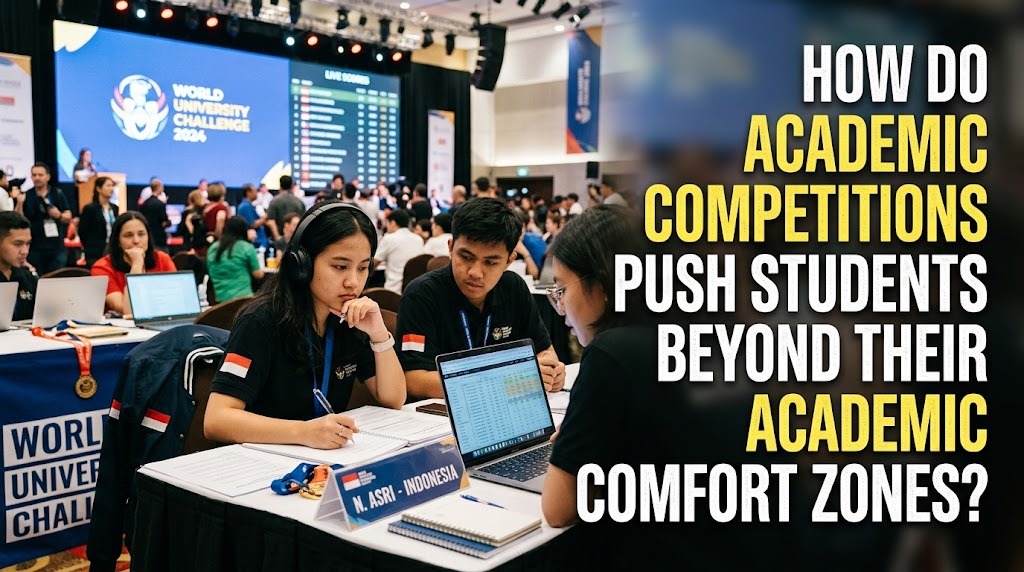
Academic competitions give university students opportunities to experience challenges that are different from their usual classroom routines. Students may participate in research contests, debates, academic olympiads, innovation challenges, business competitions, or public speaking events. These activities require more than completing regular assignments because participants often need to prepare independently and perform under pressure. As students face unfamiliar situations, they may discover abilities that were not previously developed. For this reason, academic competitions can become an effective way to push students beyond their academic comfort zones.
CHALLENGING STUDENTS TO FACE UNFAMILIAR PROBLEMS
Classroom assignments often provide clear instructions and predictable learning objectives. Academic competitions can be different because students may encounter complex questions or problems that require independent thinking. They cannot always depend on familiar formulas or previously practiced examples. Unfamiliar challenges encourage students to explore new approaches and consider solutions they may not have tried before. This process can gradually make students more comfortable with uncertainty.
Facing unfamiliar problems can also change how students respond to difficulty. Instead of immediately giving up when they do not know the answer, they learn to search for information, analyze the situation, and test possible solutions. Problem solving becomes an active learning process rather than simply an academic requirement. Over time, students may become more confident when dealing with challenging tasks. This confidence can influence their approach to future academic and professional situations.
ENCOURAGING STUDENTS TO LEARN BEYOND THE CLASSROOM
Preparing for a competition often requires knowledge beyond standard course materials. Students may need to read academic articles, explore new theories, study current issues, or learn technical skills independently. This encourages self directed learning because students take greater responsibility for their preparation. They learn how to identify what they do not know and find appropriate resources to fill those gaps. This habit can make learning more active and purposeful.
Independent preparation also teaches students that learning does not stop when a class ends. Students may become interested in subjects that are not directly included in their regular curriculum. Curiosity and continuous learning can develop as students explore new areas of knowledge. These habits are useful because modern academic and professional environments continue to change. Students who are willing to learn independently can adapt more easily to new demands.
BUILDING CONFIDENCE THROUGH CHALLENGING EXPERIENCES
Entering an academic competition can feel intimidating, especially when students compete with participants from other universities or experienced academic communities. The fear of making mistakes or performing poorly may initially prevent students from participating. However, taking the first step can help them discover that they are capable of handling challenging situations. Confidence grows through experience, not simply through positive thinking. Each completed stage can become evidence of personal progress.
Even unsuccessful competition experiences can contribute to confidence. Students may learn that failure does not mean they lack ability. Instead, it can reveal specific areas that need improvement. Learning from failure can make students more willing to try again and accept future challenges. This resilience can become an important part of academic and personal development.
DEVELOPING CRITICAL THINKING
Academic competitions often require students to analyze information rather than simply memorize facts. Participants may need to compare arguments, evaluate evidence, identify weaknesses, and develop logical conclusions. These activities strengthen critical thinking skills. Students become more accustomed to questioning information and examining different possibilities. This can improve the quality of their academic work.
Critical thinking also helps students deal with uncertainty. Some competition problems may have several possible solutions, requiring participants to determine which option is most appropriate. Students must consider evidence, consequences, and available resources before making decisions. Analytical reasoning helps students move beyond automatic answers. These skills can later be applied to research, work, and everyday decision making.
DEVELOPING TEAMWORK OUTSIDE THE COMFORT ZONE
Not every competition is individual. Team based competitions require students to work with people who may have different personalities, skills, and working styles. Students need to communicate, divide responsibilities, and resolve disagreements. Teamwork can challenge students who are used to working independently. It teaches them that successful outcomes often depend on cooperation.
Students may also need to take roles they have never experienced before. Someone who usually follows instructions may need to coordinate a project, while a confident student may need to learn how to listen more carefully. These experiences can develop leadership, flexibility, and interpersonal skills. Working with different people can also broaden students' understanding of collaboration.
ENCOURAGING CREATIVITY AND INNOVATION
Competitions often reward solutions that are original, useful, and practical. Students may be asked to create new ideas rather than reproduce existing answers. This encourages them to move beyond familiar academic approaches and explore creative thinking and innovation. They may experiment with different methods before finding a suitable solution. This process can make learning more dynamic.
Creativity also requires students to accept that not every idea will work. They may need to revise a proposal several times based on testing or feedback. Experimentation and continuous improvement become part of the learning process. Students can become more comfortable with uncertainty and mistakes. These habits can support innovation in both academic and professional environments.
BUILDING RESILIENCE AFTER FAILURE
Failure is one of the strongest ways competitions can push students outside their comfort zones. Not every participant will win, and some students may experience disappointment after investing significant time and effort. These moments can teach students how to manage emotions and evaluate their performance. Resilience allows students to recover and continue learning. It can become an important strength when they encounter setbacks later.
Students can use unsuccessful experiences to identify what went wrong. They may improve their preparation methods, communication, technical knowledge, or teamwork. This creates a cycle of practice, evaluation, adjustment, and improvement. Over time, students can become less afraid of failure because they understand that setbacks can provide valuable lessons.
DEVELOPING A GROWTH MINDSET
Academic competitions can encourage students to view abilities as skills that can be developed. Students may initially believe they are not good at public speaking, research, leadership, or problem solving. Competition experience can challenge these assumptions. A growth mindset encourages students to focus on progress rather than fixed limitations. They learn that improvement usually requires practice and persistence.
This mindset can change how students respond to difficult tasks. Instead of thinking that a challenge is impossible, they may ask what they need to learn to handle it. They become more willing to seek guidance, practice repeatedly, and try alternative strategies. The willingness to improve can become more important than achieving immediate success. This is one of the lasting benefits of moving beyond an academic comfort zone.
CONCLUSION
Academic competitions can push students beyond their academic comfort zones by exposing them to unfamiliar problems, demanding preparation, strict deadlines, public evaluation, teamwork, and the possibility of failure. Through these experiences, students can develop critical thinking, confidence, communication, creativity, discipline, adaptability, resilience, and a growth mindset. The process may feel uncomfortable, but productive challenges can create opportunities for meaningful development. Students do not need to win every competition to benefit from the experience. Ultimately, the greatest value lies in learning to face challenges, accept feedback, improve continuously, and become more confident in unfamiliar situations.
About the Author
Gusti Ayu Tita P
Author — STEKOM University
An active author focused on academic issues, educational technology, and human resource development in the campus environment.















