
How Do Ministers Implement Government Policies?
Gusti Ayu Tita P
12 Agustus 2026
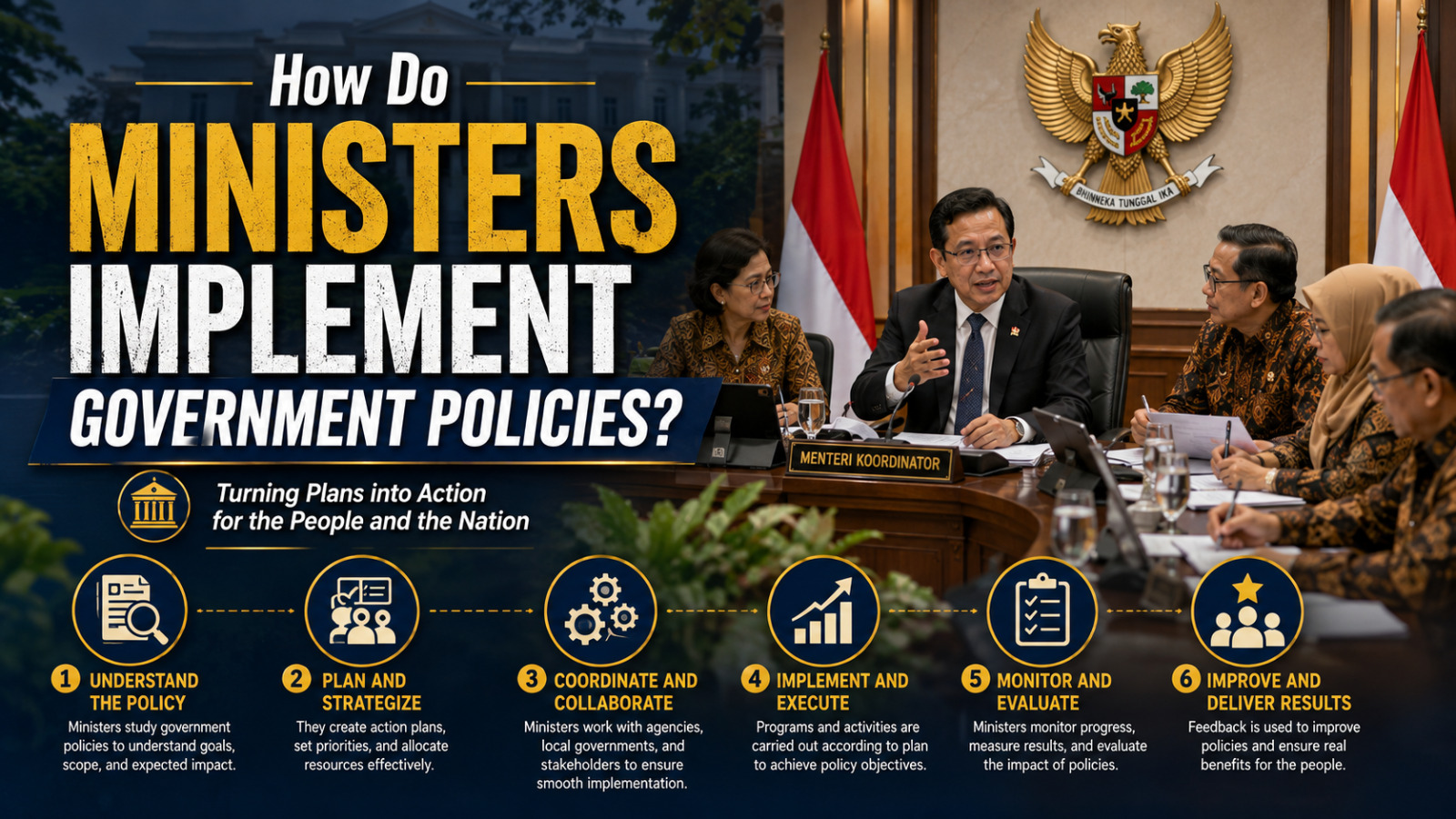
Government policies provide direction for addressing national issues and achieving public objectives. Ministers play an important role in implementing these policies because they lead ministries responsible for specific government affairs. Ministers translate government policies into programs, activities, and services that can be carried out in practice. The implementation process requires planning, coordination, resource management, monitoring, and evaluation. Through these steps, policies can be transformed into practical actions that support government goals.
UNDERSTANDING POLICY OBJECTIVES
The first step in implementing a government policy is understanding its objectives and intended outcomes. Ministers and their ministries need to identify what the policy aims to achieve and which responsibilities fall within their authority. Clear objectives help ministries determine the appropriate programs and actions. This process also ensures that implementation remains consistent with government priorities and applicable regulations.
Ministries can use data, research, and information from relevant institutions to understand the conditions surrounding a policy. This information helps identify challenges and determine suitable approaches. Ministers provide direction so that officials understand the priorities that need to be addressed. A clear understanding of policy objectives creates a strong foundation for implementation.
DEVELOPING IMPLEMENTATION PROGRAMS
After understanding a policy, ministries need to turn it into practical programs and activities. Ministers guide officials in developing plans that include objectives, responsibilities, resources, and expected results. A well-designed program makes policy implementation more structured and measurable. Programs should also consider the actual conditions faced by communities and institutions.
Implementation plans may involve different units within a ministry. Some policies may also require cooperation with other ministries, agencies, or regional governments. Clear division of responsibilities helps reduce confusion and overlapping tasks. Through careful planning, ministries can improve the efficiency of policy implementation.
COORDINATING GOVERNMENT INSTITUTIONS
Many government policies involve several sectors, making coordination an important part of implementation. Ministers communicate and cooperate with other government institutions when responsibilities overlap or are closely connected. Effective coordination helps align programs, responsibilities, and resources among different institutions.
Coordination can occur throughout the implementation process rather than only during planning. Government institutions may need to exchange information, solve problems, and adjust activities when conditions change. Ministers help maintain consistency between their ministry's programs and broader government policies. Strong cooperation can make complex policies easier to implement.
MONITORING AND EVALUATING IMPLEMENTATION
Government policies need to be monitored after implementation begins. Ministers and their ministries can track progress, identify challenges, and assess whether programs are following established plans. Monitoring helps detect problems early, while evaluation measures the effectiveness and results of policy implementation.
Evaluation results can be used to improve programs and policies within the government's authority. If an activity does not produce the expected results, officials can examine the causes and consider appropriate adjustments. Continuous evaluation also supports accountability in government administration. This process helps ensure that policies remain effective and responsive to changing conditions.
CONCLUSION
Ministers implement government policies through understanding objectives, developing programs, coordinating institutions, managing implementation, monitoring progress, and evaluating results. Each minister performs these responsibilities according to the authority and functions of their ministry. Effective implementation requires clear planning and cooperation among government institutions. Monitoring and evaluation are also necessary to identify problems and improve outcomes. Through these processes, ministers help transform government policies into practical actions that can support public interests and national objectives.
About the Author
Gusti Ayu Tita P
Author — STEKOM University
An active author focused on academic issues, educational technology, and human resource development in the campus environment.















