
How Does Community Service Program Support Student Self Development?
Gusti Ayu Tita P
20 Agustus 2026
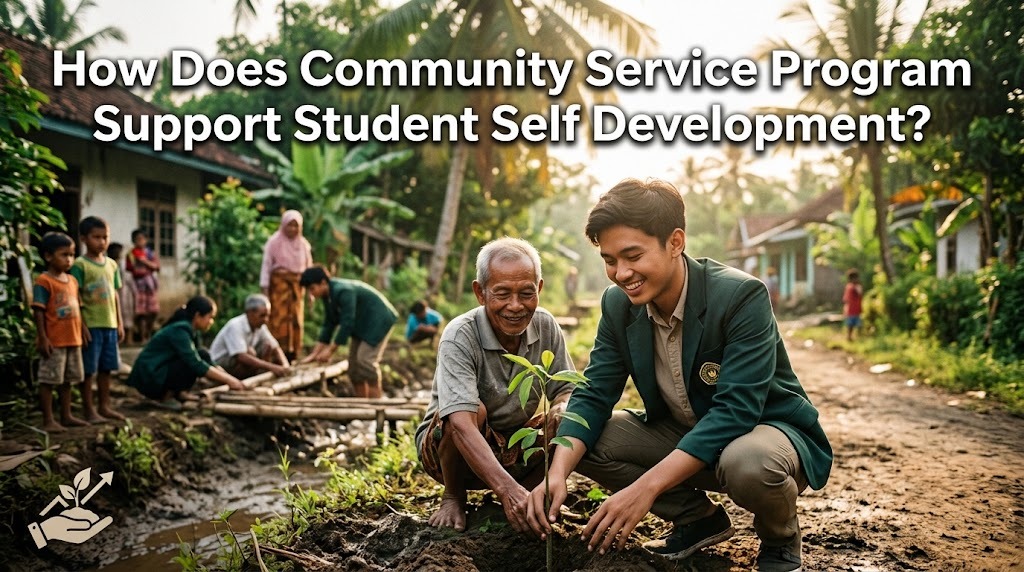
A community service program gives university students an opportunity to learn outside the classroom while contributing to society. In Indonesia, programs such as KKN allow students to work directly with communities and apply knowledge to real situations. This experience can develop more than academic skills because students also face social, practical, and personal challenges. Through interaction with residents, teamwork, and problem solving, students can discover their strengths and weaknesses. Therefore, community service can become an important part of student self development and preparation for future professional life.
DEVELOPING RESPONSIBILITY AND INDEPENDENCE
Community service encourages students to take responsibility for activities that affect other people. They need to plan programs, manage schedules, complete assigned tasks, and communicate with community members. These responsibilities require discipline and independence because students cannot depend entirely on lecturers or university staff. They must make decisions and respond to situations that may not have simple solutions. This experience can gradually make students more confident in managing responsibilities.
Living or working in a community environment can also require students to handle daily needs independently. They may need to organize their time, manage resources, and adjust to unfamiliar situations. Such experiences teach students that independence is not simply working alone. Independence also means being responsible for decisions and their consequences. These lessons can be useful when students enter professional environments after graduation.
IMPROVING COMMUNICATION SKILLS
Communication is one of the most important abilities developed through community service. Students interact with residents who may have different ages, backgrounds, experiences, and communication styles. They need to explain their ideas in simple language and listen carefully to community concerns. This process helps develop clear and respectful communication skills. Students also learn that effective communication requires understanding the other person's perspective.
Community activities may involve meetings, presentations, discussions, and group projects. Each situation requires students to adjust the way they communicate. They may need to speak publicly, negotiate responsibilities, or explain a program to residents. Active listening is equally important because students need to understand what the community actually needs. These experiences can improve both verbal communication and interpersonal skills.
BUILDING EMPATHY AND SOCIAL AWARENESS
Community service allows students to interact directly with people whose experiences may differ from their own. Through these interactions, students can gain a better understanding of different social and economic conditions. They may discover that problems which appear simple from a distance can be more complicated in everyday life. This experience can develop empathy and social awareness. Students learn to consider people's needs and perspectives before proposing solutions.
Empathy also encourages students to avoid making assumptions about communities. Instead, they learn to listen and observe before deciding what should be done. Respect for local knowledge is important because residents understand their own environment and needs. When students combine academic knowledge with community perspectives, their programs can become more relevant. This approach can develop a stronger sense of social responsibility.
INCREASING SELF CONFIDENCE
Community service can place students in situations that require them to take initiative. They may need to speak in front of residents, organize activities, solve unexpected problems, or make decisions as a team. Successfully handling these responsibilities can increase self confidence. Students begin to recognize that they are capable of doing things outside their usual comfort zone. This confidence can influence how they approach future academic and professional challenges.
Confidence also grows when students receive feedback from community members and teammates. Positive feedback can strengthen their belief in their abilities, while constructive criticism can show them what needs improvement. Students learn that confidence does not mean believing they are always right. True confidence includes the willingness to learn and improve. This mindset can support continuous personal development.
IMPROVING TIME AND RESOURCE MANAGEMENT
Community service requires students to manage several responsibilities within a limited period. They may need to balance program activities, meetings, documentation, academic requirements, and personal needs. This situation provides practical training in time management and prioritization. Students learn to determine which tasks are urgent and which can be completed later. These habits can improve their ability to work efficiently.
Resource management is also important when programs operate with limited budgets, equipment, or facilities. Students must find practical ways to achieve their goals without wasting available resources. Sometimes, a simple solution can be more effective than an expensive one. Creativity in using limited resources can become an important professional skill. These experiences teach students to work realistically while still trying to achieve meaningful results.
PREPARING STUDENTS FOR FUTURE CAREERS
The skills developed through community service can be transferred to professional environments. Employers often value abilities such as communication, teamwork, problem solving, adaptability, responsibility, and leadership. Community service provides students with opportunities to practice these abilities in real situations. The experience can therefore complement academic knowledge with practical and interpersonal skills. Students can also use meaningful community projects as examples when discussing their experience during future career applications.
More importantly, community service can help students understand the importance of working with people. Professional success often depends not only on technical knowledge but also on the ability to collaborate and respond to changing situations. Students who have experienced real community challenges may become more prepared to handle uncertainty. Learning through service can connect education with real world responsibilities. This makes community service valuable as part of broader career preparation.
CONCLUSION
A community service program can support student self development by providing experiences that are difficult to obtain through classroom learning alone. Students can develop responsibility, communication, teamwork, leadership, problem solving, adaptability, empathy, confidence, and time management. They also learn how to apply academic knowledge to real community situations and respond to unexpected challenges. The most valuable result is not simply completing a program, but understanding how the experience changes their skills, attitudes, and perspective. When approached with commitment and reflection, community service can help students become more independent, socially aware, adaptable, and professionally prepared individuals.
About the Author
Gusti Ayu Tita P
Author — STEKOM University
An active author focused on academic issues, educational technology, and human resource development in the campus environment.















