
How Does Language Style and Laptop Display Build Social Status in the Classroom?
Gusti Ayu Tita P
26 Agustus 2026
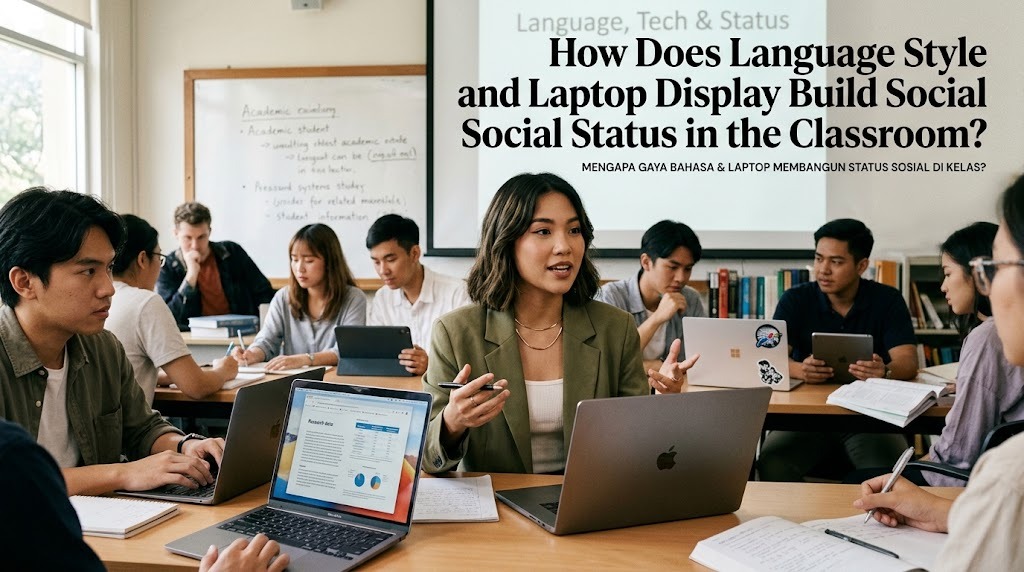
The classroom is not only a place for academic learning but also a social environment where students interact, form friendships, and develop their identities. In this environment, language style and visible possessions such as laptops can influence how students are perceived by others. The way someone speaks may create an impression of confidence, education, or social background. Meanwhile, a laptop can sometimes become a visible symbol of technology, lifestyle, or economic resources. However, social status is not determined by these factors alone because personality, achievement, relationships, and behavior also play important roles.
LANGUAGE STYLE AS A SOCIAL SIGNAL
Language style can communicate more than the meaning of the words being spoken. Students may use formal, casual, technical, or mixed language depending on their social environment. The way a student speaks can influence how classmates interpret their confidence, knowledge, and personality. Someone who communicates clearly may be viewed as more prepared or capable during classroom discussions. However, language differences should not automatically be used to judge a person's intelligence or social value.
Students often adjust their language when speaking with lecturers, friends, or people from different backgrounds. This ability to change communication styles can be considered a form of social adaptation. For example, a student may use formal language during a presentation but speak more casually with close friends. Such changes show that language is connected to social situations and relationships. Therefore, language style can contribute to the way students construct and express their social identity.
LAPTOPS AS VISIBLE SYMBOLS IN THE CLASSROOM
A laptop is primarily a learning tool, but its appearance can also become part of how students perceive one another. Brand, design, size, and condition may sometimes create assumptions about a student's lifestyle or financial background. A premium-looking laptop may be interpreted as a sign of economic status, even though the assumption may not be accurate. Some students may also associate certain devices with professionalism or technological competence. These interpretations are social perceptions rather than reliable measurements of a person's actual ability.
The visibility of laptops becomes more significant when students frequently use them in classrooms, group projects, or presentations. A device can become noticeable because it is placed on the desk for long periods. However, the function of a laptop is more important than its appearance for academic purposes. A basic device can be just as useful for writing assignments, conducting research, and creating presentations. Judging students based on their devices can therefore create unnecessary social comparisons.
HOW SOCIAL STATUS IS FORMED AMONG STUDENTS
Social status in the classroom can develop through many different factors. Academic achievement, communication skills, leadership, friendships, appearance, possessions, and participation may all influence how students are perceived. Language and laptops can contribute to these perceptions because they are relatively visible during daily interactions. However, their influence depends on the culture and values of each classroom. What is considered impressive in one group may have little importance in another.
Students may also develop informal social categories based on shared interests and lifestyles. For example, students interested in technology may gather together because they have similar interests rather than because of their economic position. Likewise, students who communicate confidently may naturally become more active during discussions. Social recognition is usually created through repeated interactions, not through one visible characteristic. Over time, behavior and relationships can have a stronger influence than possessions.
THE ROLE OF DIGITAL DEVICES IN STUDENT IDENTITY
Digital devices have become closely connected to modern student life. Laptops are used for research, writing, communication, presentations, creative projects, and online learning. Because of this frequent use, technology can become part of a student's daily identity. A student may be recognized as technologically skilled because they often help classmates solve digital problems. In this situation, the laptop itself is less important than the skills associated with its use.
At the same time, differences in access to technology can create social inequalities. Not every student has the same financial resources or access to high-performance devices. Students with older or simpler laptops should not be considered less capable. Equal opportunities in education should focus on access to learning rather than the prestige of personal devices. Schools and universities can help by providing appropriate digital facilities when students need them.
BUILDING A HEALTHY CLASSROOM SOCIAL ENVIRONMENT
A healthy classroom should allow students to express themselves without feeling pressured to display wealth or social superiority. Lecturers and students can encourage an environment where different communication styles and levels of technological access are respected. Respect and inclusion are important because students come from different family, cultural, and economic backgrounds. Classroom activities can focus on collaboration rather than competition based on possessions. This approach helps students feel valued for their contributions and abilities.
Students also have a role in creating this environment. Avoiding judgments based on someone's accent, vocabulary, laptop, clothing, or economic background is a simple but meaningful step. Instead, students can appreciate others based on their ideas, effort, creativity, and willingness to cooperate. Social status should not become a measure of personal worth. When students support one another, the classroom becomes a more comfortable and productive place for learning.
CONCLUSION
Language style and laptop display can influence social perceptions in the classroom, but neither should be treated as a definitive measure of someone's social status or ability. Language may communicate confidence, identity, and social background, while laptops can become visible symbols of technology and economic resources. However, these signals are often incomplete and can lead to inaccurate assumptions. Academic performance, communication, character, relationships, creativity, and digital competence are equally important in shaping student identity. Ultimately, students can build stronger social recognition by developing genuine skills and maintaining respectful relationships rather than relying on appearances.
About the Author
Gusti Ayu Tita P
Author — STEKOM University
An active author focused on academic issues, educational technology, and human resource development in the campus environment.















